PA DHS Announces Increase to SNAP Income Limits and Maximum Benefits

News

October 1, 2026

PA DHS Announces Increase to SNAP Income Limits and Maximum Benefits

Pennsylvania’s Department of Human Services (DHS) announced increases to the Supplemental Nutrition Assistance Program’s (SNAP) income limits and maximum benefits starting on October 1 following an annual adjustment to account for food costs and inflation.

The changes will benefit all SNAP recipients and there will be no decrease in benefits because of the updates, the DHS said.

The USDA’s Food and Nutrition Administration (FNA) made the changes as part of an annual reevaluation of SNAP’s income eligibility standards, the maximum benefit amount, and the minimum benefit amount. The adjustment is a routine, annual process.

The average increase for most SNAP recipients will be $18. 

“SNAP is the nation’s most important anti-hunger program,” state DHS Secretary Dr. Val Arkoosh said. “SNAP helps more than 1.7 million Pennsylvanians afford food for themselves and their families, and PA DHS will always help Pennsylvanians facing food insecurity keep food on their tables.”

The new SNAP federal poverty income guideline income limits and maximum benefit amounts a household can receive effective October 1 through September 30, 2027 are:

  • Household of 1: $2,660 (maximum monthly income), $306 (maximum benefit amount)
  • Household of 2: $3,608 (maximum monthly income), $562 (maximum benefit amount)
  • Household of 3: $4,554 (maximum monthly income), $808 (maximum benefit amount)
  • Household of 4: $5,500 (maximum monthly income), $1,023 (maximum benefit amount)
  • Household of 5: $6,448 (maximum monthly income), $1,217 (maximum benefit amount)
  • Household of 6: $7,394 (maximum monthly income), $1,463 (maximum benefit amount)
  • Household of 7: $8,340 (maximum monthly income), $1,616 (maximum benefit amount)
  • Household of 8: $9,288 (maximum monthly income), $1,841 (maximum benefit amount)
  • Household of 9: $10,236 (maximum monthly income), $2,066 (maximum benefit amount)
  • Household of 10: $11,184 (maximum monthly income), $2,291 (maximum benefit amount)
  • Each additional member (through household of 17): + $948 (maximum monthly income), + $225 (maximum benefit amount)

Factors that could contribute to a household’s higher SNAP allowance and income limits in Pennsylvania include household size and monthly income. More information on these benefit levels is available on the DHS’ website.

Changes to SNAP Utility Allowances

As of February 9, due to updated federal requirements, SNAP applicants and recipients must provide proof of their shelter costs and utility responsibility for their current residence. Applicants and recipients must provide proof of these costs at application and renewal if they are not already on file with the DHS. 

SNAP households will need to submit new documentation if they move to a different residence or if the costs or their responsibility to pay changes.

Certain SNAP recipients are now subject to SNAP work requirements and time limits. Pennsylvanians need to comply with work requirements to continue to receive SNAP unless they meet an exemption. The expanded work requirements apply if someone:

  • Is between 18-64 years old
  • Does not have a dependent child under 14 years old
  • Is considered physically and mentally able to work

Additionally, being a veteran or a current or former foster youth, ages 18-24 will no longer be an exemption from work requirements.

For more information on documentation and work requirements, view the state’s SNAP update announcement.

ELRC Region 5 Kicks Off Winter Coat Program on October 5

News

September 30, 2026

ELRC Region 5 Kicks Off Winter Coat Program on October 5

Families can visit Early Learning Resource Center Region 5 starting Monday, October 5 to pick up winter coats for their children.

The coats are available while supplies last through a partnership with the state’s Department of Human Services.

Children and their families can pick up their coats between 8 a.m. and 4:30 p.m. on Monday through Friday at:

ELRC Region 5
304 Wood Street, Suite 400
Pittsburgh

For more information, call the office at 412-350-3577.

DHS Announces Request for Application for Children’s Trust Fund Grants

News

January 20, 2026

DHS Announces Request for Application for Children’s Trust Fund Grants

Pennsylvania’s Department of Human Services (DHS) has announced a Request for Application (RFA) for the Children’s Trust Fund (CTF) grants.

Learn More

The CTF’s board has identified the following funding priorities to be explored by communities as they seek to create or grow community-based primary and secondary child abuse and neglect prevention programs and projects:

  • Fostering innovation
  • Well-rooted evidence-based services
  • Emerging evidence-based

Any community-based organization located and operating in Pennsylvania that provides direct services for children or direct provision of services for child abuse and neglect prevention that meets the criteria set forth in the RFA is eligible to apply for a CTF grant.

The CTB board funds grantees that are part of a collaborative community-driven approach that directly engages youth, parents, and families. As required by state law, eligible entities have to demonstrate consultation with the county child welfare agency.

The application deadline for the grants is Thursday, February 5. More information on the grants is available online. 

SNAP Recipients Must Take Action to Ensure They Don’t Lose Benefits in December

News

September 4, 2025

SNAP Recipients Must Take Action to Ensure They Don’t Lose Benefits in December

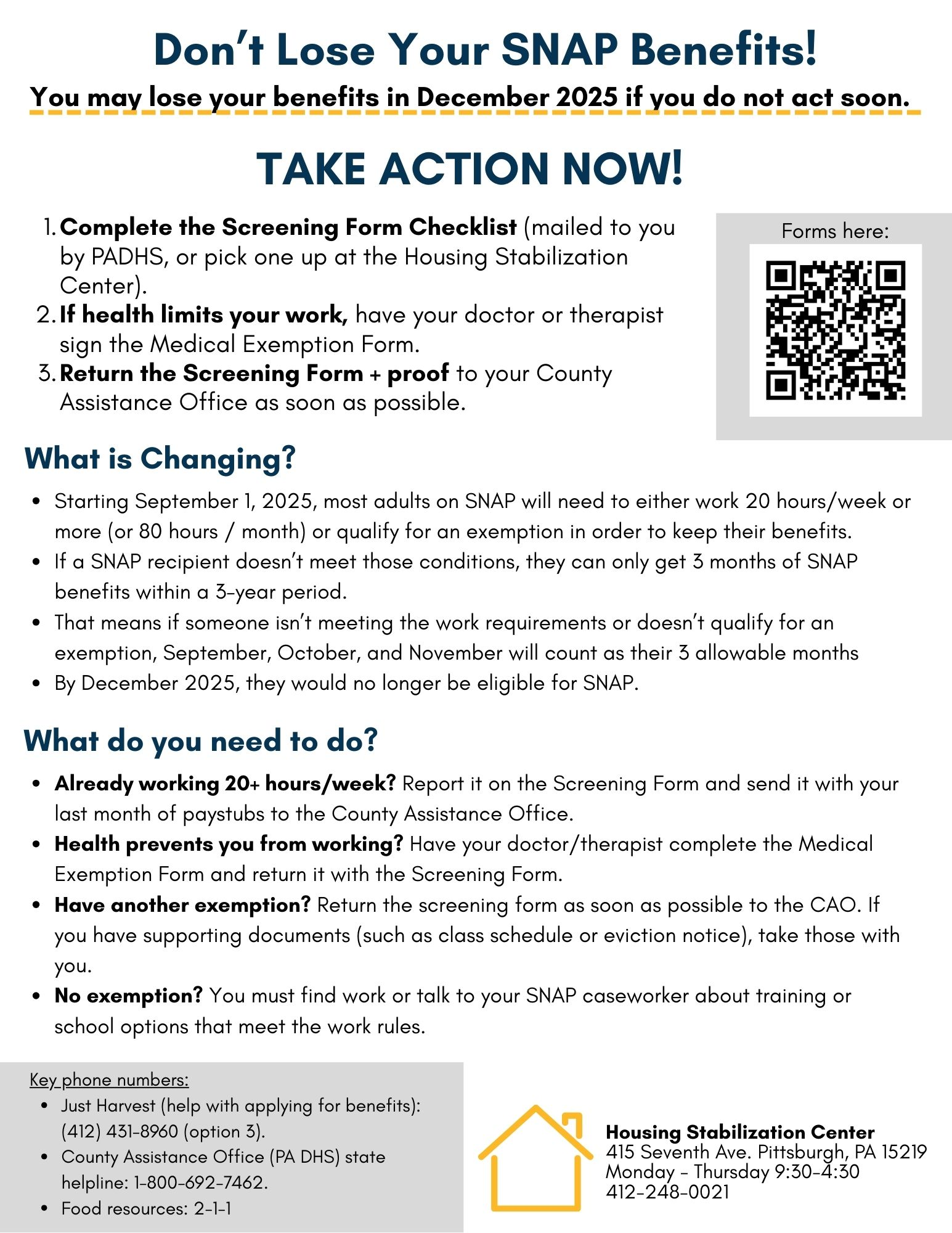
Recipients that fail to take action to secure their SNAP benefits could lose them in December following federal changes to the benefits that have recently taken effect.

Learn More

As of Sept. 1, most adults on SNAP are required to work at least 20 hours per week or qualify for an exemption. People who do not properly document that they meet these conditions can only receive three months of benefits over a three-year period, meaning they would run out in December.

SNAP recipients must take the following actions:

  • Complete the Pennsylvania Department of Human Services’ (DHS) screening form checklist that was mailed to recipients by the DHS. The checklist can also be found online.
  • If health limits their work, have a doctor or therapist sign a medical exemption form.
  • Return the screening form and proof to the County Assistance Office, which is operated at the state level by the DHS.

Details about who needs to take action and when can be found on the DHS’ website.

For Providers

To ensure that people in your network are aware of these updates, share this flyer from the Housing Stabilization Center that summarizes key action items and includes quick reference phone numbers.

Reminder: New Civil Rights Compliance Form Required for Submitting Licensing Applications and Renewals

News

November 8, 2024

Reminder: New Civil Rights Compliance Form Required for Submitting Licensing Applications and Renewals

Pennsylvania’s Department of Human Services’ (DHS) Bureau of Equal Opportunity (BEO) is reminding certified child care providers to take immediate action for compliance regarding anti-discrimination laws and regulations by using a new Civil Rights Compliance form.

Learn More

Providers must use the new form when submitting a new licensing application or renewing an existing one, according to Pennsylvania’s Office of Child Development and Early Learning (OCDEL).

The new forms and process went into effect on Oct. 1. 

Prospective child care providers seeking a new license will utilize the Civil Rights Compliance (CRC) form (HS 2126 9/24). The prior form (HS 2126 8/22) is now obsolete.

For licensing renewals, a licensee must also now submit the new CRC Renewal form. The prior attestation form (HS 2125 8/22) is obsolete. The renewal notice will still be sent out 130 days prior to expiration.

More Details

The BEO develops, implements, and monitors policies and programs for DHS as directed by the Civil Rights Act of 1964, Titles VI and VII, and other federal and state anti-discrimination laws, regulations, and policies.

The DHS Civil Rights Compliance Forms and process for the department’s licensed providers and applicants have been updated to reflect new and updated anti-discrimination laws that went into effect in 2023.

Visit the Pennsylvania Key’s website for more details or to access the form.

Pennsylvania to Discontinue PA Position Statements for Environment Rating Scales

News

August 20, 2024

Pennsylvania to Discontinue PA Position Statements for Environment Rating Scales

As of Aug. 1, the state has discontinued the use of PA Position Statements for the Environmental Rating Scale (ERS) and School-Age Environment Rating Scale (SACERS).

Learn More

The sunsetting of the scales was part of an effort to simplify guidance and strengthen consistent use of program observation instruments for continuous quality improvement.

Programs may continue to use ERS, third editions, and SACERS-U as a quality assessment tool without the position statements.

State Department of Human Services regulations are the foundation of all quality work and compliance is required for all certified programs.

If variance occurs between ERS quality expectations and PA DHS Certification regulations, programs must ensure that regulations are met. Programs utilizing the most updated ERS or SACERS are encouraged to review PA DHS Certification regulations around the following to ensure compliance with regulations:

  • Use of hand sanitizer
  • Handling of soiled diapers
  • Placement of nap equipment
  • Mandated Reporter training and policies
  • First Aid training

ERS and SACERS

ERS focuses on the typical daily experiences of children in early childhood and school-age settings. The assessment considers how teacher engagement, the spaces and equipment used by the children, accessible play materials, and children’s activities combine to enhance learning. It includes a variety of factors, including indoor and outdoor space and furnishings as well as supports for parents and staff, and personal care routines, including health and safety practices.

SACERS is a tool used to evaluate group-care programs for children, ages 5 to 12. It consists of 49 items that are organized into seven subscales. Items include everything from space and furnishings to health and safety.

More information on Program Quality Assessment can be found on The Pennsylvania Key website.