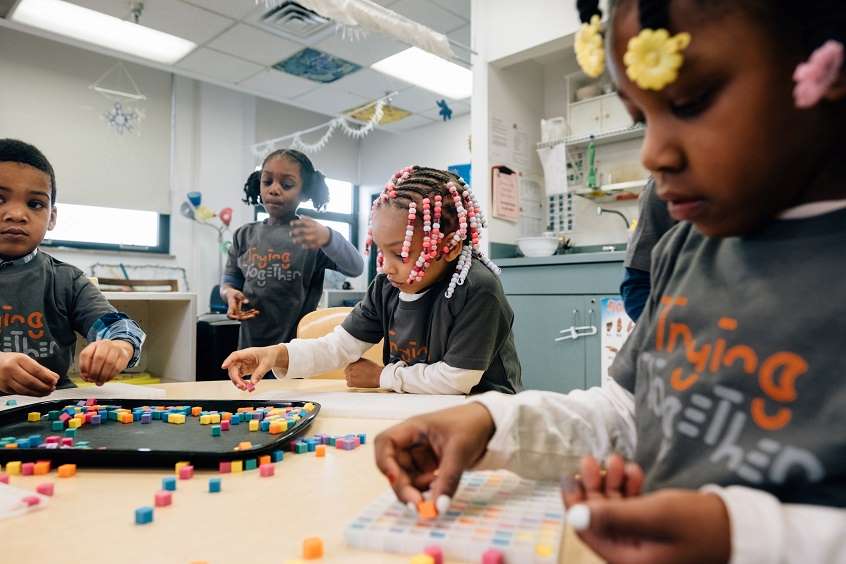
As caregivers, community members, and early childhood educators, we have a responsibility to ensure each child, family, and caregiver is safe from racism and discrimination and has equitable opportunities to thrive.
To do this, we must begin with ourselves. With the correct anti-racism tools, a community can continue to grow and learn. Set aside time in your day to do a personal inventory. What thoughts, feelings, and behaviors have you contributed to upholding systems of racism? Are you making assumptions? What actions or inactions have you taken that contribute to systems of oppression?
Next, consider your family and your friends—which behaviors, statements, or jokes have gone unchecked? What actions or inactions have you taken within your interpersonal relationships that have contributed to an unsafe community for our Black and Brown children, neighbors, and colleagues? How might you begin to lead by example within your own family or community?
Anti-racism work is something that has to be attended to in an ongoing way. To support this work, we have compiled the following anti-racism tools. Note that this list is not exhaustive.
Anti-Racism Tools for Adults
Videos & Podcasts:
- Video: ‘I Can’t Breathe: From Agony to Activism’, Pitt Diversity
- Podcast: Notice the Rage, Notice the Silence, On Being with Krista Tippett
- Video: What I am learning from my white grandchildren – truths about race, TEDx Talks
- Video: Juneteenth Round Table with Rep. Chris Rabb & Rep. Ed Gainey, For Our Future Pennsylvania
- In My Skin Podcast, University of Pittsburgh Office of Child Development
Tools & Reading Lists:
- Anti-Racism Resources, Sarah Sophie Flicker and Alyssa Klein
- An Anti-Racist Reading List, The New York Times
- Exploring & Understanding Structural Racism, Embrace Race
- Implicit Bias Test, Harvard
- Center for Race & Gender Equality, YWCA Greater Pittsburgh
- Race Research Online Directory, University of Pittsburgh School of Social Work
- Race and Equity Resource List, Pennsylvania Department of Human Services
- After Atlanta: Teaching About Asian American Identity and History, Learning for Justice
- Resources to Help Empower Asian and Pacific Islander Communities, Online MSW Programs
Health-Related:
- Mental Health Support and Education, Steel Smiling
- Antiracism Meditation
- Mental Health Issues Facing the Black Community, Sunshine Behavioral Health
- Black Lives Matter, Substance Abuse, and Addiction Recovery in the United States, Addicted.org
- Not Equal: Racial Disparities In Addiction/Substance Abuse Treatment, AddictionResource.net
- Black Men Matter – Examining Mental Health Issues Among Black Men – A Guide To Freedom, Drug Rehab USA
- Race and Ethnicity: How it affects your risk of cancer, HealthMatch
- Racism is a Public Health Crisis, Milken Institute School of Public Health
Take Action:
- 5 Ways White People Can Take Action in Response to White and State-Sanctioned Violence, Medium
- The critical role white parents play in shaping racism — and eradicating it, PBS
- How Not to be an Ally: Common missteps and advice for effective allyship, Psychology Today
- Talking About Race, National Museum of African American History & Culture
- Want to support Black Lives Matter? Here’s where to start in Pittsburgh., Kidsburgh
- Confronting Prejudice: How to Protect Yourself and Help Others, Pepperdine University
- Citizen Journalism and Political Protests, Syracuse University
- Asian Americans Advancing Justice
Family-Related:
- How to raise anti-racist kids: 20 resources for parents, Motherly
- Why Raising Kids to ‘Not See Color’ Doesn’t Help Fight Racism, HuffPost
- Our Family’s Commitment to Being Anti-Racist, PBS Kids
- Black Boys Matter: Cultivating Their Identity, Agency, and Voice, NAEYC
- Things to Know If You Love a Multiracial Child, Embrace Race
- “Love is not enough”: Supports for Transracial Adoptive Families, Embrace Race
- Nurturing Resistance & Joy in Black Children, Embrace Race
- Raising Muslim American Children Who Thrive, Embrace Race
Observance-Related:
Anti-Racism Tools for Educators
Personal/Professional Development:
- Talking to Kids About Racism and Justice: a list for parents, caregivers & educators, Oakland Library
- Video: Identity, Challenge and Dismantle: A Few Sociocultural Strategies for Teaching About Racism, SPSSI
- An Essential Reading Guide for Fighting Racism, BuzzFeed News
- Teacher’s Corner, University of Pittsburgh School of Education
- Advancing Equity in Early Childhood Education Position Statement, NAEYC
- Becoming Upended: Teaching and Learning About Race and Racism with Young Children and Their Families, NAEYC
- Teaching #BlackLivesMatter, Teaching for Change
- A Guide to Equity and Antiracism for Educators, Edutopia
- NEA activists launch series of video “primers” for anti-racist white educators, NEA
- A Simple Way to Self-Monitor for Bias, Edutopia
- What White Colleagues Need to Understand, Teaching Tolerance
- Building Antiracist White Educators
Classroom/Community Development:
- ‘All we are asking for is change!’ How schools are taking steps toward justice-centered learning, Kidsburgh
- Black Students Are Not ‘Marginalized,’ They Are the Center of Our Work, Education Post
- Asian Americans K-12 Education Curriculum, Asian Americans Advancing Justice
- The Impact of Racism on Child and Adolescent Health, The American Academy of Pediatrics
- Talking About Race, National Museum of African American History and Culture
- Understanding Anti-Bias Education: Bringing the Four Core Goals to Every Facet of Your Curriculum, NAEYC
- How to Root Out Anti-Black Racism From Your School, EdWeek
- How Indigenous, Black, and POC Educators Envision a Better School Experience, KQED
- Racial inequities in education can start as early as preschool, AXIOS
- How to create anti-racist virtual classrooms: Strategies for teachers and families, Kidsburgh
- How do you teach antiracism to the youngest students?, The Hechinger Report
- How to Better Support Your Black Colleagues, Edutopia
- Building Anti-Racist Early Childhood Programs with Implicit Bias Trainings & Resources, HiMama
- Inclusion of All Children in Early Childhood Education Programs in Pennsylvania, Pennsylvania Office of Child Development and Early Learning
- One School’s Commitment to Equity Using Student-Centered Learning, Students at the Center Hub
- Mere Engagement: Reflections about the Connections Between Online Learning, Student Agency, and Student Engagement, Aurora Institute
- How to Provide a Multicultural Education, Baylor University
Resources:
- Black Lives Matter Resources, Writix
- Early Childhood Education
- Elementary Education
- Positive Racial Identity Development in Early Education (P.R.I.D.E) – Understanding PRIDE in Pittsburgh, University of Pittsburgh School of Education
- P.R.I.D.E. Speaker Series, University of Pittsburgh School of Education
- In My Skin: A P.R.I.D.E Podcast, University of Pittsburgh School of Education
- What is Race?, Flocabulary
- Tools for Anti-Racist Teaching, PBS Teachers Lounge
- Advancing Equity Initiative, NAEYC
- Race & Ethnicity Resources, Teaching Tolerance
- My Racial Journey, University of Pittsburgh Office of Child Development
- Equity Services, Pennsylvania School Boards Association
- The Cultural Proficiency Framework, The Robbins Group
- Learning for Justice
- Public Health Resources for Understanding Environmental Racism, Public Health Degrees
- 135 Racial Equity Resources For Education, Professional & Community Development, Health, And Civil Rights, College Consensus
Anti-Racism Tools for Children
Discussing Racism with Children
- Video: A Clinical Perspective on Talking to Kids About Racism, Child Mind Institute
- Transcript: A Clinical Perspective on Talking to Kids About Racism, Child Mind Institute
- ‘Raising White Kids’ Author On How White Parents Can Talk About Race, NPR
- They’re not too young to talk about race! The Children’s Community School
- Talking to Children About Racial Bias, HealthyChildren
- Talking Race with Young Children, NPR
- How to Talk to Kids about Race and Racism, Parent Toolkit
- 10 tips for teaching and talking to kids about race, Embrace Race
- Talking about Race with Kids and Teens, Carnegie Library of Pittsburgh
- How to talk to kids about racism, explained by a psychologist, Vox
- 21 Anti-Racism Videos to Share With Kids, We Are Teachers
- Experts answer your kids’ tough questions about race and racism, The Hechinger Report
- Talking to Children Authentically about Race and Racism, PBS Kids
- Video – PBS KIDS Talk About Race & Racism, PBS Kids
- Talking to Young Children About Race and Racism: A Discussion Guide, PDB Kids
- Raising Kids Who Embrace Race, National PTA
- So You Want to Raise a Young White Ally? Embrace Race
- Supporting Children’s Leadership & Activism, Embrace Race
- Supporting Healthy Racial Learning in Early Childhood, Embrace Race
Discussing Racism, Violence, and Protests with Children
- Racism and Violence: How to Help Kids Handle the News, Child Mind Institute
- Talking to Children About Race, Policing and Violence, The New York Times
- Addressing Race and Trauma in the Classroom: A Resource for Educators, The National Child Traumatic Stress Network
- Resources for Talking about Race, Racism and Racialized Violence with Kids, Center for Racial Justice in Education
- George Floyd. Ahmaud Arbery. Breonna Taylor. What do we tell our children?, USA Today
- Video: “How do I make sure I’m not raising the next Amy Cooper?” with Jennifer Harvey, Embrace Race
- How to Talk with Kids About Racism and Racial Violence, Common Sense Media
- Resources for Talking About Race, Racism and Racialized Violence with Kids, Center for Racial Justice in Education
- How to Talk to Your Children About the Protests, The Wall Street Journal
- Talking with Children About Racism, Police Brutality and Protests, Aha! Parenting
- How To Talk To Your Kids About Race, Racism And Police Violence, WBUR
- How To Talk About Race And Protests With Your Kids, Explained By A Child Psychologist, WBUR
- Talking to Kids About Racism and Violence, Child Mind Institute
Children’s Books
- I Too Am America, by Langston Hughes, ages 5+
- Baby Blessings: A Prayer For The Day You Were Born, by Deloris Jordan, ages 0-6
- Lullaby, A Poem, by Langston Hughes, ages 0-6
- Welcome, Precious, by Nikki Grimes, ages 0-5
- Malcolm Little: The Boy Who Grow Up to Become Malcolm X, by IIyasha Shabazz, ages 6+
- CROWN: An Ode To A Fresh Cut, by Derrick Barnes, ages 3-10
- Turning 15 On The Road To Freedom: My Story of 1965 Selma Voting Right March, by Lynda Blackmon, ages 12+
- A Child’s Introduction To AA History, by Jabari Asim, ages 5+
- 10 Children’s Books About Racism And Activism To Help Parents Educate Their Kids, HuffPost
- 31 Children’s books to support conversations on race, racism and resistance, Embrace Race
- These Books Can Help You Explain Racism and Protest to Your Kids, The New York Times
- Books About Racism and Social Justice, Common Sense Media
- Books on race and racism, by age, recommended by Carnegie Library of Pittsburgh, Kidsburgh
- Reading Race in Picture Books with Children, Embrace Race
Anti-Racism Tools for Social/Emotional Development
- Helping Children Cope With Frightening News, Child Mind Institute
- How to Foster Resilience in Kids, Child Mind Institute
- What to Do (and Not Do) When Children Are Anxious, Child Mind Institute
- NASP: Managing Strong Emotional Reactions to Trauma, National Association of School Psychologists
- Supporting Young Children after Crisis Events, NAEYC
- Coping with Grief After Community Violence, SAMHSA
- The Brown Mama Blueprint Podcast, Pittsburgh Brown Mamas
- Resources to Support Children’s Emotional Well-Being Amid Anti-Black Racism, Racial Violence, and Trauma, Child Trends
- Asian Mental Health Collective