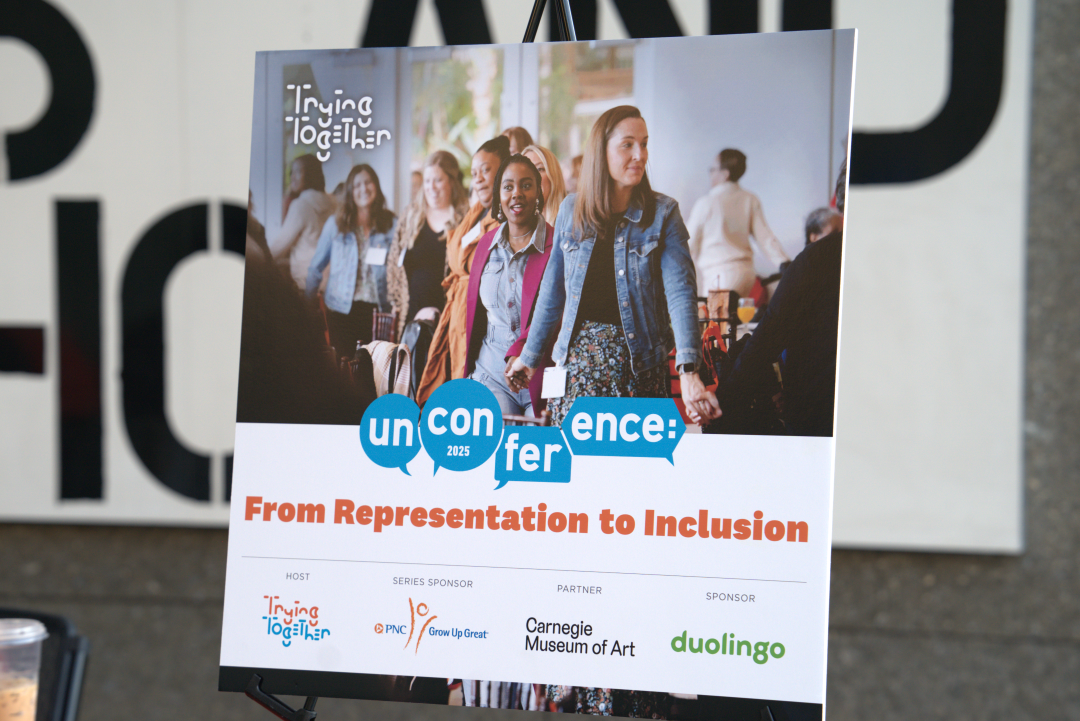
Early care and education professionals gathered at the Carnegie Museum of Art on October 4 to learn how to foster supportive and inclusive learning environments for immigrant children.
Learn More
 UnConference: From Representation to Inclusion kicked off with keynote speaker Ivonne Smith-Tapia, director of refugee and immigrant services at Jewish Family & Community Services. During her presentation to the over 90 early childhood educators in attendance, Smith-Tapia explained the significant challenges immigrant families face when navigating unfamiliar environments and practices.
“Immigrant parents have to adjust in many different ways when they migrate,” she explained. “For many, the adjustment is not only about language differences. It’s also about understanding the cultural nuances. The spoken rules of society can become overwhelming and create stress in parents’ daily lives. Experiences can be particularly challenging when parents lack a community to guide and support them.”
Smith-Tapia also noted the crucial role that early care and education professionals play in supporting immigrant families. “Every time a child educator takes an extra moment to learn about a family’s cultural practices, they’re creating the structure, function, and quality of social connection that transforms isolation into belonging,” she said.
Parent Panel
 Five parents participated in a panel discussion to share their own unique experiences as immigrants with children enrolled in child care. They drew comparisons between child care in their home country vs. the United States, noting that access, cost, and enrollment requirements can vastly differ.
The panelists also shared personal anecdotes, detailing both difficulties and joys. They offered practical tips and advice for educators, encouraging them to listen and ask questions so the immigrant families in their care feel welcome, safe, and included.
The panel included Ana Guerrero, Sol Moure Peña, Jing Zhang, Januka Regmi, and Ricardo Solis Moreno.
The Cultural Iceberg
Casey Rich, director of professional learning for Trying Together, explained to the group the concept of the “cultural iceberg.” This visual representation demonstrates that culture is comprised of both visible and invisible components, with much of what makes up a culture living beneath the surface.
“By understanding that these layers of culture exist,” Rich explained, “you can have a better understanding of why people act the way they do, and appreciate them for those differences instead of always seeing those differences as sources of conflict.”
With this concept in mind, participants engaged in a creative self-reflective art activity that encouraged them to examine their own cultural traditions, both visible and below the surface.
Workshops
After lunch, representatives from organizations that serve immigrant families in the region led hands-on workshops focused on inclusion in early childhood classrooms.
The first round of afternoon sessions included discussions on trauma-informed communication pathways for English learners and their families, building trust and inclusion with Muslim families in learning environments, exploring cross-cultural communication through play, and supporting positive identity development through picture books.
The second round of sessions focused on honoring identity through cultural learning, inclusive practices that nourish, background and practical considerations for early childhood education teachers, and a reflection on bias and creating inclusivity within multicultural classrooms.
Takeaways
Participants gained a deeper understanding of the lived experiences of immigrant children and families and left with new resources to better equip them to care for immigrant families in their classroom. Additionally, participants were offered translated versions of Trying Together’s Developmentally Appropriate Parenting series – now available in seven different languages thanks to the generous support of Duolingo.