How do we protect the freedom to take chances and the right to fall short?
A panel discussion explored this question and more during Carnegie Mellon University’s Meaningful Play Conference on October 15.
The panel, titled The Freedom to Fail: Understanding the Role of Risk in Play, addressed the specific benefits of risk and failure in play, from early learners to adults. Cara Ciminillo, Trying Together’s executive director, was one of three panelists. She was joined by Shannon Merenstein, founder of Hatch Partners in Play, and Rae Sookhoo, senior undergraduate and Failure Games research team member at Carnegie Mellon University.
The panel was moderated by Kristen Burns, the associate director of the Grable Foundation.
Drawn to the Crown Demonstration
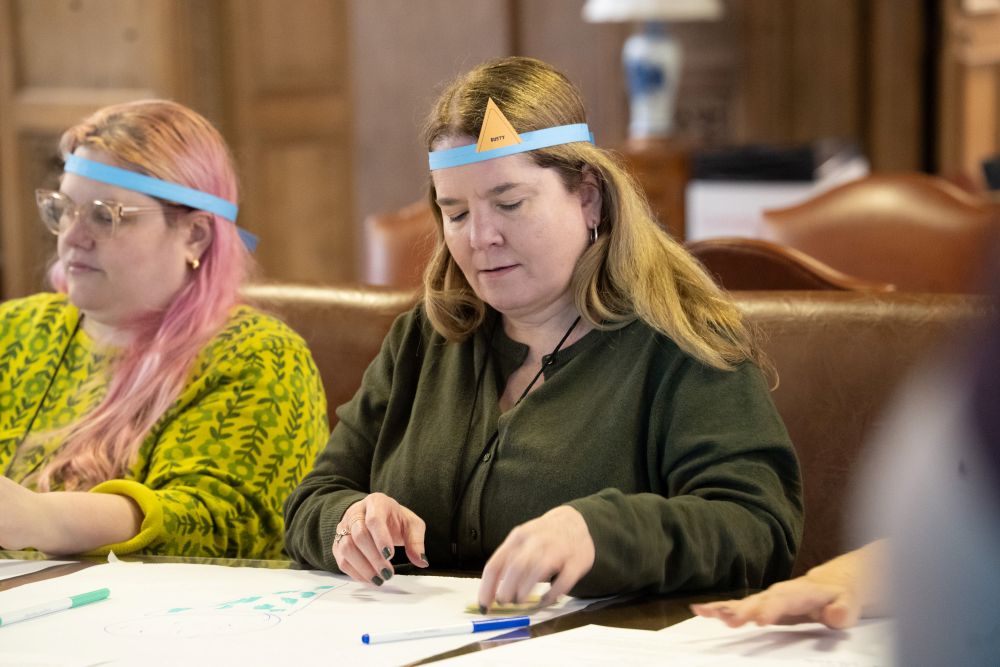
Before the discussion began, Sookhoo led a demonstration of her original game “Drawn to the Crown.” The game was simple: First, a single card with a noun was drawn – in this instance, the word “dessert.” The players then drew their interpretation of the word with a time limit of 45 seconds. Then, a second card was drawn – an adjective to describe the noun. In this demonstration, the word was “rusty.”
The challenge of the game is that once you begin drawing, you cannot cross anything out or begin again. Once the drawings were complete, a judge chose which drawing they believed was best. The winner placed the card into her crown, and the next round began.
While simple, this game relies on vulnerability and risk. Because the players have limited time and unexpected word choices, failure is an expected and humorous outcome.
Panel Discussion
The panelists began the discussion talking about risky play and the benefits for children, which led to a rich conversation about failure. A running theme throughout the discussion was that it’s OK to do something and fail immediately – especially when we learn and try again.
“Failure isn’t who you are as a person,” explained Ciminillo. “The focus is on the trying, not the outcome.”
For children especially, this is an important part of growth and development. Merestein pointed out that children should have the freedom to “tinker, dabble, experiment, and assume new roles.”
“Free play is the time you build your identity and discover what you’re interested in and connected to. It’s a critical part of early childhood – but good for all of us,” she said.
The panel also discussed the tension between allowing young children the autonomy to engage in risky play, while at the same time considering their safety. Children are perceptive to how adults are feeling – and if they are with an adult who is rigid or overly cautious, their experience can be affected.
“Risk, agency, and trust go hand in hand with children,” explained Merestein. “We all want to feel trusted and respected, and have agency and choice. Adults can allow that safe risk to happen, to pull back.”
Ciminillo encourages caregivers to be aware of themselves and to bring neutral judgement about what’s unsafe when interacting with children. This gives them more space to learn and explore. Learning cannot occur if adults are constantly stopping play.
Sookhoo connected risk in play to more developed creativity and a willingness to forgo perfection.
“Try fast and fail fast,” she encouraged. “Free play is a big part of the brainstorm. It’s important for people to go with their ideas and not hinder the thinking process.”
This provides the opportunity to move on quickly and try new things – for both adults and children.
The discussion then shifted to different risks across various demographics, including socioeconomic, racial, cultural, gender, physical ability, and more. Ciminillo urged game creators to be mindful of their biases and belief systems when creating.
The discussion wrapped up with a question to the audience: How do we as adults perceive, embrace, and speak about play?
Participants cited video games, cosplay, sports, and board games as typical methods of play for adults. However, adults may be less likely to consider things like baking or crafting as “play,” despite the incredible opportunity to experiment and learn.
The ultimate takeaway from the discussion is that risky play should be embraced and encouraged for people of all ages. With risky play comes the potential for failure – and this is a good thing. When we embrace that failure, we open ourselves up to greater learning, creativity, and possibility.