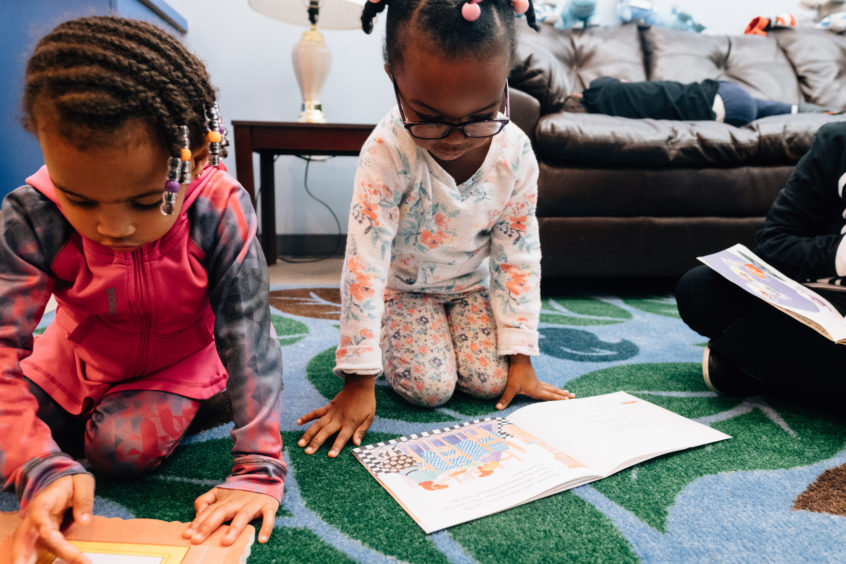
United Way’s 100,000 Books initiative is giving away new and gently used books to support your students’ developing reading skills. A variety of books are available for various age groups, although this year’s selection appears to have more in the pre-k to 3rd-grade range.
To qualify, your program must use a mentor – reader model. This event is first come – first serve, so show up early. Bringing boxes is recommended. Register here.
What is 100,000 Books?
100,000 Books builds on research that demonstrates the importance of connecting a caring adult or older student with a child. This mentor model has been shown to have a significant impact on the life of a child and will be the primary model that 100,000 Books uses to support reading skills development. Mentors (teachers, librarians, youth workers, caring adults, older students…) will reinforce reading skills through one time and on-going read-along opportunities that will help kids to build this critical love of reading.
Questions
If you have any questions, please contact Tanya Baronti at tanya.baronti@unitedwayswpa.org or Joe Welsh at joe.welsh@unitedwayswpa.org.
Tickets for Kids and the Sto-Rox Library announced the discussion dates for their new collaborative book club. The book chosen by their group is: “Evicted: Poverty and Profit in the American City” by Matthew Desmond. Winner of the Pulitzer Prize, this book was also the One Book One Community choice of the University of Pittsburgh’s School of Public Health.
If you would like to attend, RSVP to Jennifer Gray by email (jgray@forstorox.org) or phone (412.771.1222). Parking is located in the parking lot on the side of the building, PNC parking lot after banking hours, or on the street.
Discussion Dates
Discussions will be held at the Sto-Rox Library on the following dates:
- December 10, 2018: 4-5:30 PM
- February 11, 2019: 6-7:30 PM
- April 8, 2019: 6-7:30 PM
- June 10, 2019: 6-7:30 PM
About the Book
“Evicted” by Matthew Desmond describes the plight of poor families who, for want of a few dollars, are forced to move from their homes, apartments, or trailers. An ethnographer, Desmond shares the intimate vicissitudes of his subject/friends as they struggle to make ends meet while negotiating a bewildering system of slumlords, public agencies, law enforcement, and courts, a system that seems almost designed to reinforce a downward spiral of poverty. The consequences of eviction are especially felt by mothers with young children, whose development is jeopardized by substandard housing, low-quality neighborhoods, and poor nutrition.
*Information provided by Tickets for Kids Charities and Pitt Public Health*

In 2019, the Pennsylvania One Book Program will adapt to meet the increasing need to support early literacy to Pennsylvania’s youngest learners. These changes include a shift in focus to get more books into the hands and homes of more children.
Available Books
There will be two books available for purchase:
- “Barnyard Banter” by Denise Fleming
For infants and toddlers (available in English).
- “Not a Box” by Antoinette Portis
For children ages three to five (available in English and Spanish).
There are no minimum or fixed quantities required. Early learning providers, library staff, and community partners can purchase the exact number of books needed. To keep costs more affordable, paperback options are the only available option.
Purchasing Details
Purchasing of the two titles are through Scholastic Publishing Family and Community Engagement (FACE) program. If your organization already participates in the FACE or Scholastic Literacy Partners Program, you will just need to complete the order form available from Scholastic Publishing. Click here for the order form.
A two-page Family Fun Guide for both titles will be available on the PA One Book website (www.paonebook.org) by January 2019. Other guides aligned with the Pennsylvania Standards for Early Childhood will also be available with activities for use by early childhood educators and families.
With this change, copies of the One Book titles will no longer be mailed to early learning programs, however, anyone may purchase and donate copies to child care homes and centers, as well as families.
*Information provided by NAEYC*