Connections and Conversations Virtual Check-Ins are biweekly interactive sessions that highlight topics of interest to the field of early childhood education. Participants engage in virtual discussions with child development experts while interacting with early learning practitioners to share questions, experiences, and expertise about the highlighted topic. Sessions offer one hour of PQAS credit. Act 48 credit will not be provided.
Participants will receive the course Zoom link via email within 24 hours before the start date for the course. For questions, contact Jasmine Davis at jasmine@tryingtogether.org.
Session Rules and Guidelines
These virtual discussions are designed to provide educators the opportunity to grow professionally and share knowledge on early childhood topics. During the meeting, participants should follow the guidelines below to ensure a successful virtual meeting for all participants.
Please allow all participants a chance to speak. Listen respectfully and actively.
Commit to learning about each other, not to debating the topic.
Embrace differences of opinion as healthy and support each person’s authentic self-expression.
Participants will be muted for the beginning portion of the session.
Participants may use the “Raise Hand” feature in Zoom to request an opportunity to comment or ask a question. Individuals will be temporarily unmuted by the moderator.
Participants may type a comment or question in the Chat or may send comments or questions directly to the moderator for them to share.
To receive PQAS credit, you must complete an evaluation at the end of the session and include your PD Registry number.
Have fun, make connections, and engage in the conversations!
Connections and Conversations Virtual Check-Ins are biweekly interactive sessions that highlight topics of interest to the field of early childhood education. Participants engage in virtual discussions with child development experts while interacting with early learning practitioners to share questions, experiences, and expertise about the highlighted topic. Sessions offer one hour of PQAS credit. Act 48 credit will not be provided.
Participants will receive the course Zoom link via email within 24 hours before the start date for the course. For questions, contact Jasmine Davis at jasmine@tryingtogether.org.
Session Rules and Guidelines
These virtual discussions are designed to provide educators the opportunity to grow professionally and share knowledge on early childhood topics. During the meeting, participants should follow the guidelines below to ensure a successful virtual meeting for all participants.
Please allow all participants a chance to speak. Listen respectfully and actively.
Commit to learning about each other, not to debating the topic.
Embrace differences of opinion as healthy and support each person’s authentic self-expression.
Participants will be muted for the beginning portion of the session.
Participants may use the “Raise Hand” feature in Zoom to request an opportunity to comment or ask a question. Individuals will be temporarily unmuted by the moderator.
Participants may type a comment or question in the Chat or may send comments or questions directly to the moderator for them to share.
To receive PQAS credit, you must complete an evaluation at the end of the session and include your PD Registry number.
Have fun, make connections, and engage in the conversations!
Are you interested in hearing guidance from experts on early childhood development, adverse childhood experiences, and the impact of COVID-19 on children? Join the NIHCM Foundation on September 10 for their webinar, “Protecting Our Children: COVID-19’s Impact on Early Childhood and ACEs.”
About
Although most children are not at high risk for contracting COVID-19, the pandemic has disrupted their lives and exacerbated challenges to children’s health and well-being. This webinar will convene experts to provide information and guidance on early childhood development, adverse childhood experiences (ACEs), and the impact of COVID-19 on children.
Speakers will discuss the following topics:
the importance of early childhood experiences in lifelong health and how adversity affects both the developing brain and other physiological systems;
what ACEs initiatives are doing to respond to COVID-19 and the opportunities and challenges the pandemic has produced for professionals in the field; and
lessons from a health plan’s investment in programming that addresses ACEs, including education on ACEs for teachers, policymakers, and health care professionals.
Are you interested in hearing guidance from child development experts? Join Trying Together on August 19 and September 2 for our free virtual professional development sessions! Each session will offer one PQAS credit hour.
Both sessions are a part of our interactive Connections and Conversations Virtual Check-In series that features guidance from child development experts, information on the highlighted topic, and opportunities for early learning professionals to share questions, experiences, and expertise.
Join Trying Together on August 19 to explore the core principles of Magda Gerber’s RIE philosophical approach to educaring for infants and toddlers in the early childhood setting. Participants will have an opportunity to engage in conversations around developmentally appropriate practice for infants and toddlers while reflecting on how to best create a safe, challenging, predictable environment for all children.
More than ever before, early childhood practitioners play a critical role in supporting children’s social and emotional wellness. Join Trying Together on September 2 for a conversation on promoting children’s communication skills and emotional development through the use of technology and media. Participants will engage in discussion and reflection on their current practice and the impact of COVID-19.
During the webinar, participants will hear from Danette Glassy, MD, FAAP, pediatrician, about guidance from the U.S. Centers for Disease Control and Prevention (CDC) and discover practical strategies for implementation in a variety of early care programs. Webinar topics include:
CDC guidance for early care and education programs;
barriers to implementation within early care settings; and
strategies for early care and education programs to keep children and staff as safe as possible.
This event is best suited for Head Start program directors and health services staff; Head Start State Collaboration directors; child care resource and referral agencies; child care directors and health consultants; state public health departments; and nurses working with early care and education programs.
Registration
To register, visit the event page. The registration link can be used for both the live event and on-demand viewing.
A recording of the discussion will be available to watch on-demand 30 minutes after the event ends until June 15, 2020. A version with English closed captions will also be posted on the Early Childhood Learning and Knowledge Center (ECLKC) in the coming weeks.
More Information
For questions, please contact NCECHW at 888.227.5125 or health@ecetta.info.
News
March 31, 2020
How to Practically Implement the Six Keys to Early Childhood Reading
In this webinar, participants will hear from reading experts who have spent 17 years in the classroom with children. Presenters will make it easy for attendees to understand how to apply and teach children the six keys to early childhood reading (as outlined by the NICHD) in a practical way. These six keys include the following:
demonstrating how to sound out words with letter-sound blending;
using connected, decodable text to practice letter-sounding relationships; and
reading interesting stories to develop language comprehension.
This webinar will be of interest to pre-k through elementary teachers and school and district leaders. There will be time for questions at the end of the presentation.
Bringing together parents, caregivers, the Association of Black Psychologies, health experts, creatives, and learning leaders, the 2nd Annual Centering the Identity of the Black Child through African Culture conference will highlight health and education as a central focus to optimize energy, development milestones, and success. Attendees can expect to leave the conference with tools to latch onto the high teachings that have been preserved by the knowledge bearers to help families and communities understand the role of African Culture in the development of black children.
This one-day free evening opportunity is designed to help mothers feel confident about navigating pregnancy, labor and delivery, life with an infant, and the transition to motherhood. It’s a chance to explore new options and find resources on the aspects of pregnancy, birth, babies, or parenthood that are most important to mom and partner.
You will have an eye-opening experience to experience dozens of vendors along with featuring doulas, midwives, and OBs, pediatricians, lactation consultants and IBCLCs, chiropractors, photographers, prenatal fitness experts, child care facilities, book shops, baby boutiques, early childhood programming.
There’s a strong focus on education — there will be expert-led seminars, mini-classes, and panel discussions on topics related to pregnancy, childbirth, babies, and the transition to parenthood, as well as demonstrations designed to teach skills like babywearing and cloth diapering skills.
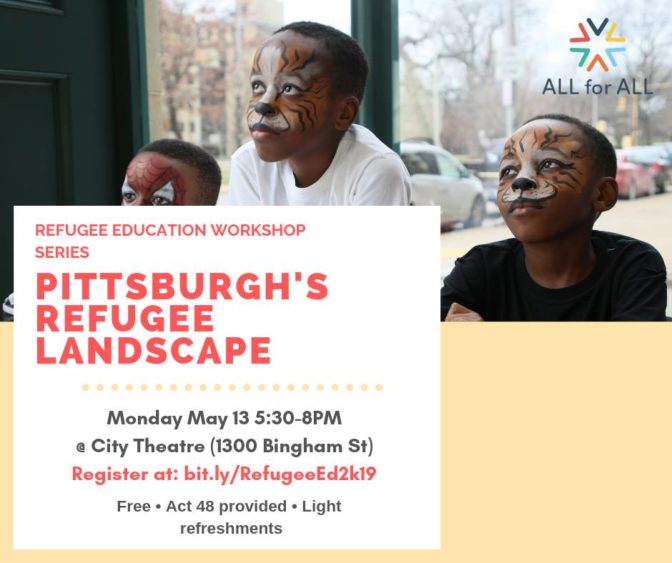
Workshop: Supporting Pittsburgh’s Refugee Students
Join Dr. Xia Chao for the first of four interactive workshops in a series dedicated to helping educators understand the cultures, needs, and assets of the Pittsburgh area’s refugee communities.
Through a grant from the National Geographic Society, Dr. Chao has conducted research over the past several years that explores the experiences and narratives of local refugee communities including the Nepali/Bhutanese, Somali Bantu, and Sudanese. This workshop series seeks to incorporate the findings of Dr. Chao’s research in order to offer local educators insight into working with students from these populations and resources for creating culturally sustaining practices.
This event is free and light refreshments and Act 48 credits will be provided.
Topics
Workshop topics will be as follows:
Understanding the Local Immigrant and Refugee Landscape | May 13, 2019 | City Theatre
Culturally Relevant Pedagogy with Refugee Populations | June | TBA
Cultural Navigation and Cultural Humility | Fall | TBA
Join Brazelton Touchpoints Center for the Learning to Listen webinar series, as they celebrate Dr. Brazelton’s enduring legacy by learning from other masterful communicators about what children and parents have taught them through the power of listening.
Available Times & Topics
The series includes three webinars:
May 21, 2019, 2:00 PM: Listen With More than Our Ears: Helping Children through Simple, Ordinary Interactions
T. Berry Brazelton, MD (1918 – 2018) foresaw the many new challenges facing families today, including the interference of social media and digital technology with family relationships and child development, and their polarizing effects on public debate. Brazelton was a master of the kind of observation and listening so desperately needed today, and helped generations of parents and professionals around the world to learn to listen to babies, children and to each other.