Trying Together’s UnConference Event Focuses on Equity in Play

News

October 16, 2024

Trying Together’s UnConference Event Focuses on Equity in Play

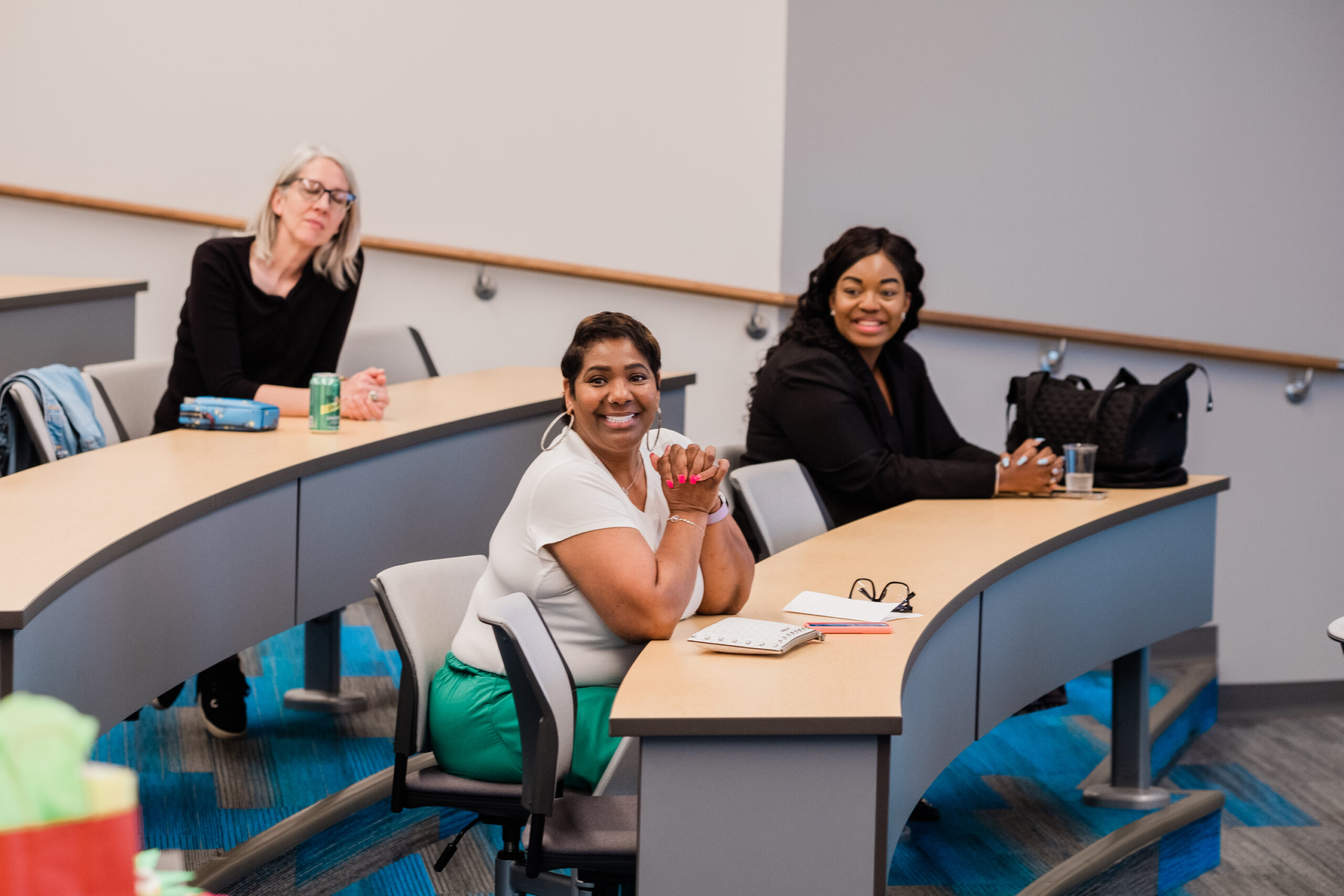
Trying Together focused on the theme of equity in play during its annual UnConference event on Monday, Oct. 14 at Phipps Conservatory and Botanical Gardens.

Beyond the Playground: Advancing Racial Equity in Play featured two keynote speakers, four breakout sessions, and performances by the Council of Three Rivers American Indian Center dancers.

Play as Early Childhood Liberatory Pedagogy

The day’s first keynote speech was “Play as Early Childhood Liberatory Pedagogy” by Dr. Denisha Jones.

Jones, who serves as the director of Defending the Early Years, noted that childhood is “under attack,” arguing that many reforms in state schools focus on future success, and not early childhood education. She added that early childhood teachers deserve autonomy and a living wage.

“Students go into environments that stifle learning from early childhood, instead focusing on standards, rigor, and testing,” Jones said. “There’s so much pressure on the early childhood community to prepare kids for the rigidity of public schooling. 

Jones said there has been a lack of a national investment in young children and their families, adding that there’s not even a foundation to which changes could be proposed. To get free of the current system, Jones said educators must restore the link between high-quality and child development. 

In theory, she said, the way to improve the system would be to trust children so that they can trust themselves, ensure that everything in early education is grounded in child development, and emphasize a focus on agency, play, and identity.

In practice, she said, educators should emphasize a child-driven curriculum, document liberated learning (which means to not just test what students know, but to document what they know by paying attention to the play in which they’re involved), and to address the elephant by not assuming that children cannot handle the oppressive forces they face in society.

“We’re being told it’s divisive to talk about race,” she said. “It shouldn’t take a racist encounter to talk about it. We need to give children the language to respond. We say to treat everyone equally. When they’re not treated equally, we don’t give them the tools to respond. Equity is not enough; we need liberation and to remove the barriers. The reality is that this is a highly unequal society.”

Jones said that children who are free to learn are driven by innate curiosity; self-directed through questioning; have time to tinker, build, and experiment; have sustained persistence; are trusted to take risks; and take part in collaboration. 

She said that teachers who are free to teach go from teaching their students to survive to teaching them to thrive; utilize the power of observation; take part in nurturing relationships and take time to nurture development; follow a child-driven curriculum; and partner with parents to unleash potential in students.

Spreading Optimism

The event’s afternoon keynote speaker, Anthony (Ant) Toombs, senior guide and outreach specialist for Life is Good’s The Playmaker Project, talked about how to spread optimism among children.

“To combat trauma, we use the antidote of play,” he said. “We teach early childhood educators how to heal through play, we improve student-teacher relationships, reduce educator burnout, and better support the social-emotional health of kids and adults alike.”

In addition to in-person training, The Playmaker Project also offers fully online programs. Every graduate gets ongoing support through further access to coaching, events, and advanced trainings.

During his speech, Toombs incorporated games involving beach balls and paper-rock-scissors to emphasize the importance of play for all ages. 

Toombs noted that there are three parts of the brain – the reptile brain (which focuses on survival), the limbic brain (which processes emotions and love), and the neomammalian brain, which focuses on such things as problem-solving and reasoning. He said that many children who have suffered adverse childhood experiences are stuck in the mode of the reptilian brain, making them hostile or aggressive.

“We have to figure out ways to quiet and nurture the snake brain, so that we can engage the limbic brain, which is all about connection,” he said. “Once you have a connection, then you can teach a child.”

He said the four key domains for a positive learning environment in which to grow the roots of optimism are joy, internal control (covering such elements as confidence and safety), active engagement (in other words, being present in the moment), and social connection.

Breakout Sessions

During the morning and afternoon, the UnConference held four breakout sessions on: 

  • Strategies to advocate for playful learning in early childhood (Trying Together’s Policy Team)
  • An approach to prioritizing open-ended play in the classroom (HATCH Partners in Play)
  • Risk in play (Trying Together)
  • Race, identity, and the arts (Lakeisha Wolf)
  • Parent LAB Play Day (Dr. Ari Brazier)

Playful Pittsburgh & Trying Together Launch New Resource Series

News

October 11, 2024

Playful Pittsburgh & Trying Together Launch New Resource Series

Playful Pittsburgh, in collaboration with its lead organization, Trying Together, has launched the first part of its Playful Resource Series, a collection of resources designed to educate and advocate for play for all. The resource series will cover topics such as the benefits of play, how people of all ages can better incorporate play into daily life, advocating for equity in play, and more.

Modeled after Trying Together’s 12-part Developmentally Appropriate Parenting (DAP) Resource Series, the Playful Resource Series includes a digital library of curated resources with printable and interactive tools organized by play type and issues relating to different age groups.

The first part of this series focuses on “Play is Learning” and future topics and related resources will be released periodically through 2027 on the Playful Resource Series’ web page.

Learn More

The first topic covered in the series is “Play is Learning.” In this part, readers can explore resources that feature information on:

  • The benefits and necessity of play for healthy brain development
  • How play supports cognitive development over time
  • How people develop executive functions through play

Any questions regarding the series should be emailed to playfulpgh@tryingtogether.org. 


Working Together Webinar

News

October 2, 2024

Working Together Webinar

Start Strong PA and Pre-K for PA will host an upcoming webinar that will focus on early learning in Pennsylvania’s 2025-26 budget.

Learn More

The webinar, which will be available in English and Spanish, will focus on early learning in the state budget for 2025-26. It will also include an advocacy update and a discussion on opportunities for child care.

The webinar will begin at 10 a.m. on Thursday, Oct. 10. Those interested in attending should register in advance. After registering, participants will receive a confirmation email containing information about joining the webinar.

Speakers will include Pre-K for PA and Start Strong PA partners, including:

  • Champions for Early Education
  • Pennsylvania Association for the Education of Young Children
  • Pennsylvania Child Care Association
  • Pennsylvania Head Start Association
  • Trying Together

Attendees will learn how to continue working with others to strengthen the state’s early learning system for teachers and programs and grow access to more eligible families.

American Red Cross First Aid, Pediatric First Aid, CPR, and AED Training

News

August 21, 2024

American Red Cross First Aid, Pediatric First Aid, CPR, and AED Training

Trying Together and ELRC Region 5 are partnering to provide First Aid, Pediatric First Aid, cardiopulmonary resuscitation (CPR), and automated external defibrillator (AED) training to early childhood professionals.

About the Course

This PQAS-certified in-person course provides life-saving skills in alliance with The Occupational Safety and Health Administration (OSHA)’s Best Practices for Workplace First Aid Training Programs.

Certification will be issued upon successful completion of the course. This certification is valid for two years. The cost is $38.

Session Details

Monday, August 26 | 10 a.m.  – 4 p.m.
Pitt CEC Homewood
622 N. Homewood Avenue
Pittsburgh, PA 15208
Register

Wednesday, October 9 | 10 a.m. – 4 p.m.
Pitt CEC Homewood
622 N. Homewood Avenue
Pittsburgh, PA 15208
Register

PLEASE NOTE: Successful course completion requires full participation in classroom and skill sessions, as well as successful performance in skill and knowledge evaluations.

Participants will be conducting strenuous activities, such as performing CPR on the floor. If you have a medical condition or disability that will prevent you from taking part in the skills practice sessions, please let your instructor know so that accommodations can be made for the practice portion. The CPR and AED evaluations must be completed with the manikin on the ground.

Questions?

For questions about the sessions, contact Holly Cessna at holly.cessna@alleghenycounty.us.

American Red Cross First Aid, Pediatric First Aid, CPR, and AED Training

News

American Red Cross First Aid, Pediatric First Aid, CPR, and AED Training

Trying Together and ELRC Region 5 are partnering to provide First Aid, Pediatric First Aid, cardiopulmonary resuscitation (CPR), and automated external defibrillator (AED) training to early childhood professionals.

About the Course

This PQAS-certified in-person course provides life-saving skills in alliance with The Occupational Safety and Health Administration (OSHA)’s Best Practices for Workplace First Aid Training Programs.

Certification will be issued upon successful completion of the course. This certification is valid for two years. The cost is $38.

Session Details

Monday, August 26 | 10 a.m.  – 4 p.m.
Pitt CEC Homewood
622 N. Homewood Avenue
Pittsburgh, PA 15208
Register

Wednesday, October 9 | 10 a.m. – 4 p.m.
Pitt CEC Homewood
622 N. Homewood Avenue
Pittsburgh, PA 15208
Register

PLEASE NOTE: Successful course completion requires full participation in classroom and skill sessions, as well as successful performance in skill and knowledge evaluations.

Participants will be conducting strenuous activities, such as performing CPR on the floor. If you have a medical condition or disability that will prevent you from taking part in the skills practice sessions, please let your instructor know so that accommodations can be made for the practice portion. The CPR and AED evaluations must be completed with the manikin on the ground.

Questions?

For questions about the sessions, contact Holly Cessna at holly.cessna@alleghenycounty.us.

CDA Completion Community of Practice

News

August 19, 2024

CDA Completion Community of Practice

On Wednesdays from mid-September to late October, those working towards their Child Development Associate (CDA) Credential can join a network of fellow educators.

Learn More

Trying Together’s virtual CDA Completion Community of Practice is a seven-week course that offers a blend of structured learning and interactive community engagement tailored to empower CDA candidates.

Each week, participants will dive into individual pieces of the required CDA portfolio, application, and available financial assistance. The facilitator will provide step-by-step instructions and practical tips as well as answer questions to help participants navigate the complexities of the CDA credential.

Educators must have completed the minimum 120 hours of CDA training to qualify for the course.

The course will run from 6:30 p.m. to 8 p.m. on Wednesdays, from Sept. 11 to Oct. 23. Registration is now open.

CDA Completion Community of Practice

News

CDA Completion Community of Practice

On Wednesdays from mid-September to late October, those working towards their Child Development Associate (CDA) Credential can join a network of fellow educators.

Learn More

Trying Together’s virtual CDA Completion Community of Practice is a seven-week course that offers a blend of structured learning and interactive community engagement tailored to empower CDA candidates.

Each week, participants will dive into individual pieces of the required CDA portfolio, application, and available financial assistance. The facilitator will provide step-by-step instructions and practical tips as well as answer questions to help participants navigate the complexities of the CDA credential.

Educators must have completed the minimum 120 hours of CDA training to qualify for the course.

The course will run from 6:30 p.m. to 8 p.m. on Wednesdays, from Sept. 11 to Oct. 23. Registration is now open.