News

September 8, 2025

OCDEL Asks Licensed Child Care Providers Charging Private Pay Rates to Take Survey

The Pennsylvania Office of Child Development and Early Learning (OCDEL) is requesting that licensed child care providers who charge private pay tuition rates complete a survey between Sept. 8 and Dec. 8.

Learn More

OCDEL is required to collect up-to-date tuition information from all licensed providers every three years. The 2025 Child Care Market Rate Survey helps OCDEL set child care subsidy payment rates that are reflective of the private pay market.

Even programs that don’t accept subsidies should fill out the survey. When all providers complete the survey, the date gives a more accurate picture of child care tuition rates across Pennsylvania.

Benefits of filling out the survey include:

  • The results help to set payment rates for child care subsidies over the next few years.
  • When more providers respond, rates are more fair and reflect real tuition rates.
  • It supports policies that better reflect the real structure and value of child care services statewide.
  • It strengthens the case for public investment in child care for everyone.
  • If you don’t respond, decisions may be based on other programs that don’t reflect your rates.

Participants who complete the survey will be entered into a raffle and could win a gift card. A total of 100 winners will each get a $100 e-gift card.

Surveys can be filled out online or on paper. A paper copy of the survey will be sent in mid-September to all programs that have not yet completed the survey online. Surveys should be returned in the pre-paid return envelopes that are provided. Or, those taking the survey can scan or take photos of it and submit it to ChildCareResearch@psu.edu. 

It is being conducted by the Institute of State and Regional Affairs at Penn State Harrisburg, in partnership with OCDEL and the Pennsylvania Key. 

The survey should be filled out between Sept. 8 and Dec. 8.
News

September 4, 2025

Nonprofits Encouraged to Take Part in Survey on PA State Budget Impasse

Nonprofit organizations – including those in the early childhood education sector – are being encouraged to take part in a survey on Pennsylvania’s state budget impasse on Survey Monkey.

Learn More

The survey takes approximately 15 to 18 minutes to complete. It focuses on the projected impact of the state budget delay on various organizations’ financial well-being, staff, operations, and those served by the organizations.

The survey asks for participants to provide current and estimated data, if possible, and poses questions about current and projected impacts. Organizations’ names will not be used in a final report resulting from the survey.

The state Legislature has not passed a budget more than two months past the deadline. As a result, public schools are not receiving state funding that educators say is critical to keep schools operating.

The survey’s deadline is 11:59 p.m. on Sept. 15. The survey is available on Survey Monkey.

News

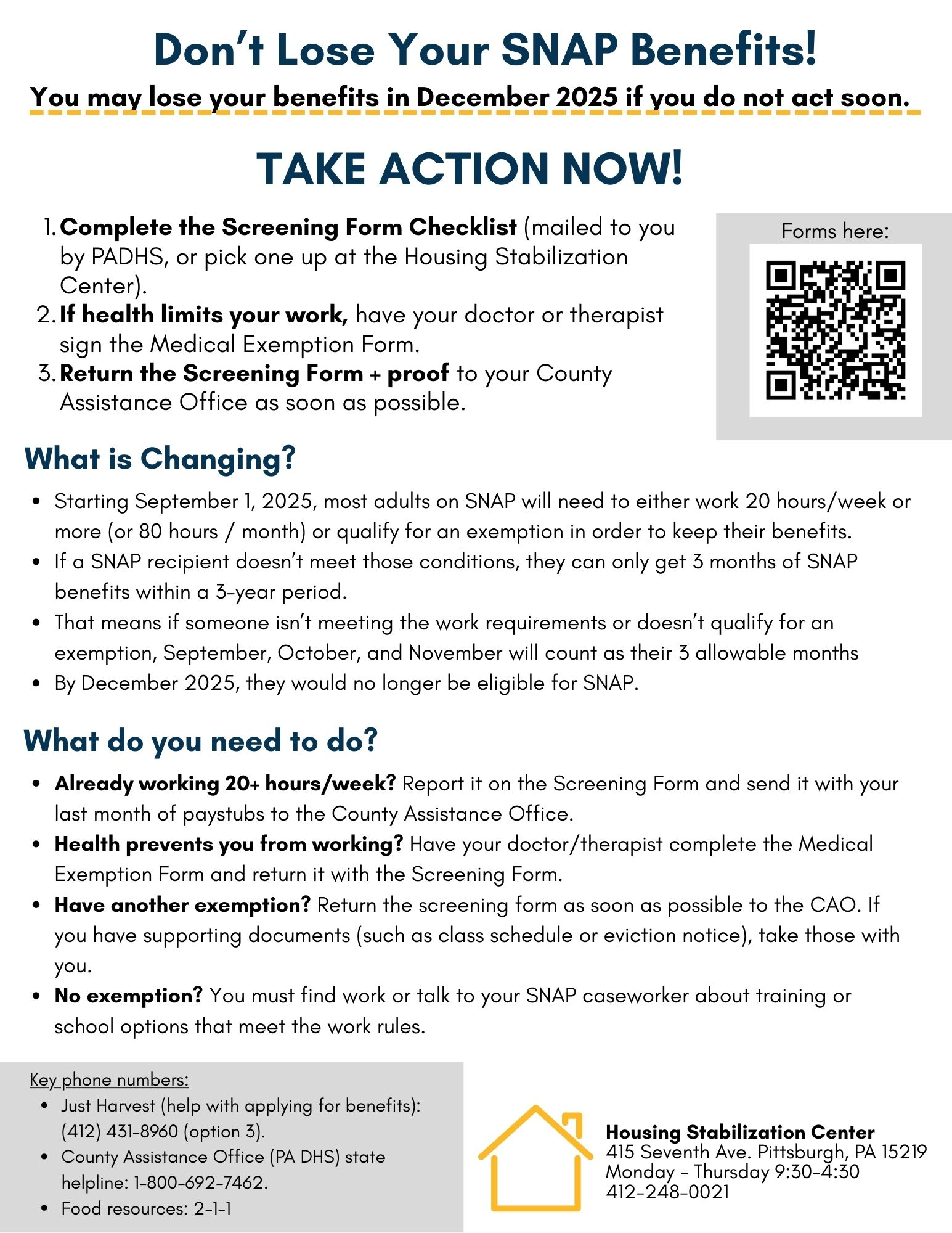
SNAP Recipients Must Take Action to Ensure They Don’t Lose Benefits in December

Recipients that fail to take action to secure their SNAP benefits could lose them in December following federal changes to the benefits that have recently taken effect.

Learn More

As of Sept. 1, most adults on SNAP are required to work at least 20 hours per week or qualify for an exemption. People who do not properly document that they meet these conditions can only receive three months of benefits over a three-year period, meaning they would run out in December.

SNAP recipients must take the following actions:

  • Complete the Pennsylvania Department of Human Services’ (DHS) screening form checklist that was mailed to recipients by the DHS. The checklist can also be found online.
  • If health limits their work, have a doctor or therapist sign a medical exemption form.
  • Return the screening form and proof to the County Assistance Office, which is operated at the state level by the DHS.

Details about who needs to take action and when can be found on the DHS’ website.

For Providers

To ensure that people in your network are aware of these updates, share this flyer from the Housing Stabilization Center that summarizes key action items and includes quick reference phone numbers.

News

September 3, 2025

Deadline to Apply for APOST’s Lights On Afterschool Mini-Grant is Sept. 23

Those interested in applying for Allegheny Partners for Out of School Time’s (APOST) Lights on Afterschool 2025 mini-grants must do so by Tuesday, Sept. 23.

Learn More

Celebrating its 25th year, Lights on Afterschool is a nationwide event celebrating afterschool programs and their important role in the lives of children, families, and communities. The program is meant to draw attention to the many ways afterschool programs support students by offering them opportunities to learn new things – such as science, community service, robotics, poetry, Tae Kwon Do, and other new skills.

APOST celebrates Lights on Afterschool by awarding mini-grant funds to local out-of-school time programs to showcase their work and share the importance of their mission.

The deadline to apply for APOST’s mini-grants is 5 p.m. on Sept. 23. To be eligible, organizations must be located within Allegheny County and qualify as a 501(c)3 nonprofit.

A maximum of one award will be given per event or project.

Mini-grant requirements include:

  • Events or projects must take place within the week of Monday, Oct. 20 to Friday, Oct. 24.
  • Events or projects must be submitted to the Lights on Afterschool Directory by Monday, Oct. 13.
  • At least one photo of the event or project must be sent to APOST to be shared publicly. 

Providers chosen for the grant will receive $500 to implement a Lights On Afterschool-inspired event or project. APOST staff may attend the event or participate in a project where possible, and chosen events or projects will have a chance to be spotlighted in the News You Can Use newsletter or on the APOST website.

For more information, visit APOST’s Lights On Afterschool web page.

News

September 2, 2025

Back-to-School Resources for Children Who Are Struggling

Starting back at school in the fall presents a number of challenges for young children – but especially those who are already struggling. 

The Child Mind Institute has provided a series of resources for children who might need a little extra help to achieve success.

Learn More

Children might experience anxiety as they start a new school year – especially if they are attending for the first time.

But some students might need a little extra assistance as they navigate the challenges of school. Some students with selective mutism might speak comfortably at home but find it harder to interact at school.

Other students with attention deficit hyperactivity disorder (ADHD) might need tools and strategies to stay organized, while others with sensory processing challenges may need help to stay comfortable and focused.

Most children would benefit from a consistent schedule and homework routine, the Child Mind Institute noted.

Here are some resources for back-to-school success for children who might be struggling:

News

The Common Causes for ECE Burnout and Tips on How to Manage It

A recent article by Zero to Three addresses the common causes for early childhood educator burnout and provides tips on how to manage or prevent it.

Learn More

The article by Zero to Three – a national nonprofit focused on the healthy development of infants and toddlers – notes that burnout in early childhood education goes beyond fatigue. It is “described as a state of mental, physical, and emotional exhaustion” that can be a response to intense or prolonged stress.

According to the Zero to Three article, burnout may be disguised as cynicism, detachment, or feelings of helplessness or ineffectiveness. Physical symptoms can manifest as headaches, stomachaches, changes in appetite, and continuing to feel drained after adequate rest.

Common Causes

The three most common causes of early childhood educator burnout are:

  • Emotional labor – the effort required to manage emotions, especially when meeting workplace demands; for example, this may look like patience with young children even when their behavior is challenging.
  • High workloads – due to early childhood staff  shortages, educators often find themselves juggling more demands, often leaving little time for breaks or relaxation; as a result, this can lead to impaired work-life balance that can result in everything from headaches to sleep issues.
  • Lack of resources – limited access to specialized materials can make it challenging to support children with developmental delays, disorders, or disabilities; also, teachers may experience feelings of guilt or inadequacy if they sense they’re being forced to cut corners or compromise their quality of service.

Self-Care Tips

Zero to Three provides tips on how educators can cope with stress and frustration to avoid burnout, arguing that self-care is “nonnegotiable.” 

Three areas to focus on include:

  • Mindfulness – the intentional practice of being fully present in any given moment and approaching it with openness and acceptance. In the early childhood education sphere, the advantages of mindfulness include: reduced anxiety, higher empathy and compassion, and improved well-being.
  • Seeking peer support – consider forming a peer support group or establishing individual mentorships to help with stress management in child care settings.
  • Setting boundaries – establishing healthy boundaries help to prevention overextension or over-commitment, reduce emotional exhaustion and stress, reinforce self-worth and self-respect by promoting the prioritization of well-being, and protecting enthusiasm for serving young children and their families. 

To learn more, read Zero to Three’s recent article.

News

September 1, 2025

Podcast Provides Tips for Building Up Children’s Self Esteem

A recent Thriving Kids podcast covers the topic of how to build up children’s self esteem and includes tips on instilling confidence.

Learn More

In the latest Thriving Kids episode, psychologist Jennifer Louie, PhD, joined Dave Anderson, the Child Mind Institute’s senior psychologist and vice president of public engagement and education, to discuss how caregivers can support children in developing confidence.

The discussion covered such topics as when children are self-critical, why praising effort matters more than praising talent, and how to help children feel capable even when they fail. 

Among the methods discussed on everyday ways to help nurture a child’s self esteem at home include:

  • Show your child love every day – not just with words, but with your presence.
  • Share your family’s values – kindness, respect, and courage – not as rules but as guiding principles for a strong character.
  • Expose your child to a variety of activities – such as playing music, being active, or making art.
  • Encourage your child to seek meaningful, but attainable, goals – and avoid challenges that are too easy and can lead to boredom as well as those too difficult that can make them discouraged.
  • Focus on the effort and the journey, rather than praising a child’s natural abilities; instead, recognize the hard work, which highlights the value of dedication and improvement.

Other tips for caregivers include modeling confidence in yourself even when you’re not feeling it, not getting upset about mistakes, praising perseverance, helping children find their passion, celebrating effort, expecting them to pitch in, and showing love, no matter what.

The episode is available on the Child Mind Institute’s website.

News

August Recalls on Children’s Products

Below is a list of August recalls from the following federal agencies: the Consumer Product Safety Commission, the Food and Drug Administration, and the National Highway Traffic Safety Administration

Learn More

  • Petmate recalled its Pet Zone Pet Toys due to a risk of serious injury or death from ingestion. The toys violate the mandatory standard for consumer products containing button cell or coin batteries as required by law because the LED-illuminated plastic sphere can break upon impact, making the button cell batteries easily accessible to children.
  • TEMI Go recalled its basketball toys due to choking risks. The toy contains small balls and is intended for children under age 3, which violates the small ball ban.
  • Monica Vinader recalled its select 14k yellow gold mini-heart chain bracelets, necklaces, and stud earrings due to high levels of cadmium, which can be toxic if ingested by young children.
  • AliExpress recalled its LeymanKids Children’s Pajama Sets due to risk of burn injuries. The pajama sets violate the mandatory flammability standards for young children’s sleepwear. 
  • Sefralls recalled its Minoxidil Hair Generation Serum due to risk of serious injury or death from child poisoning. The serum contains minoxidil, which is not in child-resistant packaging as required by law.
  • La Ligne recalled its Enfant Bonne Nuit Pajamas due to the risk of burn hazard. The pajama sets violate mandatory standards for children’s sleepwear flammability. 
  • Firefly Fuel recalled its Firefly Safe & Green 32 oz. fuel bottles due to the risk of poisoning to young children. The bottles contain hydrocarbons, which are not in child-resistant packaging as required by law.
  • Children’s toys sold by STWUQIKONG were recalled because they pose a choking hazard for children. The toys contain small balls and are intended for children under age 3, which violates the small ball ban.
  • CT Energy recalled its lithium coin battery chargers because they pose a risk to children if they swallow them. The battery charger violates the mandatory standard for consumer products containing button cell or coin batteries because the charger has lithium coin batteries that can be easily accessed by children. 
  • MTC recalled its Party Favors Lite-Up Torches and Laser Pointers because they pose a risk to children if they swallow them. The torches and laser pointers contain button cell batteries in violation of the mandatory standard for toys because the batteries can be easily accessed by children.
  • Lulive recalled its dressers due to the risk of serious injury or death to children if the dressers tip over and entrap them. The dressers are unstable if they are not anchored to the wall, posing tip-over and entrapment hazards for children.