PA Promise for Children Combines Activities with September Books for Preschoolers

News

September 15, 2026

PA Promise for Children Combines Activities with September Books for Preschoolers

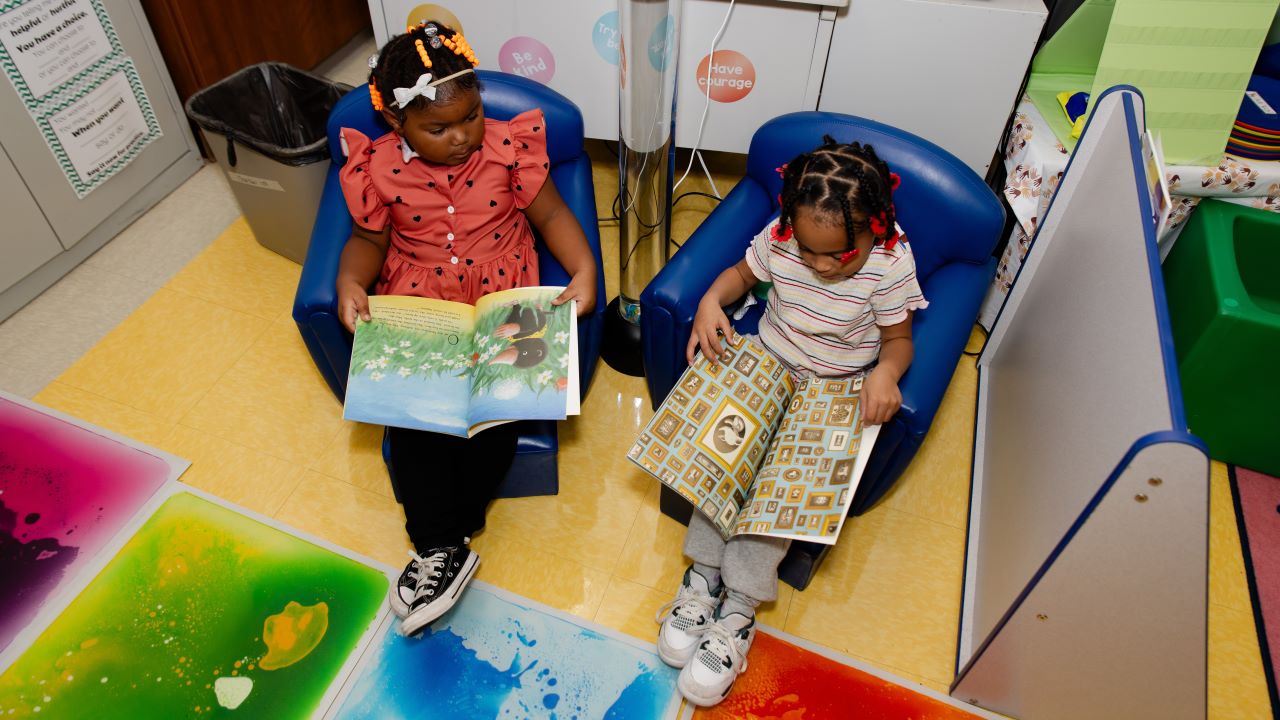
PA Promise for Children released its list of September books for preschoolers, recommending eight books across four categories and combining some of them with activities that can increase interest in literacy.

Learn More

The book list includes four categories: Social Studies Thinking, Language and Literacy Skills, Science Thinking and Technology, and Mathematical Thinking and Expression.

The titles include:

Social Studies Thinking

  • Actual Size (Steve Jenkins)
  • Say Please, Little Bear (Peter Bentley)

Language and Literacy Skills

  • It Is Night (Phyllis Rowand)
  • The Bus for Us (Suzanne Bloom)

Science Thinking and Technology

  • Put It On the List (Kristen Darbyshire)
  • Mrs. McNosh and the Giant Squash (Sarah Weeks)

Mathematical Thinking and Expression

  • One Mole Digging a Hole (Julia Donaldson and Nick Sharratt)
  • 365 Penguins (Jean-Luc Fromental and Joelle Jolivet)

For the Science Thinking and Technology selections, PA Promise for Children suggests that caregivers have children look at fruits, vegetables, cans, and boxes in a grocery store or farmer’s market. Talk to them about the different shapes, colors, and sizes. Use words like same or different and continue reinforcing this concept with word cards, signs, or braille. 

An activity to pair with the Mathematical Thinking and Expression books is to make a height chart with paper. Place the paper against the wall or door and ask a child to stand with their back against the chart. Mark their height and date it. Try this again in three months and talk about the change. 

The child could also lie on the paper or use measurements to draw a line. Ask them to stretch out their arms and measure their arm span. Use the information about their height to compare with another object in the house and to talk about the circumference of objects.

Make the Call in Support of Head Start

News

September 14, 2026

Make the Call in Support of Head Start

Head Start is facing its greatest threat in decades. We need your help.

In early August, the federal government proposed significant changes to Head Start. For over 60 years, Head Start has provided high-quality early learning alongside health, developmental, nutrition, mental health, and family supports. These proposed changes would affect what families children and families experience. 

One of the most concerning changes impacts class sizes, staffing standards, and teacher qualifications that would result in more children with fewer educators including:

  • Changes to classroom sizes and child-to-adult ratios
  • Less guidance causing confusion for local program operations 
  • Curriculum implementation and requirements to English-only instruction 
  • Weakened staff qualifications 

With this new proposal, approximately 700,000 children and families who benefit from this program are at risk of reduced services. Moreover, it makes access to Head Start more challenging and impacts the quality of the program.

These changes are not final and as of now, this is a proposal – not law.  However, in order to influence this decision, we need your help! Contacting your federal lawmakers makes more than a difference. It creates impact. Whether you call or submit a public comment, every action counts. The public has until October 6 to weigh in.


Your Voice Makes a Difference

How does calling your Congress members move the needle? Here are a few reasons:

  • When you call your federal lawmaker, staff members are required to track constituent opinion. Imagine a sudden surge of calls; it signals immediate urgency.
  • Phone calls are also harder to ignore; they gather attention.
  • Lastly, it shows we are actively watching and care about the decisions made. The more phone calls they receive about Head Start, the more pressure they feel to take a stand to protect it. 

Your voices are what make a difference; they’re what allow those who do not understand what it’s like in a program to see the true stakes. 


Start Taking Action

Over the next few weeks, we will dive deeper into some of the proposed changes and ways to take action – but there are actions you can take immediately.

On Tuesday, September 15, advocates will be on the ground in Washington, D.C., meeting with members of Congress to defend Head Start. But you don’t have to be there in person to make your voice heard. Wherever you are, your voice matters.

How you can participate:

  1. Find your members of Congress. Look up your Representative and Senators using the online tool. It only takes a minute.
  2. Call their D.C. offices. Use the simple script below to urge them to protect Head Start.
  3. Spread the word. Share this email with three family members or friends and ask them to make the call.

Talking points for your call:

  • Head Start is a lifeline for more than 30,000 children in Pennsylvania, providing not just early education, but also nutritious meals, health screenings, and vital family support.
  • HHS’s proposed rule would strip away the quality standards that make Head Start the gold standard:
    • eliminating critical mental health services and supports for children and families;
    • increasing class sizes and reduce a teacher’s ability to provide individualized care and education by allowing 33% more children per teacher; and
    • reducing the number of teachers, home visitors, and support staff, creating a more stressful and less effective environment for learning.
  • It’s essential that Congress protect Head Start. Families depend on this program to keep their children safe and to be able to work.

Call-In Script

For Your U.S. House Representative

“Hello, my name is [Your Full Name] and I’m a constituent from [Your address].

I’m calling to urge Representative [Last Name] to protect Head Start from proposed cuts and rollbacks to its quality standards.

Head Start is a lifeline for children right here in our community. It provides safe, nurturing early learning environments, nutritious meals, and access to health and family support. These proposed changes would weaken the mental health services and support systems that help children and their families thrive.

I’m asking Representative [Last Name] to stand with working families and oppose any effort to weaken this essential program. Can we count on their support?

Thank you for your time.”

For Your U.S. Senators

“Hello, my name is [Your Full Name] and I’m a constituent from [Your address].

I’m calling to urge Senator [Last Name] to protect Head Start from proposed cuts and rollbacks to its quality standards.

This program is a vital support system for over 30,000 families and children across the state. These standards are what make Head Start the gold standard for early learning and comprehensive family support and weakening them would harm children and their families for years to come.

I urge Senator [Last Name] to protect Head Start and ensure its high standards remain in place.

Thank you for your consideration.”
Thriving Kids Podcast Episode Focuses on How Boredom Can Help Children Grow

News

Thriving Kids Podcast Episode Focuses on How Boredom Can Help Children Grow

When caregivers hear children say they are bored, their immediate reaction might be to help them fill the void by finding them something to do.

But the restless feeling of having nothing to do isn’t a problem that needs to be fixed, according to the latest Thriving Kids podcast episode, but rather a means by which many valuable skills that involve critical thinking, self-direction, and independence get built.

Learn More

In the Thriving Kids episode, Dave Anderson, PhD, senior psychologist and vice president of public engagement and education for the Child Mind Institute, joins Aliza Pressman, PhD, a developmental psychologist, associate clinical professor at the Icahn School of Medicine and Mount Sinai, co-founding director of The Mount Sinai Parenting Center, and host of the “Raising Good Humans” podcast, to discuss why boredom is important for children’s growth.

The podcast’s discussion touches on gentle parenting, including common misconceptions about the term and the benefits of an evidence-based approach called authoritative parenting. It also focuses on ways to manage screen time and the quiet value of boredom. 

Suggested Strategies

When children learn to sit with unstructured time, this is a skill – not a sign that something is wrong. Some of the expert-backed strategies to help children work through the discomfort of being bored include:

  • Build the boredom menu before the boredom hits: During a calm moment, sit down with your child and make a list of things they like to do, mixing your ideas with theirs. Keep it varied and low-effort. For younger children, a picture chart might work better.
  • Point them to the menu: When the complaint arrives, steer them back to their own menu. You can give them a choice between items on the menu, but the goal is for them to decide, not you.
  • Notice when “I’m bored” actually means “notice me”: If a child rejects every option you offer, boredom might not be the real issue: They could be angling for your attention. Rather than getting pulled into a negotiation over activities, give them a short window to make a decision and let them know that if they don’t, you’ll choose for them.
  • Let the project flop: Half the value of an open afternoon is the thing that doesn’t work. Rather than smoothing it over, ask what worked, what didn’t, and what they’d try next time. This is how boredom builds frustration tolerance and the willingness to try again.
  • Change your own script: For caregivers, “I’m bored” often translates as a request for rescue, and anxiety can lead them to fill the gap with a screen or one more scheduled activity. Instead, treat it as an opening: Tell children, “I can’t wait to see what you come up with.” When boredom stops coming across as an emergency to a caregiver, it stops seeming like one to a child.

To learn more, listen to the latest Thriving Kids podcast episode.

The Buzzword is PLAY

News

The Buzzword is PLAY

As part of its programming, Buzzword distributes its signature “BUZZ Boxes” to local families to help excite children from birth to age five as well as their caregivers about new words that are all around them. These family engagement kits come complete with a high-quality children’s book and enriching activities that support early literacy skills and development.

Learn More

This month’s Buzzword is PLAY, which means any fun, freely chosen activity done just for the joy of it. Buzzword’s PLAY Activity Book will give children – ages birth to five – and their caregivers the opportunity to connect through science, art, music, and early literacy activities.

Caregivers are encouraged to read through The Way Champs Play, Sea by Naomi Osaka with their child. Then, they should go through the different activities and ideas together, taking time to explain the meaning of the words and connecting them to their child’s real-life experiences.

Buzzword has also provided a PLAY book list of recommendations from the Carnegie Library of Pittsburgh for further reading.

More Information

Want to learn more on how to get involved with Buzzword? Ask your local Allegheny County Family Center about the program, or email buzzword@tryingtogether.org.

OCDEL to Award Funds for Implementation or Continuation of Family Support Programs

News

September 10, 2026

OCDEL to Award Funds for Implementation or Continuation of Family Support Programs

Pennsylvania’s Office of Child Development and Early Learning (OCDEL) is seeking to award funds to qualified applicants for the implementation or continuation of Family Support Programs.

OCDEL’s Bureau of Early Intervention Services and Family Supports would award funds for the programs, which consist of community-based, high-quality evidence-based home visiting (EBHV) services, as well as three categories of enhancements to evidence-informed programs, EBHV model enhancements, and program enhancements.

About Family Support Programs

Family Support Programs help families to access a broad array of supports and services, including formal supports (such as EBHV and parenting classes), informal supports (such as providing resources and connecting families to services in the community), and a community system of services that promote the well-being of families and their children.

Such services can take many different forms, depending on the strengths and needs of the family, but the overarching goal is to help caregivers enhance skills and resolve problems to promote optimal child development

Applicants must apply to implement as least one EBHV model, and may apply to implement one or more enhancements.

Applications must be received no later than Tuesday, October 13, while questions must be submitted by Tuesday, September 15 and answers to potential applicant questions will be posted by Tuesday, September 22.

For more information, visit the eMarketplace website.

OCDEL Calls for Providers to Strengthen Measles Prevention Efforts Amid Outbreak

News

September 9, 2026

OCDEL Calls for Providers to Strengthen Measles Prevention Efforts Amid Outbreak

Pennsylvania’s Office of Child Development and Early Learning (OCDEL) is calling for early childhood providers to strengthen measles prevention efforts, contribute to vaccination awareness, and ensure that rapid response procedures are up to date as the number of cases rises statewide.

Currently, Pennsylvania has confirmed more than 570 cases of measles and several counties are experiencing concentrated outbreaks. The state’s Department of Health has a measles dashboard that shows case counts by county.

Measles Symptoms

Measles is a highly contagious viral illness that spreads through the air, often when an infected person coughs or sneezes. The virus can linger on surfaces and in the air for up to two hours. Symptoms include a rash, fever, cough, runny nose, sore throat, and red, watery eyes. Other severe complications can include pneumonia and swelling of the brain, and some may be hospitalized or die. 

Those infected with the illness are contagious from four days before to four days after the rash appears. Symptoms typically appear seven to 14 days after exposure, but it can take up to 21 days to appear.

Vaccines 

Vaccines are the best protection against getting sick from measles, specifically two doses of the measles, mumps, and rubella (MMR) vaccine, OCDEL said. Two doses provide approximately 97% protection, while one provides 93% protection. Most people who are fully vaccinated will be protected for life.

According to the Pennsylvania code 27.77, a licensed child care facility requires all children, ages 2 months and older, to have an immunization record on file. The record should be provided by the parent from a physician, physician’s assistant, CRNP, the state’s Department of Health, or a local health department. 

The record must contain the dates that the child received all age-appropriate vaccinations. Newly enrolled families have up to 60 days to provide the child’s updated record. If a child has not received vaccinations, acceptable documented exemptions must be on file. For exemptions due to medical concerns, documentation must be provided by a medical professional, while a religious exemption requires a signed and dated written statement from the child’s caregiver.

People who are not immune by either vaccination or documented prior infection have a 90% chance of developing measles after being exposed.

Child care providers should review the immunization status for all children and talk to staff members and volunteers about their status. Proof of immunity includes:

  • Documentation of one or more doses of the MMR vaccine
  • Laboratory evidence of immunity (blood test) or laboratory confirmation of measles disease
  • Birth before 1957; adults born before that year are more likely to have had measles as children and are generally, but not always, considered immune.

Providers should remind families and staff about the vaccination, including where it can be accessed, such as primary care providers, urgent care, pharmacies, federally funded health centers, state health centers, and local health departments.

Prevention and Response 

Providers should promote infection control practices, such as respiratory hygiene and cough etiquette, frequent handwashing, and disinfection of high-touch surfaces. Staff and children should be encouraged to stay home when they are ill. Families of unvaccinated children and staff who are exposed to measles should be notified that they may need to stay home for up to three weeks after their last exposure.

If a case of measles occurs, providers should contact their local health department or the state’s Department of Health at 877-724-3258.

For more information, visit The Pennsylvania Key’s website and Trying Together’s recent news post, Measles a Growing Concern as Number of Cases Rises.

Help to Promote Reading Among Children During September’s National Literacy Month

News

Help to Promote Reading Among Children During September’s National Literacy Month

Although promoting early literacy is a year-round endeavor, September has been designated as National Literacy Month, during which educators and caregivers should encourage reading among children.

Learn More

Pennsylvania’s Office of Child Development and Early Learning shared a message this week that families should spend at least 15 minutes per day reading, storytelling, singing, and taking part in conversation. 

OCDEL cited research showing that shared reading experiences help to strengthen vocabulary, comprehension, social-emotional development, and caregiver-child relationships while helping children prepare for school.

Children who are exposed to books and language early in life, according to OCDEL, are more likely to:

  • Develop strong language and communication skills
  • Build larger vocabularies
  • Strengthen listening and comprehension skills
  • Be prepared for kindergarten and future learning
  • Develop creativity and imagination
  • Foster a lifelong love of reading

OCDEL noted that it would share weekly tips and resources to help promote early literacy as part of National Literacy Month. 

Meanwhile, some other resources from Trying Together, Buzzword, and the Carnegie Library of Pittsburgh to help celebrate the month include:


Annual Lights On Afterschool Celebration To Be Held in October

News

September 8, 2026

Annual Lights On Afterschool Celebration To Be Held in October

Lights On Afterschool will hold its 27th annual nationwide event celebrating after school programs and their role in the lives of children, families, and communities in October.

Learn More

Lights On Afterschool has become a hallmark of the afterschool movement since its launch in October 2000.

The Afterschool Alliance organizes Lights On Afterschool events to draw attention to the numerous ways that afterschool programs support students by offering them opportunities to learn new things and discover new skills.

Subjects and activities about which students learn through Lights On Afterschool include science, community service, robotics, poetry, and Tae Kwon Do, among others.

The annual Lights On Afterschool events send a message that more children need quality afterschool programs around the nation.

2026 Event

This year’s event will be held on Oct. 22. For more information, visit Lights On Afterschool’s website.

More than 8,000 programs across the country are expected to take part in Lights On events in October. Those interested in hosting a Lights On event can register their event online.

Child Mind Institute Resources Help Caregivers to Address Children’s Back-to-School Worries

News

Child Mind Institute Resources Help Caregivers to Address Children’s Back-to-School Worries

Going back to school in the fall can be an exciting time for children – but it can also be a stressful one. The Child Mind Institute has put together some resources on how caregivers can talk to children about their back-to-school worries.

Learn More

As a caregiver, it is tempting to focus on positive aspects of the back-to-school experience, but glossing over a child’s worries can be a missed opportunity to help them share their concerns and prepare to deal with them.

The Child Mind Institute notes that while it is important to emphasize good things about starting school, caregivers should also take children’s worries seriously. This could involve bolstering the confidence of a child with a learning disorder while recognizing that their challenges can make school frustrating.

Caregivers should help children to have strategies in place for dealing with common stressors such as homework or test-taking before they get overwhelmed. The institute provides tips for children going back to school with ADHD and sensory processing issues and teens who are socially anxious.

The Child Mind Institute’s resources include:

APOST Accepting Applications for 2026-2027 Quality Campaign Cohort

News

September 7, 2026

APOST Accepting Applications for 2026-2027 Quality Campaign Cohort

Allegheny Partners for Out-of-School Time is accepting applications for its 2026-2027 quality campaign cohort.

Learn More

Participants will be able to take part in a network of 66 organizations that are committed to improving out-of-school-time program quality.

The Quality Campaign 2026-2027 cohort will go through a Youth Program Quality Improvement Process (YPQI) led by The Weikart Center at the Forum for Youth Investment with support from APOST from October through March.

Participation in the cohort will help organizations to:

  • Provide better experiences for young people
  • Receive free professional development
  • Engage staff at every level
  • Receive shared tools and framework for improvement
  • Use a sustainable, cost-effective model that is in use in hundreds of communities across the country

Those interested in participating must fill out a brief application by 5 p.m. on Friday, September 18. Questions about the cohort can be sent to apost@afterschool.org.