Trying Together Responds to Federal Reconciliation Bill

News

July 8, 2025

Trying Together Responds to Federal Reconciliation Bill

Last week, Congress passed the reconciliation bill that was signed into law on July 4. Thank you to all who sent emails, made calls, and shared stories regarding the concerning cuts to Medicaid and the Supplemental Nutrition Assistance Program (SNAP). This is not the outcome we hoped for and we are disheartened by the choice to cut investments to programs we know support families, young children, and professionals in the early childhood field. 

Across Pennsylvania, it’s estimated that nearly 144,000 Pennsylvanians who receive SNAP could lose access and 310,000 Pennsylvanians could lose Medicaid coverage. The Shapiro Administration released a factsheet with an estimate by Congressional district. We encourage you to continue to engage with your Congress member and Senators John Fetterman and Dave McCormick about the impact to you and your community. 

  • Enter your address to confirm your U.S. Congressperson here.
  • Contact Senator John Fetterman here.
  • Contact Senator Dave McCormick here.

Trying Together remains committed to advocating alongside early educators, families, and communities to educate policymakers on the negative impact of the cuts and how to strengthen policy and investments that will help the early care and education system and families to thrive. 

Read NAEYC’s statement on the reconciliation passage here.

While the reconciliation negotiations are over, Congress must still go through the process of the annual appropriations bill for Fiscal Year 2026, which includes yearly discretionary funding for child care and Head Start. The deadline for the appropriations bill is Sept. 30, so there is still time to let our policymakers know how important it is to invest in early learning.


Take Action

As Congress switches gears to make decisions about the annual appropriations, including such key early childhood programs as Child Care and Development Block Grant, Head Start and IDEA preschool special education and early intervention, urge your federal policymakers to invest in early learning. Add your voice to ours by taking action today and sending a message to your members of Congress.


Ongoing Pennsylvania State Budget Negotiations

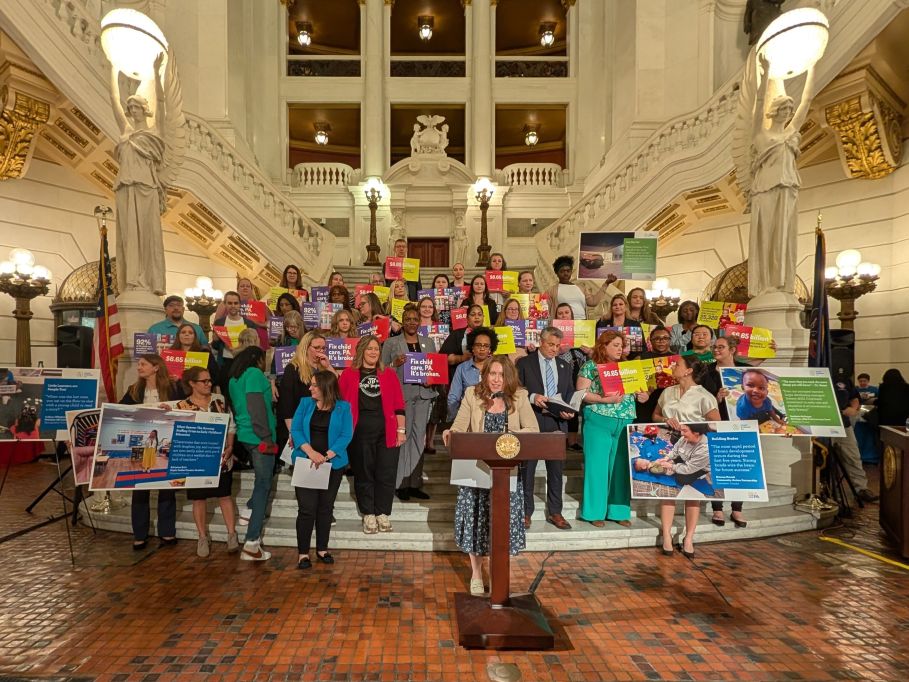
Additionally, we are still in the midst of Pennsylvania state budget negotiations for Fiscal Year 2025-2026 where we have the opportunity to establish a new “line item” in the Department of Human Services’ budget for the child care workforce. 

As we navigate the ongoing developments and policy implications at the federal and state level, the Trying Together policy team stands as a steadfast resource for your questions and concerns. In solidarity with the early learning community, we are here to help make sense of the information and collaborate on meaningful action.  

Take Action

It’s important that we keep working together to ensure policy makers hear from us that child care needs strong public investment. Your voice can make a difference – and we need your help in the final days of budget negotiations to make sure the Pennsylvania General Assembly hears how important the $55 million is for children, families, educators, and businesses. Email your legislators today and urge them to support Gov. Shapiro’s $55 million child care workforce investment as they negotiate the final budget.
Guide Provides Information on Bringing Learner-Centered Practices Into Classrooms

News

Guide Provides Information on Bringing Learner-Centered Practices Into Classrooms

KnowledgeWorks has released a new resource for school districts looking to bring more learner-centered practices into its classrooms using Pennsylvania state education policies.

Learn More

KnowledgeWorks’ Pennsylvania Innovation Guide for Personalized Learning provides context for state policies, such as descriptions of statutes and regulations.

The guide’s introduction notes that parents and students believe that schools need to do a better job ensuring that learners attain the durable skills necessary to respond to rapid changes in their communities and the economy.

Pennsylvania has established policies and structures to facilitate this transformation, the guide says, and enable schools and districts to consider how to best personalize learning for students.

Personalized learning, the guide notes, involves empowering learners and providing experiences to help them find relevance and meaning in their educational journey. It creates opportunities for learners to explore their interests and passions through experiences that are meaningful to them.

In the guide, personalized learning is described as having six key components:

  • Empowered learners
  • Flexible learning environments
  • Learner relationships
  • Relevant learning experiences
  • Equitable learner supports
  • Demonstration of learning

To learn more, check out KnowledgeWorks’ Pennsylvania Innovation Guide for Personalized Learning.

Trying Together, ELRC Region 5 Offering August and September Professional Development Courses

News

July 7, 2025

Trying Together, ELRC Region 5 Offering August and September Professional Development Courses

Trying Together and ELRC Region 5 are offering a variety of professional development opportunities for early childhood educators in August and September as the 2025-26 school year begins.

Learn More

Trying Together will offer Introduction to ASQ-3 on Tuesday, Aug. 5 at 6 p.m. and Saturday, Sept. 27 at 9 a.m. The course, which is free for Allegheny County providers, teaches participants how to use ASQ-3 as a screening tool for children ages 3 months to 5 years. The session provides information on why a developmental screening tool is administered for early childhood programs, how to administer and score the screener, strategies for sharing results with families of diverse backgrounds, and supporting resources for making referrals to additional services.

ELRC Region 5 will hold a Supervision 101 class on Thursday, Aug. 7 at 6:30 p.m. This live webinar will give a foundational overview of supervision in licensed early childhood programs. The course will focus on the supervision aspects of the DHS Certification Regulations for child care in Pennsylvania. The session will also focus on ratio, scenarios, and the importance of supervision in child care.

Trying Together and ELRC Region 5 will offer American Red Cross First Aid, Pediatric First Aid, CPR, and AED training on Monday, Aug. 11 at 10 a.m. and Friday, Sept. 19 at 9 a.m. This PQAS-certified in-person course provides life-saving skills in alliance with The Occupational Safety and Health Administration (OSHA)’s Best Practices for Workplace First Aid Training Programs. The cost is $70.

Trying Together will host Introduction to ASQ:SE-2 on Tuesday, Aug. 12 at 6:30 p.m. Attendees should have already taken the ASQ-3 professional development prior to this training. Attendees will learn how to use the ASQ:SE-2® as a social-emotional developmental screening tool for children ages 3 months to 5 five years.

On the third Wednesday of every month, Trying Together hosts Growing Together, a professional development series focused on frequently requested topics relating to early childhood educators. The Wednesday, Aug. 20 session will be Resilience in the Classroom – What to Do When Things Fall Apart, while the Wednesday, Sept. 17 session is Supporting Immigrant and Refugee Families. Both begin at 6:30 p.m.

ELRC Region 5 will offer FLIP IT® on Thursday, Sept. 4.  The course is a strategy that offers a simple, kind, strength-based, common sense, and effective four-step process to addressing children’s day-to-day challenging behaviors. The four steps embodied in FLIP IT are F (Feelings), L (Limits), I (Inquiries), P (Prompts).

Kidsburgh Provides Heat Safety Tips for Children This Summer

News

Kidsburgh Provides Heat Safety Tips for Children This Summer

While summer is a great opportunity to convince children to play outside, caregivers should also keep in mind health and safety tips for spending long periods of time in the sun, especially during a heatwave.

Learn More

When the heat index is above 90 degrees – as it has been recently in the Pittsburgh region – it poses a significant health risk for children, Kidsburgh wrote in a recent post on heat and sun safety.

Children are much more susceptible to heat illness than adults as they have more trouble regulating body temperature. As a result, extreme heat can cause them to experience dehydration, heat exhaustion, or heat cramps or stroke. Some of these ailments can become medical emergencies.

According to Kidsburgh, approximately 9,000 high school athletes are treated for heat illness every year around the nation.

In a recent interview with Kidsburgh, Dr. Joe Aracri, chairman of the AHN Pediatric Institute, provided advice for parents of young children about sun and heat safety. His tips included:

  • Use sunscreen, but for children under the age of six months it should not be used all over the body, but rather just the hands, feet, and face. 
  • For the areas not covered with sunscreen, cover the baby’s body with lightweight clothing and always use a hat.
  • Keep babies in the shade as much as possible to avoid too much sun exposure.
  • Put on sunscreen a half-hour before going into the sun so it can absorb and be effective once you go outside. Then, reapply it every two hours and after swimming.
  • Keep children well hydrated with cool water and other hydrating beverages.
  • Keep children indoors in a cool environment. If air conditioning isn’t available, have a fan circulating the air where a child is sleeping or playing.
  • For asthmatic children, parents should look out for such signs as coughing, wheezing, and shortness or breath, and ensure that inhalers and allergy medications are immediately available.
  • If a child is having trouble breathing, go to your local emergency department.

To read the entire article, visit Kidsburgh’s website.

Child Mind Institute Shares Resources on Setting Screen Time Rules for Summer

News

Child Mind Institute Shares Resources on Setting Screen Time Rules for Summer

As summer temperatures heat up, parents will likely want to encourage their children to spend more time outside and hope that they’ll spend less time thinking about screen time.

The Child Mind Institute has put together a list of resources on how to make effective rules for screen time during the summer.

Learn More

Most parents will want to limit their children’s screen time and, more importantly, not spend much of the summer arguing about it.

The Child Mind Institute has shared tips for identifying the tech-related harms that parents will want their children to avoid as well as the activities they’ll want to encourage. It also discusses how to make a practical plan to achieve both objectives.

The resources include recommendations on screen use for children who are neurodivergent and strategies to keep children reading over the summer. The Child Mind Institute proposes ways to provide the structure that children with ADHD need to thrive while on summer vacation.

Lastly, the resources explore how parents should not be afraid to let their children become bored because there are lessons they can learn from it.

Here are The Child Mind Institute’s resources on how to approach screen time for children during the summer:

For more information, visit The Child Mind Institute’s website.

June Recalls on Children’s Products

News

July 3, 2025

June Recalls on Children’s Products

Below is a list of June recalls from the following federal agencies: the Consumer Product Safety Commission, the Food and Drug Administration, and the National Highway Traffic Safety Administration.

June Recalls

  • Medtech Products recalled five lots of Little Remedies Honey Cough Syrup due to the presence of Bacillus cereus and loss of shelf-stability. Bacillus cereus can cause food-borne illness that can result in nausea, vomiting, stomach cramps, and diarrhea.
  • ZRWD recalled its infant swings due to suffocation hazards. The swings posed a deadly suffocation risk because they were marketed for infant sleep and they have an incline greater than 10 degrees. Additionally, the remote control for the swing contains a lithium coin battery, which if ingested can cause serious injuries, chemical burns, and death.
  • Shantou Haochencheng hobby toy hammer ball sets sold on Amazon were recalled due to choking hazards. The toy sets contain small balls that violate regulations for toys intended for children under three years of age.
  • Zhorange recalled its portable bassinets due to the risk of serious injury or death from a fall. The bassinets violate federal safety standards for infant sleep products because the sides are too low to contain the infant and the portable bassinets do not have a stand, which poses a fall hazard.
  • Ravmix recalled its portable hook-on chairs sold on Amazon due to risks of serious injury or death from falling. The chair poses a deadly fall hazard because the crotch restraint can be removed without the use of a tool and infants can fall through an opening.
  • Funlio recalled its convertible high chairs due to risks of serious injury or death from falling or being entrapped. The chairs pose a deadly entrapment hazard because the opening between the seat and tray is large enough that a child can become entrapped in it. Additionally, the child restraint system can fail, posing a fall hazard.
  • Bugaboo North America recalled its giraffe high chairs because they pose a fall hazard and risk of serious injury or death to babies. The legs of the chair can detach from the frame if the screws connecting the legs are not properly tightened during assembly.
  • Endless Pools recalled its manual retractable pool covers due to drowning and entrapment hazards. The pool covers can leave a gap of more than 4.5 inches between the cover roller and the pool surface, when installed incorrectly. Improper installation can result in the covers not conforming to the voluntary industry standard, posing drawing and entrapment hazards to children. 
  • YaFiti recalled its white dressers due to tip-over and entrapment risks. The dressers are unstable if they are not anchored to the wall and can result in injuries or death to children.
  • TADAKAZU recalled its baby loungers because its sides are shorter than the minimum side height limit to secure infants, the sleeping pad’s thickness exceeds the maximum limit, and an infant could fall out of an enclosed opening at the foot of the lounger or become entrapped.
  • iHerb recalled bottles and blister packs of California Gold Nutrition Iron Supplements because they failed to meet federal standards for child-resistant packaging. The supplements contain iron but are not in child-resistant packaging, posing a risk of poisoning if swallowed by young children.
  • LED fireplace lanterns have been recalled because they violate mandatory federal standards for consumer products containing button cell or coin batteries. The lithium coin battery can be accessed easily by children, posing an ingestion hazard.
  • Boyro recalled baby walkers because they violate the federal safety standard for infant walkers. The walkers can fit through a standard doorway and fail to stop at the edge of a step as required, posing a risk of serious injury or death due to a fall hazard.
  • Peg Perego recalled its Tatamia 3-in-1 recliners, swings, and high chairs due to risk of suffocation. The products have an incline angle greater than 10 degrees.

Vodcasts on Water Safety, POC Training Available for PA Providers

News

July 2, 2025

Vodcasts on Water Safety, POC Training Available for PA Providers

Two new vodcasts are available for early childhood education providers on the topics of water safety and plan-of-correction (POC) training.

Learn More

The first vodcast – Swimming, Wading, Water Activity Provider Training – is a 40-minute video that reviews regulatory requirements surrounding water activity as outlined in the Pennsylvania code. However, the vodcast does not satisfy requirements for water safety instruction.

The other vodcast – Provider Tiered POC Training – is a nine-minute video that explains how a tiered LIS includes a directed plan of correction that requires more than one step to come into compliance for one area of regulatory non-compliance. The tiered summary video walks viewers through the process of completing tiered LIS training. A tiered POC tip sheet was provided for providers as an additional resource.

Both vodcasts and other information about operating a child care facility can be found on the state’s Early Childhood Education page.

YWCA’s Action Conversations Aim to Create Change in Pittsburgh Communities

News

YWCA’s Action Conversations Aim to Create Change in Pittsburgh Communities

The YWCA Greater Pittsburgh’s Center for Race & Gender Equity will host Action Conversations with local experts and leaders on the third Wednesday of the month. The conversations are designed to build community and create change.

Learn More

The conversations will be broadcast on Zoom from noon to 1 p.m. on the third Wednesday of each month. Participants are encouraged to contribute questions and comments during the discussions.

The next conversation, Public Transportation, will take place on Wednesday, July 16. It will focus on how proposed funding cuts jeopardize Pittsburgh’s capacity to cultivate an equitable public transit system that is affordable and accessible to all.

Eliminated routes and increased fares would disproportionately harm communities of color, disabled people, and low-income neighborhoods. Panelists will discuss the importance of sustainable public transit, why transportation is an intersectional issue, and how riders and advocates can take action to achieve transit equity.

Those interested in participating as a panelist or contributing a topic idea for an Action Conversation should contact Adale Sholock at asholock@ywcapgh.org. Registration is now open.

DEP Offering Lead Testing Grants to Schools and Child Care Facilities

News

July 1, 2025

DEP Offering Lead Testing Grants to Schools and Child Care Facilities

The state Department of Environmental Protection is offering lead testing grants to schools and child care facilities.

Learn More

Child care facilities and schools located in Pennsylvania with lead in drinking water sample results within 36 months of the application date showing water fixtures exceeding the remediation trigger level of 5 parts per billion may apply.

Reduction activities from the grant may include purchasing and installing hydration stations, point-of-use devices designed to remove lead, or replacement of faucets. The goal of the grant program is to reduce children’s exposure to lead in drinking water.

Funding for the grant has been appropriated under the federal Safe Drinking Water Act. Those who receive grants will be provided with up to $3,000 per hydration station per 100 students in one building. Up to $30,000 may be awarded per building or child care facility, while $100,000 may be given per school district.

Those interested in applying are encouraged to schedule a pre-application meeting to discuss their lead reduction plans to ensure they meet applicable program criteria. Meetings can be scheduled by emailing RA-EPWIINLEAD@pa.gov. 

More information on the grant can be found on the DEP’s website.

OCDEL Releases Announcement on NAEYC Accreditation Standards, Keystone STARS Alternate Pathways

News

OCDEL Releases Announcement on NAEYC Accreditation Standards, Keystone STARS Alternate Pathways

The Pennsylvania Office of Child Development and Early Learning (OCDEL) has released an announcement regarding changes to the National Association for the Education of Young Children (NAEYC) accreditation standards and system and implications for Keystone STARS Alternate Pathways.

Learn More

The announcement shares information on how changes to NAEYC will affect early care and education providers using NAEYC accreditation as a Keystone STARS, OCDEL-approved, Alternate Pathway to a STAR 4 designation.

As of March 3, NAEYC began using a new tiered system of accreditation. The three tiers included:

  • Recognition: NAEYC defined this as the first step to high quality. It requires a documentation review, and a one-year term is renewed annually.
  • Accreditation: Requires a documentation review and there is potential for a random site visit. It has a five-year term with annual reporting required.
  • Accreditation +: This requires a documentation review and site visit, and there’s potential for a random site visit. This has a five-year term with annual reporting required.

Impact of Accreditation Changes on STARTS Designation

Following an internal review of NAEYC’s new accreditation standards and tiers, OCDEL established that the Accreditation + tier will be acknowledged as an approved Alternate Pathway to a STAR 4 designation.

The NAEYC tiers of Recognition or Accreditation will not serve as OCDEL-approved Alternate Pathways to higher STARS designations.

Programs that are currently NAEYC accredited will transition to the Accreditation + tier and will not see any impact on their STAR 4 Alternate Pathway designation. If these programs experienced a drop in their NAEYC accreditation status to one of the lower tiers, they would also be designated as a STAR 1.

Programs that want to move up in STAR levels can do so by using the Keystone STARS Performance Standards or achieving the highest NAEYC accreditation tier of Accreditation +. Programs using an OCDEL-approved Alternate Pathway to a higher STAR level must complete all requirements for Keystone STARS as explained in the ELRC Policy Announcement 21 #08.

Next Steps

All programs currently using or planning to use NAEYC as an Alternate Pathway to a STAR 4 designation should:

  • Review the information contained in the OCDEL announcement.
  • Complete any upcoming Keystone STARS designation renewals as required.
  • Review their current Accreditation VUD to determine their NAEYC renewal status. For questions regarding NAEYC standards, assessments or processes, email accreditation.information@naeyc.org or call 1-800-424-2460.
  • Programs are encouraged to discuss their Keystone STARS designation with their quality coach.

ELRCs should review the information in the OCDEL announcement and direct any questions to their program representative.