News

October 29, 2021

Search for Child Care in Your School District

The Allegheny Child Care Finder Tool now has a new filter to search for available child care in your school district. When navigating the finder tool, the school district filter can be found by choosing “More Filters”.

About Allegheny Child Care

Allegheny Child Care is a unique pilot project that was developed to support the care and education needs of families. Caregivers and parents of young children can search available spots at all early learning, after school, summer camp, and virtual programs in Allegheny County in real-time with the Allegheny Child Care, After School, and Summer Camps finder tool.

The Allegheny Child Care initiative is: managed by Trying Together in partnership with the Allegheny County Department of Human Services, and Allegheny Partners for Out-of-School Time (APOST, an initiative of the United Way of Southwestern PA); with additional support from the City of Pittsburgh; and was developed in collaboration with Child Care Aware of AmericaThe Heinz Endowments, and technology partners BowtieBrightHive, and BridgeCare.

Additional Information

For additional support in finding care and education environments and with funding needs, visit the Early Learning Resource Center (ELRC) Region 5 website or call 412.350.3577.


News

October 20, 2021

Child Care Career Openings in the Pittsburgh Area

Are you looking for open child care positions? Early learning programs in the Greater Pittsburgh Area are hiring! See this week’s featured jobs.


Child Care Positions in Pittsburgh


 Pre-K Counts Lead Teacher

Heritage Community Initiatives is seeking a Pre-K Counts Lead Teacher to provide high quality programming within their assigned classroom of 3-5 year old children. All lesson plans must be based on each individual child’s goals that come from the GOLD assessments and daily observations. The Pre-K Counts Lead Teacher must also be consistent and intentional with helping children learn and develop through play.

 Pre-K Counts Assistant Teacher

Heritage Community Initiatives is seeking a Pre-K Counts Lead Teacher to provide high quality programming within their assigned classroom of 3-5 year old children. All lesson plans must be based on each individual child’s goals that come from the GOLD assessments and daily observations.

 Director – University of Pittsburgh Child Development Center

The University of Pittsburgh is seeking a Director of the Child Development Center. The position will plan, organize, and direct quality early childhood education programs for up to 100 children and their families. The successful candidate will respond to the University’s academic needs by providing laboratory, research, and practicum experiences to University students, faculty.


Submit a Job

Each week, Trying Together highlights employer-submitted jobs on our website, social media, and in our newsletter.

All jobs submitted after Tuesday each week will be published in the following week’s news post. Publication dates may vary due to state and federal holidays. Unrelated jobs will not be included.

For questions, contact Kara Bayer at kara@tryingtogether.org.


Other Jobs in Early Childhood


ECE Hire

Visit the ECE Hire website to view early childhood education job listings and helpful tips on interviewing, resumes, and more.

Submit a Job to PACCA

Pennsylvania Child Care Association (PACCA) offers a Job Board for its members to post jobs for free and sends out submitted jobs via their Facebook page and e-newsletter. PACCA members can submit jobs online after signing into their membership account. For questions, contact Maureen Murphy at maureen.murphy@pacca.org.


Receive Jobs in Your Inbox

To receive the latest job opportunities, subscribe to our newsletter and follow us on Facebook.

News

September 22, 2021

Free or Reduced-Cost Lead Testing

Individuals who have concerns about lead levels in their water supply may be eligible to receive free or reduced-cost assessments of paint, dust, soil, and water.

Obtaining an Assessment

As part of the local “Get the Lead Out, Pittsburgh” initiative, coordinated by the nonprofit Women for a Healthy Environment, individuals may be eligible for a free or reduced-cost lead risk assessment.  Fill out this form to register.

The Allegheny County Health Department also provides some free resources to qualifying households. These resources include blood lead level testing for children who are uninsured or underinsured and free full home lead assessments for households with children whose blood lead levels are elevated by the Center for Disease Control’s standards (above 5 ppb). The ACHD’s “Get Ahead of Lead” resource list contains more information and instructions for who to contact.

Additional Information

Individuals who are not able to qualify for free or reduced-cost can access a list of water authorities that said they offer or help to facilitate residential drinking water tests. Public Source Pittsburgh has information on how to read these findings and private companies who perform lead tests.

News

May 10, 2021

Grandparent Council

Become an Advocate for Young Children

The Grandparent Council helps to ensure that all young children receive high-quality care and education. Members meet monthly through virtual Zoom meetings to:

  • learn more about the importance of an early childhood education;
  • receive guidance and support in identifying high-quality early learning environments; and
  • learn how to advocate for the well-being of all children in our communities.


Join the Council

To join Trying Together’s Grandparent Council, please complete and submit the sign-up form.

Submit The Online Form


Other Ways to Sign-Up

If you would like to submit the form via mail, please print, fill-out, and mail this form (PDF) to: ATTN: Grandparent Council 5604 Solway Street Pittsburgh, PA 15217. If you would like to submit the form via email, please print, scan, and email this form (PDF) to info@tryingtogether.org.


Courses

Zoom 101

Presenter: Peter Sloan Navigating technology in our new virtual reality can sometimes be very challenging. This Zoom training will provide a brief overview of how to properly use the Zoom platform, along with tips and tricks to help everyone become more technologically savvy.

Zoom Training from Trying Together on Vimeo.

Grandparent’s Council Introduction and Advocacy 101

Presenters: Emily Neff and Lindsey Ramsey This workshop gives an overview of the origin and need for grandparent advocacy in our region. Participants will receive an overview of the Early Learning Pennsylvania (ELPA) campaigns, how ECE programs are impacted by the budget process and ways professionals and families can use their experience and knowledge to advocate. Participants should leave with foundational knowledge of the ELPA campaigns, and various advocacy actions they participate in or lead, and guidance on how to complete the mandated reporter training.

Grandparent’s Council Introduction and Advocacy 101 from Trying Together on Vimeo.

Developmentally Appropriate Practice and the Importance of Play

Presenters: Cristina Codario and Lainey Yockey As grandparents and caregivers of all types spend quality time with the young children in their lives, it is important to make every moment count! Young children need to engage in developmentally appropriate activities to ensure healthy development. This training will provide an overview of child brain development and the interactions and best practices that are needed to support it. We will also discuss the importance of play for children and provide caregivers with family resources to help support them along their journey.

Developmentally Appropriate Practice and the Importance of Play from Trying Together on Vimeo.

The Early Learning Landscape and Relative Providers

Presenter: Bliss Letang The Early Learning Landscape in Pennsylvania is full of care options for our little learners. Caregivers even have the opportunity to become “Relative Providers” for children who are receiving subsidized child care. This training will outline the care options available for children and families in our region along with giving detail on the steps it takes to become a “Relative Provider”.

The Early Learning Landscape from Trying Together on Vimeo.


More Information

For questions contact Lindsey Ramsey, Public Policy Regional Coordinator by calling 412.567.4173 or emailing lindsey@tryingtogether.org.

News

January 11, 2021

Fund My Future Information Session

Attend this online information session to learn about Fund My Future, a savings program that offers chances to win prizes and cash in monthly raffle drawings by depositing small amounts into your child’s savings account.

About

With the support from the Pennsylvania State Treasurer, Fund My Future is now available to all families in Pennsylvania to save for college and other post-secondary goals. Fund My Future provides a prize pool that makes the saving experience fun. This program is open to Pennsylvania residents who have children or grandchildren between the ages of birth to 18. Your child will benefit from the savings, and you benefit from the fun! Participants will have the chance to win a door prize.

Registration

To register, complete the online registration form.

More Information

For questions, please contact Fund My Future at 833.728.3946 or via this online form.

News

December 24, 2020

Housing Resources for Families in Allegheny County

If your family is at risk for eviction, local resources and programs are available to help.


Housing and Eviction Resources

Housing Stabilization Program

The Urban Redevelopment Authority’s Housing Stabilization Program provides one-time or short term (up to three months) financial assistance to households who are facing a temporary, non-reoccurring housing crisis. Depending on which type of support is needed, you may be able to receive funding to cover move-in fees, utilities, rent, mortgage payments, and legal fees.

Eligibility

To qualify, individuals must:

    • be a renter or homeowner,
    • live in the City of Pittsburgh,
    • develop a stability plan with a service provider.
Apply For This Program

If you are eligible, contact United Way by dialing 211 or texting your zip code to 898.211. Interested applicants may also contact United Way via chatroom (located at the bottom right of the webpage) or the online contact form.


Housing Legal Assistance Program

The Housing Legal Assistance Program assists individuals through the following services:

    • Tangled-Title: Legal assistance of up to $5,000 if you own a home but need the deed transferred to your name.
    • Eviction Prevention: Legal assistance of up to $3,000 if you are at risk of eviction or are currently experiencing eviction and need legal assistance.
Eligibility

To qualify for Tangled-Title assistance, individuals must live in the City of Pittsburgh, have an income that is at or below 80 percent of the Average Monthly Income, and not have any outstanding City, School, and County real estate taxes (or must be on a payment plan for at least three months.

To qualify for Eviction Prevention assistance, individuals must live in the City of Pittsburgh, have an income that is at or below 50 percent of the Average Monthly Income, and be experiencing wrongful threats of lock-out, eviction, or sub-standard living conditions.

Apply For This Program

To apply for Tangled-Title assistance, contact United Way by texting your zip code to 898-211 or by dialing 211. To apply for Eviction Prevention, call 412.255.6574 or email hof@ura.org.

For more information, contact Victoria Jackson at 412.255.6696 or hof@ura.org.


Just Mediation Pittsburgh

Just Mediation Pittsburgh offers free, confidential mediation services to landlords and tenants who are looking to find solutions to housing disputes. Just Mediation Pittsburgh mediators facilitate a dialogue between both parties to identify positive solutions and create a shared, legally binding agreement.

Request Services

Participation in these services is voluntary. Both parties must be willing to share their perspectives, listen to the other individual’s perspective, and create constructive solutions. To request services, visit the Just Mediation Pittsburgh page. For more information, contact 412.228.0730 or info@mysite.com.


Allegheny Link

If you are experiencing a housing crisis, the Allegheny Link can help connect you to resources. The Allegheny Link will assess your eligibility for homeless supports such as rental assistance, utility assistance, and homeless services.

Range Of Services

The Allegheny Link assists Allegheny County residents:

    • who are experiencing or at risk of homelessness in finding stable housing,
    • who are pregnant, or parents and caregivers of children up to age six years of age, get referrals to home visiting programs,
    • who are over the age of 60 live safely in their community, and
    • with any disability find services that meet their needs.
Contact

If you are in need of services, contact the Allegheny Link at 1.866.730.2368. This line will be open Monday through Friday from 8 a.m. to 7 p.m. Callers between 7 p.m. and 8 a.m. will be directed to appropriate supports by an automated message. Individuals can also contact the Allegheny Link via email. This method is especially suggested for individuals who are deaf or hard of hearing.


Rental Payment Assistance

The Department of Public Assistance has an Emergency Shelter Fund that provides financial assistance to help individuals prevent eviction or foreclosure, obtain permanent housing, or obtain temporary shelter. Individuals must be receiving public assistance benefits to qualify. For more information, contact 412.565.2146.


Fair Housing Partnership of Greater Pittsburgh, Inc.

Do you feel you have been the victim of housing discrimination? Fair Housing Partnership of Greater Pittsburgh investigates allegations of housing discrimination. If you have been a victim of housing discrimination, all of their services are free of charge.

Report Discrimination

To file an anonymous complaint, or to speak with a member of their staff, call 412.391.2535. Individuals can also report discrimination by completing this online form.


Shelter Directory

Pennsylvania’s Education for Children and Youth Experiencing Homelessness (ECYEH) Program has a Shelter Directory on its website that contains a filterable list of emergency shelters and housing providers. Shelters and providers included on the list accept homeless families and/or homeless youth. Some shelters and providers may admit single adults. Access the Directory.


More Information

Visit the Allegheny County website to learn more about housing subsidies, mortgage assistance, homelessness, discrimination support services, and more. If you are an individual experiencing homelessness, visit the Homeless Services page.

News

December 17, 2020

COVID-19 Interim Vaccination Plan for Pennsylvania

On December 11, 2020, the Pennsylvania COVID-19 Vaccine Task Force and Pennsylvania Department of Health released a COVID-19 Interim Vaccination Plan for Pennsylvania (PDF). The goal of the interim COVID-19 vaccination plan is to provide a transparent strategy to vaccinate all Pennsylvanians who want to be vaccinated so that Pennsylvanians can return to everyday activities as quickly and safely as possible.

At this time, early childhood education professionals including teachers, school staff working directly with students, child care employees, and early intervention staff fall under the 1B category (page 14), defined as essential business personnel who cannot work remotely or maintain social distancing.

A variety of factors influence the distribution of vaccinations, including vaccine supply levels, number of critical personnel requiring the vaccine, and vaccine storage requirements. The vaccine supply is projected to increase quickly over the proceeding months, allowing vaccination efforts to be expanded to additional critical populations and the general public. It is important to note that recommendations on the various population groups to receive initial doses of the vaccine could change after the vaccine is available, depending on each vaccine’s characteristics, vaccine supply, disease epidemiology, and local community factors. The Pennsylvania Department of Health will follow the U.S. Centers for Disease Prevention and Control (CDC) ACIP recommendations in identifying populations of focus.

More Resources for COVID-19

To best support these community members and the young children in their lives, Trying Together has created two resource lists, featuring helpful resources that families and educators can use to maneuver this difficult time.

For more information about COVID-19, visit the Allegheny County Health DepartmentWorld Health Organization (WHO), or Centers for Disease Control and Prevention websites.

News

December 16, 2020

Safe and Healthy Homes Program in Allegheny County

Would you like to receive a free visual inspection of your home to check for potential health or safety hazards? Apply for the Allegheny County Health Department’s Safe and Healthy Homes Program!

About

The Allegheny County Health Department’s Safe and Healthy Homes (SHHP) Program provides free in-home health and safety assessments to qualified participants in Allegheny County, as well as Beaver, Washington, and Westmoreland counties. The purpose of this program is to reduce hospitalizations, injuries, illnesses, or deaths from preventable home health or safety hazards.

The program will include a free visual inspection for potential dangers in the home such as asthma triggers, allergens, mold, moisture, inadequate ventilation, lead-based paint, pest infestations, fall hazards, and child safety hazards. The program will also offer educational materials, information on follow-up medical care if threats to health are identified, and referrals to community organizations that can offer further assistance.

Eligibility

To qualify, households must:

    • include at least one pregnant woman or a child/dependent under the age of 22,
    • live in Allegheny, Beaver, Washington, or Westmoreland counties.

Application

To apply, complete the online application. Individuals may also apply by calling 412.350.4048.

More Information

For more information, visit the Allegheny County Health Department website. A Healthy Homes Maintenance Checklist is also available. Share this brochure with your network.

Information provided by the Allegheny County Health Department. 

News

December 15, 2020

Hotspots Available in Allegheny County

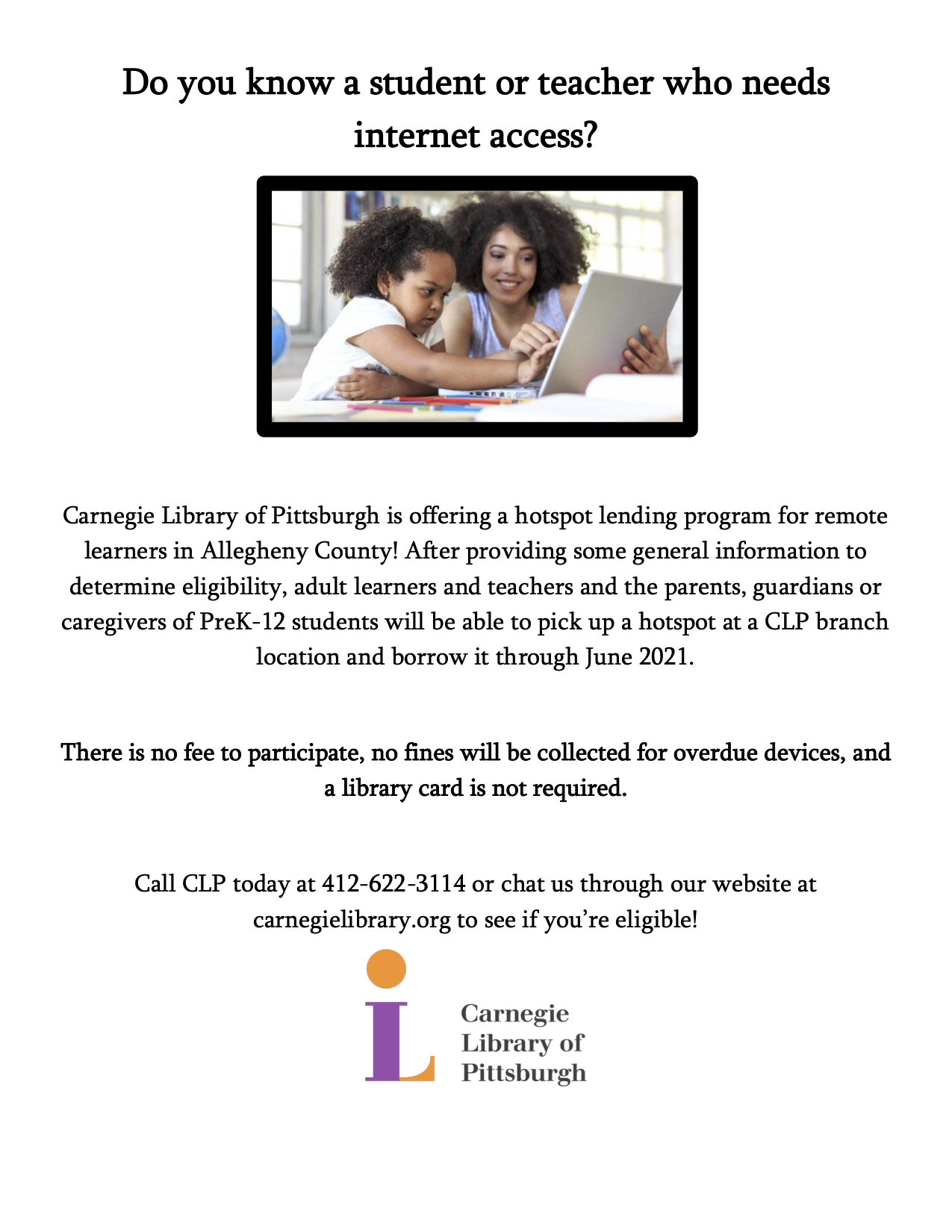
Do you know a student or teacher who needs internet access? The Carnegie Library of Pittsburgh is offering a hotspot lending program for remote learners in Allegheny County!

About

After providing general information to determine eligibility, adult learners, teachers, and the parents, guardians, or caregivers of PreK-12 students will be able to pick up a hotspot at a Carnegie Library of Pittsburgh branch location. Participants will be able to borrow the hotspot through June 2021.

More Information

For more information, call the Carnegie Library of Pittsburgh at 412.622.3114 or use the chat function offered on their website. Share this flyer with your network.

News

December 3, 2020

COVID-19

Due to the COVID-19 pandemic, children, families, and early learning professionals have had to transition to new methods of work, play, interaction, and learning. To offer support, Trying Together is providing updates on the status of COVID-19, available resources, and more.

If you are interested in learning more about COVID-19, including information on symptoms, testing, and infection rates, please visit the Pennsylvania Department of Health website. To view additional resources for families and early childhood professionals, please continue reading below.


COVID-19 Resources

To best support these community members and the young children in their lives, Trying Together has created two resource lists, featuring helpful resources that families and educators can use to maneuver this difficult time.

Guidance for Pennsylvanians

As of May 31, COVID mitigation orders are lifted in Pennsylvania. The order requiring universal face coverings was lifted statewide on June 28, 2021. The Pennsylvania Department of Health still urges Pennsylvanians to follow CDC guidance on wearing masks where required by law, rules, and regulations, including healthcare, local businesses, and workplace guidance.

Meals for Children

The Summer Food Service Program distributes free Grab ‘n Go Meals to children at 13 CitiPark and 34 partner locations in Pittsburgh. Meals are available to children up to the age of 18, and to individuals with disabilities up to 21 years old. This program runs from June 11 through August 13, 2021 (dates vary by location). To learn more, visit the program webpage or call 412.571.3291.


What is COVID-19?

According to the Allegheny County Health Department (ACHD), “COVID-19 is a disease caused by a new coronavirus not previously seen in humans.” While this strain of coronavirus is new, coronaviruses are actually a large family of viruses, some causing illness in people and others circulating among animals, including camels, cats, and bats. While it is rare for animal coronaviruses to infect people who are exposed to infected animals, it has happened in the past as seen with Middle East Respiratory Syndrome (MERS-CoV) and Severe Acute Respiratory Syndrome (SARS-CoV).

COVID-19 Vaccines

Currently, all Pennsylvanians age 12 and older are eligible to receive a COVID-19 vaccine. For more information on where you can get vaccinated, vaccine safety, and more, visit the Pennsylvania Department of Health website. For questions about COVID-19 vaccines, call the PA Health Hotline at 1.877.724.3258.

Symptoms

As COVID-19 is a respiratory disease, common symptoms of infection include fever, dry cough, tiredness, shortness of breath, and difficulty breathing. However, WHO states that some patients may have aches and pains, nasal congestion, runny nose, sore throat, and diarrhea. After being infected with COVID-19, individuals generally display mild symptoms that begin gradually, but some people who become infected may not develop any symptoms at all and may feel healthy.

80 percent of the individuals who become infected recover from the disease without needing special treatment. However, one out of every six people who get COVID-19 becomes seriously ill and develops difficulty breathing. Elderly individuals, immunocompromised individuals, and individuals with underlying medical conditions such as high blood pressure, cardiovascular disease, chronic kidney diseases, hepatitis B, and cancer are particularly at risk of developing serious illness if infected with COVID-19. Because of this, it’s important to limit possible contamination and reduce the spread of the virus.

How It Spreads

COVID-19 spreads through person-to-person contact (within about six feet) or by touching your mouth, nose, or eyes after coming into contact with surfaces that have been contaminated with respiratory droplets produced when an infected person coughs or sneezes. WHO states that “studies suggest that coronaviruses (including preliminary information on the COVID-19 virus) may persist on surfaces for a few hours or up to several days.”

The risk of getting infected by COVID-19 depends on where you are and if there is an outbreak currently happening in that area. Individuals living in or visiting cities or areas that are experiencing an outbreak have a higher risk of becoming infected. There is a higher risk of infection and serious complications for elderly individuals, immunocompromised individuals, and individuals with underlying medical conditions. With this, WHO states that it’s important to “comply with any local restrictions on travel, movement, or large gatherings” and to cooperate with disease control efforts to reduce your risk and potential spread.

How to Protect Yourself and Others

Currently, the most effective ways to reduce the spread of COVID-19 to protect both yourself and others against infection are to:

    • receive a COVID-19 vaccine if you are able to do so;
    • avoid touching your face, nose, and mouth;
    • if water and soap are not available, sanitize your hands regularly with an alcohol-based hand sanitizer that contains at least 60% alcohol;
    • clean and disinfect commonly used items and frequently touched surfaces such as the items listed above with household cleaners and EPA-registered disinfectants that are appropriate for the surface, following the label directions appropriately;
    • practice social distancing from others, especially avoiding individuals who are exhibiting symptoms, coughing, or sneezing;
    • wear a face mask when shopping at essential businesses, visiting your health care provider, on public transportation, interacting with others at essential business, and when feeling sick, coughing, or sneezing; and
    • comply with any local restrictions and recommendations on travel, movement, or large gatherings.

Visit the CDC website for more information on how to properly clean and disinfect the areas around you. While this resource is primarily intended for individuals and households with suspected or confirmed cases hygienic practices can help reduce the spread of the virus. Watch this video for proper handwashing techniques.

RESOURCE FOR AT-RISK INDIVIDUALS

The CDC also has a resource highlighting precautions and preparation tips for individuals at risk of developing serious complications from COVID-19, such as elderly individuals, immunosuppressed individuals, and individuals with underlying medical conditions. Visit the CDC website to learn more.

What to Do After Infection

If symptoms are mild:

Most people with mild COVID-19 symptoms can recover at home. To get tested for COVID-19, find a testing location near you or contact your health care provider. If you do not get tested, stay home, isolate yourself, and avoid contact with others. People who test positive for COVID-19 should self-isolate in their home for 14 days, or 10 days if they are not experiencing symptoms. People living with you will also need to quarantine unless they are fully vaccinated.

Wear a tight-fitting mask if you must be around others and make a list of people you have come into close contact with (within six feet) from two days before testing positive. Close contacts should monitor for any symptoms for 14 days after exposure. If symptoms become worse, contact a healthcare provider. For information about isolating, quarantine periods, and more, read this document from the Pennsylvania Department of Health.

If symptoms are severe:

If you are experiencing severe symptoms (including a fever above 100 degrees Fahrenheit), call your healthcare provider or the nearest hospital/urgent care to schedule an appointment. If it is an emergency, call 9.1.1. Signs of an emergency include trouble breathing, new confusion, persistent pain/pressure in the chest, inability to wake or stay awake, and/or bluish lips/face.

For more information, visit the Pennsylvania Department of Health website or CDC website.

More Information

For more information about COVID-19, visit the Allegheny County Health DepartmentWorld Health Organization (WHO), or Centers for Disease Control and Prevention websites.