News

July 28, 2019

Response: Pennsylvania Fiscal Year 2019-20 Budget

Recently, the state finalized the budget for fiscal year 2019-20, running now through June 30, 2020.

About

Alongside monumental increased investments for pre-k and home visiting, child care line items expanded, but only due to increases in funds from the federal government that are appropriated (or allowed to be spent) in the new state budget. Meanwhile, state child care dollars were cut by $36 million and replaced with federal funds.

While Trying Together is excited by the growth of pre-k and home visiting, this budget was a missed opportunity to support greater access to and affordability of high-quality child care. It is critical that our state policymakers know that the early childhood community is paying attention to their actions.

Detailed Budget Overview

Governor Wolf’s enacted budget includes the following:

Child Care
    • $6 million cut from the Child Care Services line item (replaced by federal funds).
    • $30 million cut from the Child Care Assistance line item (replaced by federal funds).
    • $27 million of federal dollars allocated to serve 970 additional infants and toddlers eligible for Child Care Works in high-quality programs; raise tiered reimbursement rates for STAR 2, 3, and 4 providers caring for infants and toddlers; and support apprenticeships for infant and toddler teachers.
Pre-K
    • $25 million increase for Pre-K Counts. This funding will also provide a rate increase of 2.95%, meaning approximately $250 more per child served over the prior rate.
    • $5 million increase for the Head Start Supplemental Assistance Program to serve more children.
Evidence-Based Home Visiting
    • $5 million increase for evidence-based home visiting programs to serve an additional 800 eligible families.

Why It’s Important

Today, only one-third of children on child care subsidy are accessing high-quality STAR 3 or 4 care. On average, families wait 88 days to access subsidies they need to join or remain in the workforce, with 4,300 children on the subsidy waiting list. However, child care subsidy reimbursements do not cover the cost of quality care. With this, child care staff are often paid low wages, with 50 percent of child care staff receiving public assistance.

We are pleased to see a waiting list initiative to serve more infants and toddlers in high-quality care and an increase in tiered reimbursement that will provide further program stability and consistency in teacher:child relationships. These are initiatives we and partners advocated for and strongly align with our Start Strong PA campaign goals.

Trying Together appreciates Governor Wolf’s continued commitment to early care and education programs in the commonwealth. With this, we recognize that countless families still lack access to high-quality early learning programs that they can afford. Trying Together will be doubling down on our advocacy for greater state and federal funding for child care.

Take Action

To support the work of early childhood and caregivers of young children, we participate in multiple campaigns, including Pre-K for PAStart Strong PA, and Childhood Begins at Home. However, the success of these advocacy efforts is only possible when the early childhood community is visible and heard by our elected officials.

Visit our Take Action page and take action on the campaigns that matter to you. By doing so, you can thank lawmakers for greater investments in pre-k and home visiting and let them know that you expect to see them restore and grow investments in high-quality child care.

To stay up-to-date on how to advocate for these issues, sign-up to receive public policy updates.
See the full budget history here.

News

April 3, 2019

2019 P-3 Governor’s Institute Encourages Applications

The Pennsylvania Department of Education Office of Child Development and Early Learning announced the 2019 Prenatal to Grade 3 (P-3) Governor’s Institute: P-3 Collaboration – Working Together for Student Success.

Purpose

The purpose of Pennsylvania’s P-3 Governor’s Institute is to help school districts, early learning providers, and community organizations throughout the Commonwealth make the vital connections and collaborations necessary for student success from prenatal through grade 3. The 2019 P-3 Governor’s Institute is being offered June 24- 25, 2019 in Hershey, PA.

Application Details

Participation in the 2019 Institute is limited to 22 teams that have not previously attended a P-3 Governor’s Institute. Participating teams will be selected through an application process. School districts, birth-5 early learning programs, and community organizations may submit an application.

Applications may be submitted for more than one team from the same organization if each applying team represents a different elementary school and birth-5 feeder school/program. Teams should be built around a specific elementary school(s), its feeder early learning programs, and the local community. Selected teams will participate in this two-day event. Professional development will be offered to support team specific implementation of P-3 efforts.

Most expenses, except meals, will be covered for participating teams using Preschool Development Grant funds. Act 48, and Act 45/PIL professional development credits and Pennsylvania Quality Assurance System (PQAS) hours will be offered.

Required Agreements

To be considered for participation in this event, participating teams must agree to the following:

  • Participate in pre-conference assignment, webinar or call;
  • Attend and actively engage in the entire two-day event;
  • Bring a core team of no less than four educators (maximum participating team of eight members): a birth-5 administrator, a birth-5 teacher, a K-3 administrator, and a K-3 teacher. Preference will be given to applicants who include up to four of the following: family leader or family representative, Early Intervention representative, out of school time professional, community member, librarian, curriculum specialist, higher education partner, IU representative, Home Visiting, and Family Support;
  • Applying team has not attended a past P-3 Governor’s Institute;
  • Engage in continuous improvement via sharing and implementation of strategies/programs that will enhance student achievement; and
  • Maintain an active role in the Governor’s Institute cohort subsequent to the event (e.g., professional learning community, webinars, monthly follow up).

Application & Deadline

Applications are being accepted via the Governor’s Institute P-3 2019 Application link until the April 30, 2019 deadline. Selected applicants will be notified via email by May 10, 2019.

Questions

For questions, contact Jolie Phillips at jolphillip@pa.gov.

*Information provided by OCDEL’s PA Early Ed Newsletter

News

February 15, 2019

Response to Governor Wolf’s Budget Proposal

On Tuesday, February 5, Governor Tom Wolf presented his fiscal year 2019-20 budget proposal. In highlighting his plan to make the Pennsylvania workforce the strongest in the nation, he outlined several increases in early care and education programs, as well as his plans to spend over $101 million in federal child care funds. Governor Wolf’s proposal includes the following:


Child Care

  • $15 million in federal funds to provide subsidized child care for 970 additional infants/toddlers in STAR 3 and 4 programs.
  • $10 million in federal funds to provide a 28 percent increase to tiered reimbursement rates for STAR 2, 3 and 4 providers for infant/toddler care.
  • $2 million in federal funds to support an “Early Childhood Career Pathways Initiative” for education, training and professional supports for an apprenticeship, or work-based learning model for professionals serving infants/toddlers in early care and education programs.
  • $74 million in federal funds to provide a rate increase for subsidized providers for an increase in the minimum wage to $12/hour.

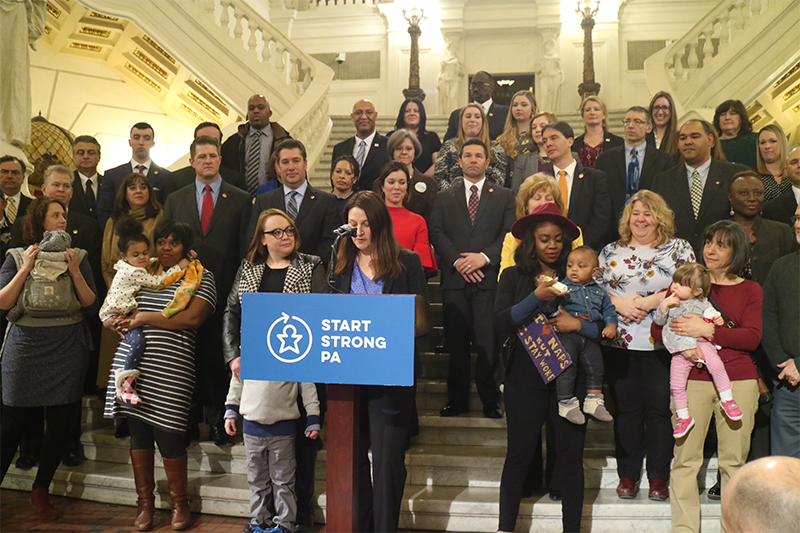
Today only one-third of subsidized children are accessing high-quality STAR 3 and 4 care, 4,300 children are on the subsidy waiting list, with families waiting 88 days to access subsidies they need to work, 50 percent of child care staff are receiving public assistance and child care subsidy reimbursements do not cover the cost of quality care. Trying Together, along with nine partner advocacy organizations, launched a new advocacy campaign last week – Start Strong PA – to turn those numbers around and increase access to high-quality child care for families so their infants and toddlers can grow, learn and succeed.

We are pleased to see the federal spending plan includes a waiting list initiative to serve more infants/toddlers in high-quality care and an increase in tiered reimbursement that will provide further program stability and consistency in teacher:child relationships. These are proposals for which we and partners advocated and align with our goals. We also believe the “career pathways” initiative will help to attract and retain talented early care and education teachers, another hallmark of the campaign.

Trying Together looks forward to learning more about Governor Wolf’s minimum wage proposal’s impact on the professionals in our field and the programs in which they work. While we appreciate the allocation of these critical federal dollars and again thank our federal delegation for strong, bipartisan support for high-quality child care, we are concerned with the lack of new state investments in this area.

Pre-K

  • $40 million for the Pre-K Counts program
  • $10 million for the Head Start Supplemental Assistance Program

This expansion would serve 5,500 additional young children.  

Today the commonwealth ranks 18th of the 30 states investing in high-quality, publicly-funded pre-k and with this investment 100,000 children still lack access. As a leading partner in the Pre-K for PA campaign, Trying Together is advocating that lawmakers fully-fund Governor Wolf’s proposal.

Evidence-Based Home Visiting

In addition, the budget proposal includes a $5 million investment in evidence-based home visiting programs to expand home visiting for 800 eligible families.

For more information on home visiting advocacy efforts go to www.childhoodbeginsathome.org.

Evidence-Based Early Intervention

There is a $15 million state funding increase proposed in the Department of Education budget and a $9.75 million increase in the Department of Human Services (DHS) budget for Early Intervention to continue to support the cost of children receiving services.

Trying Together commends Governor Wolf for his continued commitment to early care and education programs in the commonwealth and encourages a state investment be made in high-quality child care so we can provide children with the educational foundation they all deserve. We will advocate for these investments as the budget process continues. Stay up-to-date on how to advocate for these issues by signing-up to support Trying Together’s public policy agenda here.

News

February 8, 2019

Start Strong PA Encouraged by Calls for Increased State Investments

Observations

Start Strong PA observed the 2019-20 PA budget as an important down payment to ensure all infants and toddlers learn, grow, and succeed. The following statement was issued by the ten principal partners leading Start Strong PA, a campaign to ensure that children across the state can access affordable, high-quality child care programs during the most critical period of brain development, the first three years of life:

Statement on the Budget

“We are pleased Governor Wolf’s budget provides a plan for spending $101 million in federal child care dollars that will help Pennsylvania families who need high-quality child care for their children to thrive. Given the essential role that high-quality child care has to support Pennsylvania’s working families, we urge Pennsylvania policymakers to explore all options to allocate additional state resources to address the critical needs of our state’s early childhood system that limit access and affordability.

Two elements of Governor Wolf’s budget proposal closely align with the campaign’s goals, including: a $15 million allocation to remove approximately 970 infants and toddlers from the subsidy waitlist and move them into programs that will elevate their potential; and a roughly $10 million allocation that will help to reinforce program stability and consistent staff-child relationships by increasing quality add-on rates for infants and toddlers by 28% for STAR 2, 3, and 4 programs.

In addition, the Governor’s proposal includes a $2 million allocation to support early childhood career pathways which acknowledges that children develop best when they have consistent teachers and relationships. The campaign believes this proposal will begin to address the significant need to attract and retain additional talented adults to become early childhood educators. Furthermore, an allocation of approximately $74 million would increase rates to support the move to a $12 per hour minimum wage in Pennsylvania.

The Governor’s proposals use federal Child Care Development Block Grant (CCDBG) and Temporary Assistance for Needy Families (TANF) dollars. Start Strong PA campaign partners believe that these increased investments demonstrate the bipartisan support for ensuring our youngest children have what they need to thrive, while supporting the needs of our state’s workforce and education systems.” The Governor acknowledged the dual role of high-quality child care for children and families by saying, “We can get more kids off of waiting lists…and help more parents make their way into the workforce. Pennsylvania’s children deserve every chance to succeed.”

Reaction to the Governor’s Address

The importance of quality child care to the Commonwealth’s workforce was also raised by Senator Joe Scarnati in his reaction to the Governor’s address saying, “we have to focus on the families and we have to focus on their problems that stop them from getting to work.” Start Strong PA is urging the Pennsylvania General Assembly to build on the proposed federal allocations, and invest additional state dollars to support the positive brain development of all infants and toddlers by addressing access and affordability issues.

What Does Start Strong PA Support?

Specifically, Start Strong PA supports:

1. Increased reimbursement rates for the highest quality STAR 3 and 4 programs serving infants and

toddlers to the full cost of quality;

2. Increased investments to support more STAR 2 providers to move to STAR 3 and 4 thereby increasing

high-quality capacity;

3. Increased investments in the child care workforce by adding slots for Rising STARS Tuition

Assistance and T.E.A.C.H. Early Childhood® Scholarships, fully funding Education and Retention

Awards, and conducting a child care labor market survey.

“Our state is at a critical moment for determining the future of infants and toddlers in Pennsylvania. Legislators must build on last year’s momentum that acknowledges the role of state funds in our early childhood system. We call on legislators to use this year’s state budget to foster a better future for all children by providing them a solid educational foundation through access to high-quality child care that their families can afford.”

Budget Details

The 2019-20 proposed budget includes the following expanded investments to early learning:

● Allocation of $101 million in federal child care funds;

Increase in Pre-K Counts investment: $40 million;

Increase in Head Start Supplemental Assistance Program investment: $10 million;

● Increase in state funds for evidence-based home visiting: $5 million.

Start Strong PA is an initiative of Early Learning PA (ELPA), a statewide coalition of advocates focused on supporting young Pennsylvanians birth to age five (5). ELPA also advocates for expanding publicly funded Home Visiting services via the Childhood Begins at Home Campaign and access to high-quality, publicly funded pre-k for income eligible children via the Pre-K for PA Campaign.

What is Start Strong PA?

Start Strong PA is an initiative of Early Learning PA. Through a statewide collaboration of partners, Start Strong PA aims to support healthy child development, working families, and the economy by increasing access to and affordability of high-quality child care programs for young children. Learn more at www.startstrongpa.org

Partners

Fight Crime: Invest in Kids | First Up | Mission: Readiness | Pennsylvania Association for The Education of Young Children | Pennsylvania Child Care Association | Pennsylvania Head Start Association | Pennsylvania Partnerships for Children | Public Citizens for Children and Youth | The United Way of Pennsylvania | Trying Together


News

September 19, 2018

#PAbudget Funded Pre-K Expansions Recognized Locally

Policymakers from Butler and Westmoreland Counties joined Trying Together and other early-childhood advocates this week to celebrate a new pre-k grantee classroom and pre-k classroom expansion respectively. Both were made possible by the increased investment of $25 million for pre-kindergarten funding in the final 2018-19 state budget. To read more about both, see the articles below.

Articles

Ceremony Marks Expansion of Local Pre-K Programs (sharing via Butler Radio)

Advocates tout early education gains (sharing via Butler Eagle)

State grants bolster pre-kindergarten programs in Westmoreland County (sharing via Westmoreland Tribune-Review)

Statewide Voter Support

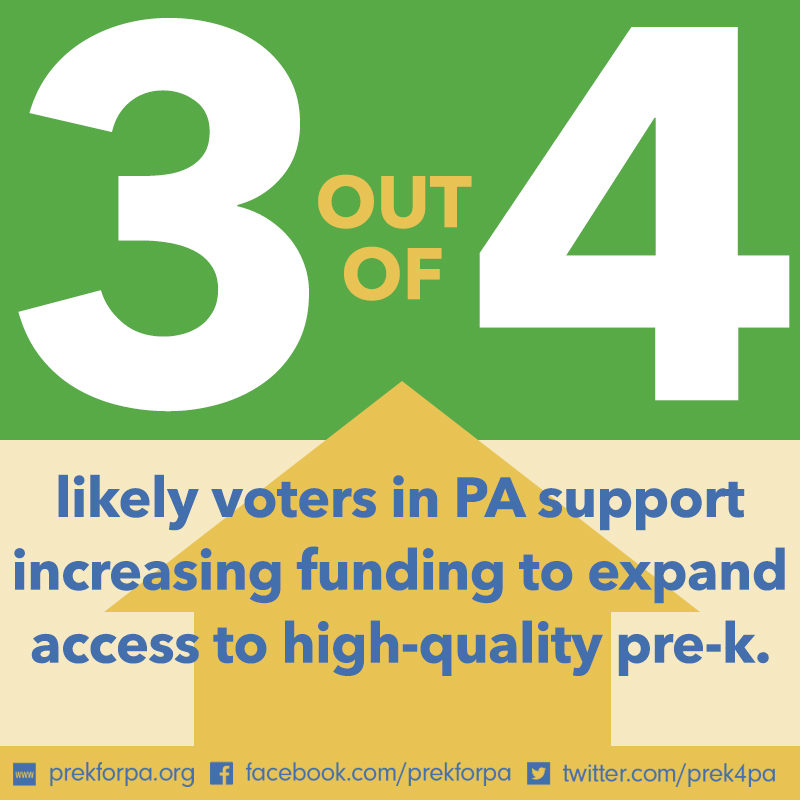
A poll commissioned by the Pre-K for PA campaign done by Harper Polling in May showed 75 percent of likely voters support increasing funding to expand access to high-quality, publicly funded pre-kindergarten, while 94 percent of voters believe that early education is important.

A large body of research shows that children who attend high-quality preschool:

  • Enter kindergarten with stronger literacy, language, math and social/emotional skills
  • Are less likely to need special education services, less likely to repeat grades, and more likely to graduate and enroll in college
  • Over a lifetime, these young learners will see stronger employment opportunities and increased earning potential
  • Are less likely to commit juvenile and adult crimes.

Still, more than 106,000 eligible children do not have access to high-quality, publicly funded pre-k due to limited state funding. This new classroom made possible by new state funding is a step in the right direction, but there is still much work to be done.

Pre-K for PA is an issue campaign supported by individuals and organizations across Pennsylvania who believe that investing in our children is the right choice and an urgent necessity. Our vision is that every 3- and 4-year-old in Pennsylvania will have access to high-quality pre-k. We will not endorse nor oppose candidates, but rather we will advocate on behalf of this vision for Pennsylvania’s children, schools and communities. For more information www.prekforpa.org.

News

August 1, 2018

Celebrate National School Success Month in September

In September, Pennsylvania will celebrate National School Success Month in recognition of Governor Tom Wolf’s strong commitment to high-quality early learning programs.

PA Promise for Children is looking for families who would like to share what their child has learned or likes to do that makes them a great student. Early care and education professionals and school district staff are being asked to share what makes them successful or their favorite part of their profession.

Photos including the subject’s name, county, success, and program/school may be sent to marhal@pakeys.org.

News

June 25, 2018

$25MIL Increase for Pre-K Classes

Leaders in Harrisburg recently aproved a $25 million investment in pre-k programs in the 2018-19 Pennsylvania state budget.

As part of the budget agreement, Governor Wolf, along with Republican and Democrat legislators made a wise investment in Pennsylvania’s early education system and prioritized the state’s youngest learners. While the 2018-19 Pennsylvania state budget grew by just 1.7%, leaders in Harrisburg grew high-quality pre-k funding by 11%, high-quality child care services grew by 4%, and home visiting by an impressive, and much needed, 33%.

The 2018-19 spending plan included the following expanded investments in early learning:

  • Increases in Pre-K Counts investment: $20 million
  • Increases investment in Head Start Supplemental Assistance Program: $5 million
  • Increases investment in Child Care Services: $6.8 million
  • New investment in home visiting programs: $6.735 million

Still more than 106,000 eligible children do not have access to high-quality, publicly funded pre-k due to limited state funding. This budget increase will allow access to thousands of 3- and 4-year-old students in the upcoming school year. It is a step in the right direction, but we still have much work to be done as Pennsylvania lags far behind neighboring states. Today, Pennsylvania ranks 18th of the 30 states investing in high-quality, publicly funded pre-k. New Jersey is spending five times more per capita than PA, and West Virginia has had universal access for pre-k aged kids since 2012.

This year’s budget is testament to the fact that Governor Wolf, along with Republican and Democrat legislators, understand their constituents’ priorities.

News

June 8, 2018

Pennsylvania Voter Consensus on Importance of Early Education

A recent poll confirms what Pre-K for PA partners have been hearing across the Commonwealth: Pennsylvanians are in lockstep when it comes to support for pre-k!

Support for pre-k has swelled to near consensus, as 94% of likely voters now think that early education is important.

Harrisburg-based Harper Polling conducted a poll on May 22-23, which indicates that three-quarters (75%) of likely voters support increasing funding to expand access to high-quality programs, and that support cuts across age, party, geographic and socioeconomic lines. Every single voting demographic in the state favors expanded access to pre-k by at least a two-to-one margin.

And it doesn’t end there. It turns out that Pennsylvanians value pre-k education for its proven benefits to the child and the commonwealth, and they’re willing to dig a little deeper to support it. In fact, two-thirds of likely Pennsylvania voters polled said they would support a tax increase to expand pre-k access.

The poll results speak for themselves. Now, it’s up to voters to ensure our legislators are listening. Last week, Pre-K for PA partners Harrisburg heard that the $40 million proposed for new pre-k funding is on the negotiating table and it’s getting cut!

PLEASE, pick up the phone or send a quick email to tell legislators, “I am part of the pre-k majority!” It’s time for all PA children to have access to high-quality pre-k. No child should be missing out when nearly all PA residents agree.

Infographic stating: Three out of four voters in PA support increased funding for pre-k.

News

May 7, 2018

Tell Legislators: Child Care Matters

Child care matters because child care works!

High-quality child care programs positively impact the cognitive, social, and physical development of infants, toddlers, and young children throughout their first five years of life. Access to child care programs also allows families to achieve better employment opportunities, participate in training or education, earn higher incomes, and grow more financially independent.

It’s time to ask legislators to support the Governor’s proposed $27 million funding increase for child care. This investment can improve the quality of life for families across the state of Pennsylvania and secure brighter futures for our children across the state.

Contact your legislators today!