News

October 20, 2025

PA Promise for Children List Features Books About Being Afraid

With Halloween just around the corner, the spooky season is upon us. But being afraid is often not a fun feeling for children – so, PA Promise for Children has compiled a list of books for children who are having difficulty with fear.

Learn More

The books cover a variety of topics, from being afraid of the dark or going to bed to being in new places. Fear can change with age or experience, so adults might not always understand a child’s fear.

Talking with a child’s doctor or teacher could be one method of combatting their fear – but reading them a book about the fears of others is another possibility.

The Child Mind Institute’s suggested list of 10 books about being afraid for children include:

  • When I Feel Scared (Cornelia Spelman)
  • There’s an Alligator Under My Bed (Mercer Mayer)
  • Franklin in the Dark (Paulette Bourgeois)
  • Orion and the Dark (Emma Yarlett)
  • The Thing Lou Couldn’t Do (Ashley Spires)
  • The Doghouse (Jan Thomas)
  • Miss Hazeltine’s Home for Shy and Fearful Cats (Alicia Potter)
  • There’s a Nightmare in My Closet (Mercer Mayer)
  • Can’t You Sleep, Little Bear? (Martin Waddell)
  • The Little Old Lady Who Was Not Afraid of Anything (Linda D. Williams)

To read the entire list, visit PA Promise for Children’s website.

News

SNAP Benefits Will Not Be Paid to Recipients in November Due to Federal Shutdown

PA DHS announced that PA SNAP recipients will not receive benefits that were scheduled to be paid in November due to the ongoing federal government shutdown. As a result, more than 160,000 people in Allegheny County will not receive payments, of which more than 50,000 are children. Read more for county food agencies and resources.

Learn More

On its website, the state Department of Human Services (DHS) provided an update on October 17 that SNAP benefits cannot be paid in November as a result of the failure to pass a federal budget that caused the shutdown. 

Benefits will not be paid until the shutdown ends and funds are released to the state, according to the DHS. SNAP recipients will be notified when payments can resume. The department provided links to two resources for those in need of immediate food assistance – PA Navigate and Feeding Pennsylvania – or recommended calling 211.

Those receiving SNAP benefits should continue to complete renewals and report changes to income, contact information, or the number of people living in the household. State offices and phone lines remain open and SNAP recipients can still visit and call state offices for help.

Additionally, changes mandated by the federal government regarding SNAP benefits will also take effect on Monday, November 1. To keep or become eligible for benefits, people will have to meet work requirements that include working, volunteering, or participating in an education or training program for at least 20 hours per week and report to the DHS that they are meeting these work requirements.

Residents in the Pittsburgh region who are in need of immediate food assistance can access the following resources:

Resources in neighboring counties include:

Those seeking assistance while SNAP benefits are not being paid out should also view lists of Pittsburgh food resources and mutual aid distribution as well as learn about the Pittsburgh Police’s Thanksgiving dinner distribution.

News

October 17, 2025

Pre-K for PA, Start Strong PA Surveys Find Devastating Impacts from Budget Impasse

Recent surveys conducted by the Pre-K for PA and Start Strong PA campaigns and the Pennsylvania Office of Childhood Development and Early Learning (OCDEL) of early childhood providers found widespread, devastating impacts resulting from the state’s budget impasse.

Learn More

The surveys found that 95 Pre-K Counts and Head Start Supplemental Assistance Program providers in 32 counties have collectively taken on nearly $20 million in loans to continue serving working families while state funding has been frozen.

Many of the loans were business lines of credit taken out at an average interest rate of 7.5%, while others have been personal loans with higher interest rates. Many providers indicated that loans will only sustain operations for a short period of time and the accumulated interest liability may have severe consequences for future operations. 

“This survey represents just a small portion of early learning providers, but it is clear that the continued state budget impasse is further destabilizing a sector that was already in the midst of a crisis with financial and staffing challenges,” said Kara McFalls, executive director of the Pennsylvania Head Start Association. “Early learning providers cannot withstand additional insecurity.”

While numerous providers have taken on debt to keep classrooms open, others have been forced to take more dramatic measures, such as layoffs and closing classrooms completely.

Through outreach across 21 grantees operating Pre-K Counts or Head Start programs in 16 state counties, OCDEL documented closures, planned closures, or delayed openings of classrooms that affect more than 4,000 slots in Pennsylvania. As a result, working families across the state are struggling to arrange and pay for alternate care for their children during working hours. Both Pre-K Counts and Head Start are free programs for qualifying families.

“Shutting our youngest learners out of classrooms will certainly have negative impacts on school readiness for this cohort of three- and four-year-olds in years to come,” said Robert S. Carl, Jr., president of the Schuylkill Chamber of Commerce. “It’s time to compromise and pass a budget that invests in the early learning workforce.”

Previous surveys have documented thousands of unfilled early learning teaching positions due to low pay. Providers fear that closures and layoffs resulting from the state budget impasse will exacerbate these staffing challenges and further destabilize programs.

Polling from March 2025 shows that Pennsylvania voters overwhelmingly support increased state funding for early learning programs – including 83% support to allocate state funding to increase child care worker wages, 73% support to increase funding to serve more eligible children in pre-k programs, 73% support to increase funding to help more low-income families afford high-quality child care, and 72% to allocate funding to increase compensation for pre-k teachers.

Pre-K for PA and Start Strong PA urge state lawmakers to pass a final budget that includes:

  • A $55 million investment in a new and recurring Child Care Recruitment and Retention line item to grant licensed child care providers participating in the child care subsidy program with $1,000 per educator
  • $17 million in additional funding for Pre-K Counts
  • $9.5 million for the Head Start Supplemental Assistance Program
  • A $16.2 million increase for infant/toddler Early Intervention and a $38.1 million increase for preschool Early Intervention

News

October 15, 2025

Trying Together Exec Director to Take Part in Webinar on Child Care Crisis and Jobs

Trying Together’s executive director will take part in an upcoming National Fund for Workforce Solutions webinar on job quality and the child care crisis.

Learn More

Cara Ciminillo, Trying Together’s executive director, will take part in a panel during the webinar, which will run from 2 p.m. to 3:30 p.m. on Thursday, November 6.

The webinar will discuss how child care is prohibitively expensive for many parents of young children in the United States, often costing nearly as much as their rent or mortgage payments. 

This makes child care a workforce issue as companies struggle to keep parents who are otherwise in their prime working years on payroll.

Meanwhile, for structural reasons it can be hard to ensure quality jobs for early childhood educators as companies in that industry face high costs and tight margins.

The panel discussion will focus on how individuals are navigating the tangled challenges of child care and the workforce. Ciminillo will join Bonny Yeager, senior manager of industry solutions at Partner4Work, on the first panel.

Then, attendees will hear from employers who are innovating in the child care space, including offering subsidized care for their employees, and organizing across municipalities and states to solve this challenging problem. Panelists include representatives from Boston Children’s HOspital, the University of Vermont’s Health Network, and the Massachusetts Business Coalition for Early Childhood Education.

Those interested in attending can register online.

News

October 14, 2025

Child Mind Institute Resources Aim to Help Adults Recognize Learning Disorders

As the school year settles in, learning disorders often become more pronounced as students begin to settle into class routines. Some children may struggle with reading, while others might find it challenging to follow directions.

Learn More

The Child Mind Institute has released a new series of resources on how to recognize learning disorders in children. The resources include 32 one-page tip sheets for an overview of such learning disabilities as dyslexia, dyscalculia, and language disorder as well as how to support children with specific challenges.

The institute wrote that while it’s important to provide academic support to children with difficulties, it’s just as important to support them emotionally because some children with learning disabilities might lack confidence.

Practicing how to discuss a learning disorder, the institute notes, can help children to understand that it’s not something to be embarrassed about. As children get older, learning to talk about their challenges can help them to advocate for themselves.

The Child Mind Institute’s resources include:

News

PBS Kids for Parents Article Lists 11 Self-Care Tips for Children

Caregivers often try to instill in their children the importance of taking care of others – but a new article by PBS Kids for Parents notes that it’s also important for caregivers to teach children simple acts of self-care.

Learn More

While some activities might come to mind when thinking about self-care – such as a bubble bath, reading a beloved book, or watching a favorite movie – there are other methods that might not immediately come to mind. Naming feelings and taking care of one’s health are examples of how self-care includes healthy habits for the mind and body.

The PBS Kids for Parents article lists 11 strategies that children can utilize to promote self-care. These include:

  • Take belly breaths
  • Get silly
  • Drink more water
  • Be proactive
  • Incorporate rest
  • Get the wiggles out
  • Write (or color) it out
  • Take a break
  • Have a healthy snack
  • Get clean
  • Try affirmations by breathing in and breathe out a positive phrase or empowering mantra

To read descriptions of these 11 strategies and to learn more how to promote self-care among children, read PBS Kids for Parents’ article.

News

October 13, 2025

PA Promise for Children Releases October Booklist for Preschoolers

PA Promise for Children has released a list of October books for preschoolers in its Kindergarten Here I Come newsletter.

Learn More

The booklist provides eight recommendations in four categories – including Language and Literacy Skills, Social and Emotional Development, Science Thinking and Technology, and Mathematical Thinking and Expression.

The books on the list include:

Language and Literacy Skills

  • One Smart Goose (Caroline Church)
  • Apples and Pumpkins (Anne Rockwell and Lizzy Rockwell)

Social and Emotional Development

  • What’s Opposite? (Stephen R. Swinburne)
  • You Are (Not) Small (Anna Kang and Christopher Weyant)

Science Thinking and Technology 

  • Bark George (Jules Feiffer)
  • When I Grow Up (Al Yankovic)

Mathematical Thinking and Expression

  • Counting Our Way to Maine (Maggie Smith)
  • Quack and Count (Keith Baker)

For more information, view PA Promise for Children’s October booklist.

News

Applications for APOST Managers Consort Due By Oct. 21

Those interested in taking part in Allegheny Partners for Out-of-School Time’s 2025-26 managers consort must submit an application by Tuesday, October 21.

Learn More

The program is aimed at new out-of-school time program managers looking to gain knowledge and skills that will help them to be more effective within their own organization. The consort will also include discussion on how to advance professionally within the out-of-school time field.

The learning consort will run from November through April and include 15 people who identify as new managers within out-of-school time programs. It will consist of several sessions, including a closing celebration.

The sessions will be a mix of in-person and virtual and will cover a variety of topics. The consort’s expected time commitment is approximately 30 hours, which includes time spent on homework assigned between sessions. The assignments are estimated to take up no more than one hour per month.

All participants will deliver a five-minute presentation at the closing celebration about their OST impact project, which is due at the culmination of the project. 

Session topics will include:

  • Overview and community building
  • Leadership, management, and coaching
  • Program evaluation
  • Crafting impactful stories
  • Nonprofit financial management and fundraising 101

Those interested in applying must do so no later than 5 p.m. on October 21.

News

October 9, 2025

Educators Explore Ways to Care for Immigrant Children and Families at October UnConference

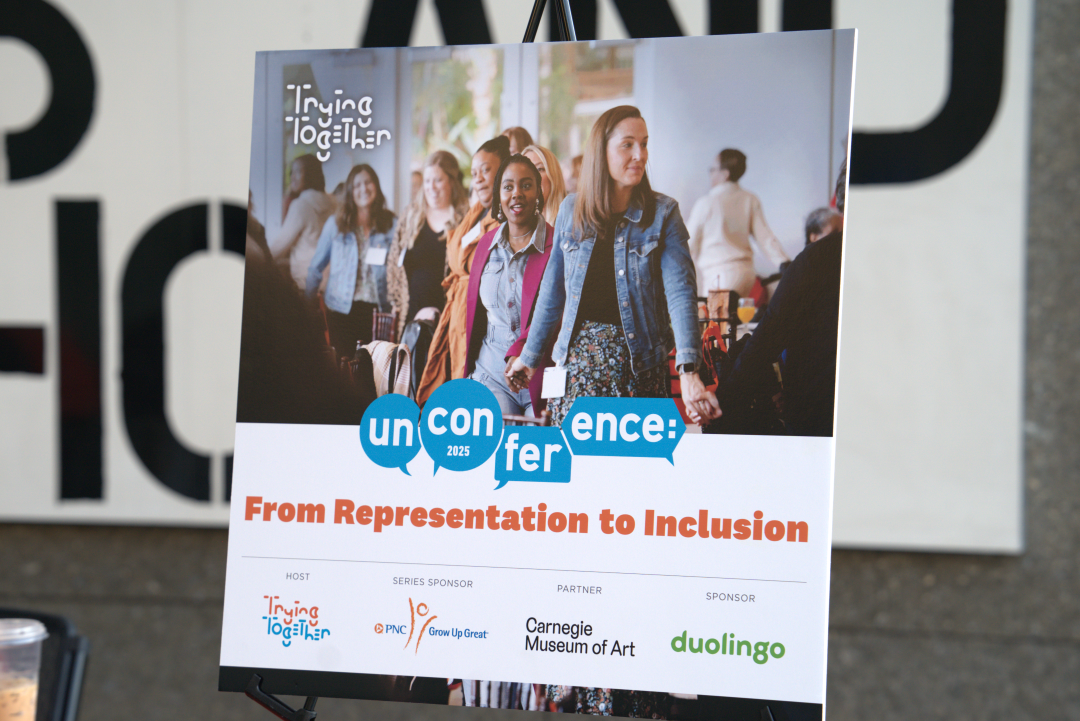
Early care and education professionals gathered at the Carnegie Museum of Art on October 4 to learn how to foster supportive and inclusive learning environments for immigrant children.

Learn More

A smiling woman with dark hair stands at a podiumUnConference: From Representation to Inclusion kicked off with keynote speaker Ivonne Smith-Tapia, director of refugee and immigrant services at Jewish Family & Community Services. During her presentation to the over 90 early childhood educators in attendance, Smith-Tapia explained the significant challenges immigrant families face when navigating unfamiliar environments and practices.

“Immigrant parents have to adjust in many different ways when they migrate,” she explained. “For many, the adjustment is not only about language differences. It’s also about understanding the cultural nuances. The spoken rules of society can become overwhelming and create stress in parents’ daily lives. Experiences can be particularly challenging when parents lack a community to guide and support them.”

Smith-Tapia also noted the crucial role that early care and education professionals play in supporting immigrant families. “Every time a child educator takes an extra moment to learn about a family’s cultural practices, they’re creating the structure, function, and quality of social connection that transforms isolation into belonging,” she said.

Parent Panel

A group of six people sit on a stage in front of a large crowdFive parents participated in a panel discussion to share their own unique experiences as immigrants with children enrolled in child care. They drew comparisons between child care in their home country vs. the United States,  noting that access, cost, and enrollment requirements can vastly differ.

The panelists also shared personal anecdotes, detailing both difficulties and joys. They offered practical tips and advice for educators, encouraging them to listen and ask questions so the immigrant families in their care feel welcome, safe, and included.

The panel included Ana Guerrero, Sol Moure Peña, Jing Zhang, Januka Regmi, and Ricardo Solis Moreno.

The Cultural Iceberg

Casey Rich, director of professional learning for Trying Together, explained to the group the concept of the “cultural iceberg.” This visual representation demonstrates that culture is comprised of both visible and invisible components, with much of what makes up a culture living beneath the surface.

“By understanding that these layers of culture exist,” Rich explained, “you can have a better understanding of why people act the way they do, and appreciate them for those differences instead of always seeing those differences as sources of conflict.”

With this concept in mind, participants engaged in a creative self-reflective art activity that encouraged them to examine their own cultural traditions, both visible and below the surface.

Workshops

After lunch, representatives from organizations that serve immigrant families in the region led hands-on workshops focused on inclusion in early childhood classrooms.

The first round of afternoon sessions included discussions on trauma-informed communication pathways for English learners and their families, building trust and inclusion with Muslim families in learning environments, exploring cross-cultural communication through play, and supporting positive identity development through picture books.

The second round of sessions focused on honoring identity through cultural learning, inclusive practices that nourish, background and practical considerations for early childhood education teachers, and a reflection on bias and creating inclusivity within multicultural classrooms.

Takeaways

Participants gained a deeper understanding of the lived experiences of immigrant children and families and left with new resources to better equip them to care for immigrant families in their classroom. Additionally, participants were offered translated versions of Trying Together’s Developmentally Appropriate Parenting series – now available in seven different languages thanks to the generous support of Duolingo.

News

ELRC Region 5 Kicks Off Winter Coat Program on October 14

Families can visit Early Learning Resource Center Region 5 starting Tuesday, October 14 to receive free winter coats for their children.

Learn More

The coats are available for families while supplies last as part of a partnership between ELRC Region 5 and the Pennsylvania Department of Human Services.

Children and their families can pick up their coats at:

ELRC Region 5
304 Wood Street, Suite 400
Pittsburgh, PA 15222

The office is open from 8 a.m. to 4:30 p.m. on Monday through Friday. ELRC Region 5 offices will be closed on Wednesday, October 29.

For more information, call the office at 412-350-3577.