Pittsburgh Residents Can Get 50% Discounts on PRT Options with ConnectCard

News

August 27, 2025

Pittsburgh Residents Can Get 50% Discounts on PRT Options with ConnectCard

Allegheny County residents can get a more than 50% discount on Pittsburgh Regional Transit (PRT) options by applying for Allegheny Go’s ConnectCard.

Learn More

County residents can ride PRT’s buses, light rail, and other means of transportation for more than 50% off with the card.

To qualify for the card, one must:

  • Be an Allegheny County resident
  • Be between the ages of 12 and 64
  • Have somebody in their household who currently receives SNAP benefits

Those interested in applying for the ConnectCard can fill out an application online. On the application, choose the “Enroll using a ConnectCard” option.

A 50% discount will be applied when fares are bought at ConnectCard machines throughout the service area, PRT Downtown Service Center, the ConnectCard online portal, and participating retail outlets, including most Giant Eagle and Goodwill locations.

Allegheny Go can be downloaded to the Ready2Ride app on a mobile device. When applying online, select the “Enroll using the Ready2Ride app” on the application. 

For more information, visit the Allegheny Go website. Flyers for the ConnectCard are available in English and Spanish.

Resources for September Observances

News

Resources for September Observances

Various organizations, states, and nations recognize a number of observances each month. Resources help parents, caregivers, and child care professionals acknowledge and navigate them.

Here is a list of resources for September observances.

Month-Long Observances

Attendance Awareness Month

Baby Safety Month

Childhood Cancer Awareness Month

Hispanic Heritage Month

National Childhood Obesity Awareness Month

National Recovery Month

Newborn Screening Awareness Month

Weeks of Recognition

September 21 – 27 is Child Passenger Safety Awareness Week 

Days of Recognition

September 6 is National Read a Book Day

September 22 is National Family Day

Early Childhood Educators Should Ensure Clearances, Mandated Reporter Training Updated for New School Year

News

August 26, 2025

Early Childhood Educators Should Ensure Clearances, Mandated Reporter Training Updated for New School Year

With the 2025-26 school year beginning, it’s time for educators to ensure that they are up-to-date on mandated reporter training and clearances.

Some resources to help with this include Pennsylvania’s page for clearances and background checks, the state’s Office of Child Development and Early Learning’s (OCDEL) announcement earlier this year on the Child Protective Services Law, and iLookOut, where they can find new online courses.

Clearances

Mandated reporter training is required every five years and is based on the date of an individual’s last certification. Under state law, public school employees are required to provide updated clearances every 60 months – or, five years.

The three clearances include:

Clearances must be obtained for employees of child care facilities, any individual with ownership interest in a certified child care facility and those who participate in the organization, any legal entity applying to open a new certified child care facility, or any individual residing in a certified child care facility. 

More information on the background checks can be found on the state’s website.

OCDEL Announcement

Earlier this year, OCDEL Deputy Secretary Shante A. Brown sent out an announcement to inform certified child care providers of the requirements for child care facilities in the state and to clarify provision hiring requirements for those hired on or after Feb. 1.

Aside from clearances, the announcement covered the following mandated reporter training topics: the minimum number of hours, providing evidence of completion, and the timeframes for obtaining or renewing the training.

iLookOut

Lastly, early educators looking to update mandated reporter training should visit the iLookOut for Child Abuse Project, which provides online courses about protecting and supporting children and their families free of charge. Visitors to the site will learn how to support at-risk children and meet required training with interactive, video-based storyline training. The site includes eight- to 12-minute micro-learning exercises and is available to all Pennsylvania-mandated reporters. 

iLookOut is a multimedia, online learning program that prepares mandated reporters to meet their professional, ethical, and legal responsibilities for identifying and reporting suspected child abuse. It engages learners through real-life scenarios incorporating video and narrative that raise concerns about possible child abuse. 

The Importance of Routines and Tips for Enforcing Them with Children

News

The Importance of Routines and Tips for Enforcing Them with Children

The Pennsylvania Key’s newsletter, Bright Start, Bright Kids, Bright Future, recently noted that the beginning of a new school year provides a great opportunity for caregivers to help children get into routines.

Learn More

After the summer – a season that, for children, provides more freedom than usual – it is important to ensure that children are getting back into routines. Doing so can create a sense of the familiar and stability. Routines can help to promote healthy and social emotional development.

According to Bright Start, Bright Kids, Bright Future, routines can help children to:

  • Make sense of the world and learn how it is organized
  • Feel secure and safe when many things in their environment are constantly changing
  • Develop their ability to regulate their own emotions and behavior
  • Learn skills and internalize habits through repetition
  • Learn self-discipline and develop personal responsibility
  • Set internal body clocks through such actions as eating meals or going to bed at the same time every day
  • Have a sense of independence and autonomy when much of what happens is out of their control
  • Engage in fewer power struggles, arguments, or conflicts with caregivers
  • Develop confidence and self esteem as various tasks are mastered
  • Anticipate and look forward to what comes next 
  • Have continuity, consistency, and predictability in their lives, which is important in a world that is unpredictable

Bright Start, Bright Kids, Bright Future also provided some tips on how to establish and enforce routines. Caregivers should create visual reminders or a picture schedule for a typical day. They should plan structured activity periods – for example, play a game right after a nap.

Caregivers should break routines into steps – such as ordering activities when getting ready for bed: bath, pajamas, brush teeth, story time, and singing. It is also helpful to prepare a child for transitions from one activity to the next – for example, tell them that in a certain amount of time the next activity will commence.

Developing regular routines for daily activities – meals, bed time, or quiet time, for example – is important. But caregivers should also be flexible and creative and try not to be rigid or unable to adjust to specific circumstances.

Other resources include a Creating Routines infographic; Visual Supports for Routines, Schedules, and Transitions; and School-Age Learning Environments: Schedules and Routines.

Students in Trying Together’s Summer CDA Course Tout Program’s Relationship Building

News

August 25, 2025

Students in Trying Together’s Summer CDA Course Tout Program’s Relationship Building

Students in Trying Together’s summer Child Development Associate (CDA) credential program said the program helped them to learn more about the early childhood education system as well as learn from each other.

Learn More
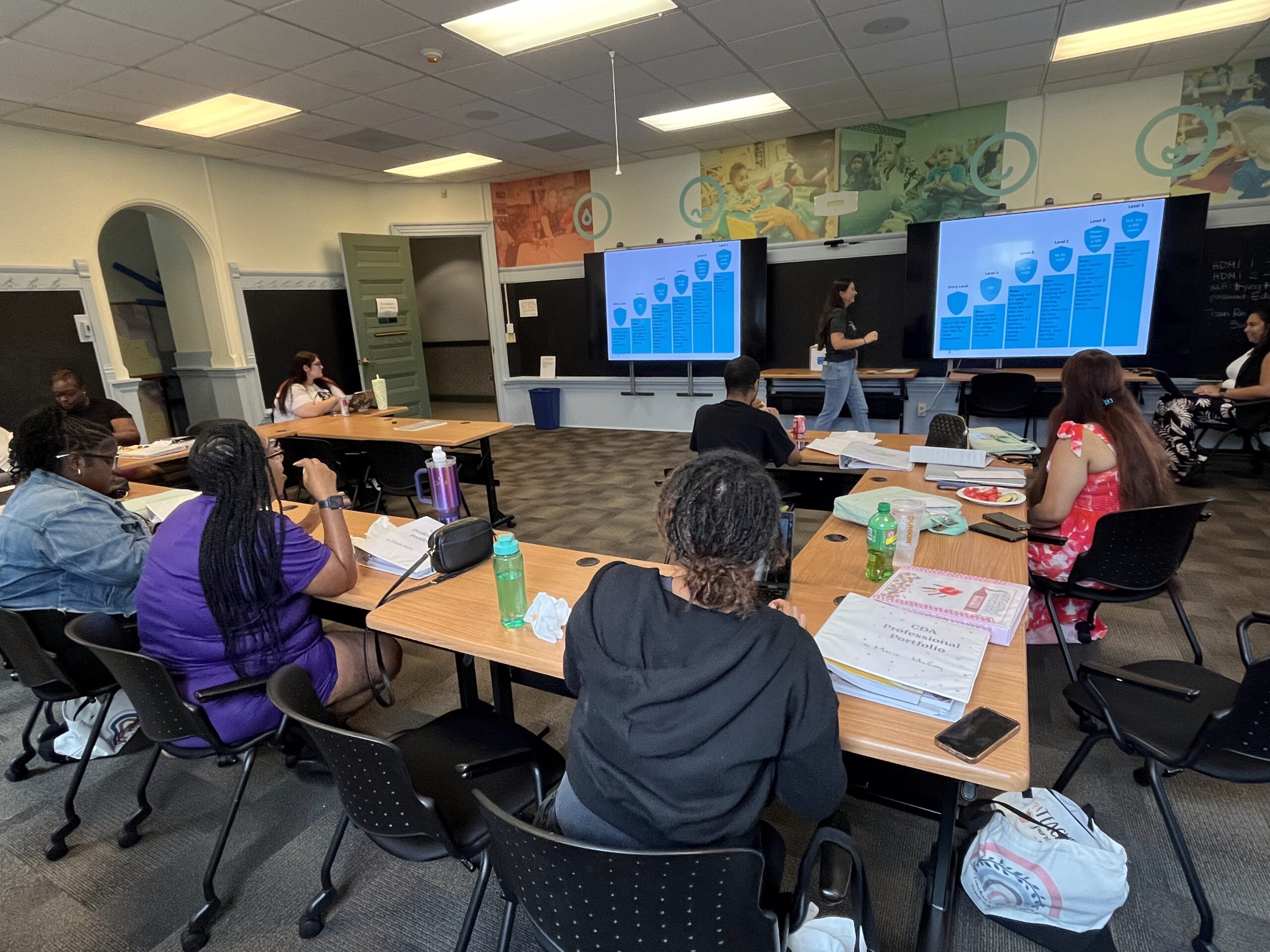
The summer CDA program was the first time Trying Together offered a hybrid course option with an in-person class in the beginning, the middle, and at the end. All other classes in between were virtual. 

Students met with instructors twice a week, every other week, for Zoom classes to review CDA course content and build their professional portfolio. The format of the summer program moved more rapidly than Trying Together’s typical CDA Program, condensing six months of content into three while still maintaining a high standard of quality. 

“I am grateful to have my CDA with Trying Together,” said student Rajlakshmi Ghosh Pal. “The whole team is just amazing. They are so helpful that I feel so confident after being in this class.”

The students were motivated and excelled at relationship building with one another. Between the instructors and students, there was a sturdy support system in which they encouraged one another to keep pushing. 

As instructors presented course content, students shared their own experiences in their classrooms and suggested teaching strategies to each other. The instructors enjoyed seeing the community building between them and their students. 

“This program has helped me to implement different types of learning into my classroom to better help children learn,” student Madison Deithorn said. “I have also learned from classmates their way of teaching to try in my classroom.”

Even though summer classes have wrapped up, the students are continuing to work hard by completing their CDA applications, taking the exam, and being observed in their classroom to showcase their work to earn their CDA Certificate.

Student Maria McCoy said she was glad to have participated in the class and noted that “Trying Together helped me become more aware of the impact that I make in my classroom daily.”

Another student, Denise Hazlip, said the class gave her a greater understanding of the early childhood education system.

“Taking my CDA class has been a valuable and rewarding experience,” she said. “Throughout the course, I have gained a deeper understanding of child development, early learning standards, and the important role that educators play in supporting children and families. The class has not only given me knowledge, but also practical strategies that I can use every day in the classroom.”
Child Mind Institute Provides Resources for Children Making School Transitions

News

Child Mind Institute Provides Resources for Children Making School Transitions

Children will head back to school in a few weeks, and some of them will do so for the first time. 

The Child Mind Institute has put together a list of resources for caregivers who have children who will make a big transition this fall by starting kindergarten, middle school, and high school.

Learn More

The transitions for students starting at these levels can involve new schools, new routines, and unfamiliar faces. As a result, both students and parents can be anxious about these transitions.

The Child Mind Institute outlines the specific challenges of each transition and offers tips for how caregivers can help children navigate changes.

For children starting kindergarten, the resources emphasize the importance of building independence such as using the bathroom solo or opening snacks. It also provides strategies that children can use to calm themselves down when they are nervous.

For middle school, the Child Mind Institute’s resources discuss how to handle an increased workload as well as social and emotional challenges that come with puberty.

And for high school, the resources provide assistance with how to help build time management and study skills as well as guidance on how to handle situations involving sex and substances. For all grades, the resources also emphasize the importance of getting enough sleep.

The Child Mind Institute’s resources include:

Northampton Community College to Offer School Age Credential Program Online This Fall

News

August 20, 2025

Northampton Community College to Offer School Age Credential Program Online This Fall

Northampton Community College is offering an online School Age Credential Program this fall.

Learn More

Those who take the course and receive a diploma will be able to teach in school-age child care centers and before- or after-school programs. 

The course prepares attendees for the Pennsylvania School-Age Professional Credential. In the program, attendees will learn about students’ social-emotional development, managing school-age programs, interacting with families and communities, and the professional code of ethics and standards for before- and after-school programs.

Participants can apply credits toward an associate’s degree in early childhood education.

About the School Age Credential Program

The program is designed for students employed in the field and offers an entry-level credential. Courses provide the student with 120 hours of training required for the credential program. Students must complete 480 hours of supervised teaching in a licensed child care facility. 

Students will receive nine total credits for the courses and they may submit their credential to the Pennsylvania Key.

The course will be held on Zoom one night per week in the evenings. Weekly class attendance, readings, and written assignments are required.

The semesters for the program include:

  • Course 1 – September through December
  • Course 2: January to May
  • Course 3 – June through August

Those interested in attending the course should contact Tara Pascoe, ECE credential coordinator, at tpascoe@northampton.edu or visit the course’s website.

Campaign Releases Toolkit to Help Those Planning Welcoming Week Events

News

August 19, 2025

Campaign Releases Toolkit to Help Those Planning Welcoming Week Events

A campaign to celebrate the diversity and values of welcoming and inclusion for all – including immigrants – has released a toolkit that contains resources and guidance to support those planning Welcoming Week events.

About Welcoming Week

Initially known as National Welcoming Week when it began in the United States in 2012, the annual campaign by Welcoming Network was created to celebrate and uplift the diversity and values of welcoming and inclusion for all. 

Now, Welcoming Week is a global movement because of the network of organizations, local governments, and other institutions that comprise the Welcoming Network.

During Welcoming Week, communities around the world host events that connect people of different backgrounds through shared causes and interests.

Toolkit

The Welcoming Week toolkit contains resources and guidance to support Welcoming America members, Welcoming Week partners, and organizations and individuals who are planning and promoting Welcoming Week events.

The toolkit contains social media tips and assets, media relations support, logos and other visuals, event planning best practices, event examples, and information about this year’s campaign theme – Stories We Share.

The 2025 theme asks that if instead of seeing difference as a divider, we see it as a multiplier to shape new possibilities. By sharing stories, we build understanding, through which we can shape what comes next.

As September nears, the toolkit will be updated with new resources. Those with questions about the toolkit should email communications@welcomingamerica.org. 

For more information, check out the Welcoming Week toolkit.

Guides Cover How Organizations and Caregivers Can Work Together to Improve Early Childhood Systems

News

Guides Cover How Organizations and Caregivers Can Work Together to Improve Early Childhood Systems

The Center for the Study of Social Policy has released two new guides that cover how organizations and caregivers can work together to strengthen childhood education.

Guide for Organizations

Its Partners for Change: A Guide for Organizations on Engaging Family and Parent Leaders in Early Childhood Systems provides ideas, strategies, and approaches to inspire and challenge early childhood organizations, nonprofits, and community groups to promote parent and family leadership within early childhood systems. 

The guide is intended for those who recognize the importance of early childhood development and want to engage families and support caregiver leadership to improve the well-being of children.

The resource was developed by a collaborative of seven national organizations – including the Center for the Study of Social Policy – and incorporated the contributions of more than 500 local leaders in 50 communities.

Guide for Caregivers

Partners for Change: A Guide for Parents on Strengthening Early Childhood Systems discusses ideas and steps that caregivers can take to strengthen early childhood systems and improve outcomes for children, from prenatal to age 8.

The guide encourages caregivers to reflect on their own leaderships and advocacy goals. It helps them to find pathways and resources for how to engage and assess which opportunities are the best fit for them. 

For more information, read the Center for the Study of Social Policy’s guides for organizations and caregivers.

Trying Together to Hold Event to Celebrate Grandparent Relative Care Providers

News

Trying Together to Hold Event to Celebrate Grandparent Relative Care Providers

Trying Together will hold an event at the Homewood Early Learning Hub & Family Center in September to celebrate grandparents who are relative care providers for their grandchildren. 

Learn More

As a cosponsor for Home Grown’s Family, Friend and Neighbor (FFN) Appreciation Week, Trying Together will host the Relative Provider Grandparents Appreciation Day on Sunday, Sept. 7 from 11 a.m. to 3 p.m. 

FFN Appreciation Week is an opportunity to celebrate the over 5 million family, friend, and neighbor caregivers who look after 11.5 million children each year. This week of celebration begins on National Grandparents Day, a holiday that honors the bond between children and grandparents. 

Those who are a grandparent caring for a grandchild can bring the children in their lives to the Hub for an appreciation celebration. The event will include food, fun activities, and an opportunity for participants to share their stories.

The event is free, but space is limited. Those interested in attending should register as soon as possible.

The Hub is located at 7219 Kelly St. in Pittsburgh.