Registration Open for UnConference: From Representation to Inclusion

News

August 18, 2025

Registration Open for UnConference: From Representation to Inclusion

Registration is now open for Trying Together’s UnConference: From Representation to Inclusion scheduled for Saturday, Oct. 4 at the Carnegie Museum of Art.

Learn More

The UnConference will focus on immigrant children and their families, delving into the ways early childhood educators can foster supportive and inclusive learning environments. Attendees will hear from a keynote speaker and caregivers as well as take part in a large group activity.

Participants will attend workshops led by representatives from organizations that serve immigrant families in the region. These workshops will cover topics such as inclusive practices and building trust, trauma-informed communication, play and literacy, honoring identity, and practical considerations for educators.

More Details

The UnConference will run from 8 a.m. to 4:30 p.m. at the Carnegie Museum of Art, located at 4400 Forbes Ave. The fee to attend is $25. Registration is required and now open.

Parking will be available in the museum parking lot and on the street. A light breakfast with coffee and tea will be available and lunch will be provided as part of the registration fee.

The event will begin with keynote speaker Ivonne Smith-Tapia, director of refugee and immigrant services at Jewish Family & Community Services. Then, participants will take part in a large group workshop and panel. 

After lunch, attendees will take part in two sessions – out of 10 options – they chose during registration. The day will end by 4:30 p.m.

A total of 6.5 PQAS and Act 48 credit hours will be available for attendees.

Workshops

Participants will be able to select their first and second choices of preferred sessions for each of the afternoon session time slots. Workshops include:

  • Effective and Trauma-Informed Communication Pathways for English Learners and Their Families
  • Muslim Families in Learning Environments: Building Trust and Inclusion
  • Who Makes the Rules? Exploring Cross-Cultural Communication Through Play
  • Supporting Positive Identity Development Through Picture Books
  • Carnegie Museums of Art Extension Activity
  • What’s in a Name? Honoring Identity Through Cultural Learning
  • Not Just a Seat, But a Say: Inclusive Practices That Nourish
  • Refugee 101: Background and Practical Considerations for ECE Teachers
  • Positionality, Power & Poetry: A Reflection on Bias & Creating Inclusive Practices Within Multicultural Classrooms
  • Carnegie Museums Guided Art Tours

For descriptions of the workshops, visit the UnConference’s registration page.

About UnConference

The UnConference is an innovative, hands-on professional development training format in which a deeper experience is provided around a particular theme. Local and national speakers are invited to present and participants are encouraged to engage hands-on in the workshops.

Best Practices to Prevent the Spread of Infections

News

Best Practices to Prevent the Spread of Infections

As the new school year begins, early learning programs can reduce the spread of illness by following routine health and safety practices. 

Hand-Foot-and-Mouth Disease

The number of hand-foot-and-mouth disease cases are growing in the Philadelphia region. The illness, which typically produces rashes and painful sores, has primarily been spreading in day care centers and summer camps.

Hand-foot-and-mouth is a mild illness caused by viruses – most often, a virus known as coxsackievirus A16 – according to the Mayo Clinic. The disease is most common in young children, but people of any age can catch it. Viruses that cause the illness can spread easily between people and through the air.

Symptoms of the disease include sores in the mouth and a rash on the hands and feet. While there’s no specific treatment for hand-foot-and-mouth, most people get better in seven to 10 days. 

With the 2025-25 school year approaching, the likelihood of viruses like hand-foot-and-mouth and respiratory viruses spreading among students at school is on the rise.

Preventing the Spread of Illnesses

The CDC has provided guidance on how students can stay healthy by minimizing the spread of infections in school. Infections often spread because of shared objects, close contact with others, students playing closely together, a lack of cleaning and disinfection routines and supplies, and lack of proper ventilation.

The CDC recommends that schools emphasize:

  • Take steps for cleaner air
  • Cleaning, sanitizing, and disinfecting
  • Hand washing
  • Respiratory etiquette
  • Vaccinations

Cleaner Air

The CDC suggests improving air quality by improving ventilation in buildings or moving gatherings outside. Strategies to provide cleaner air include:

  • Ensuring existing HVAC systems are providing the minimum outdoor air ventilation requirement in accordance with ventilation design codes
  • Considering ventilation design and/or enhancements when remodeling or constructing new buildings to optimize clean air
  • Opening windows to increase ventilation, as long as this does not create a safety hazard
  • Using portable air cleaners in spaces with low ventilation
  • Holding some activities outside, such as lunch, certain classes, or recess
  • Keeping bus windows open when it does not create a safety hazard

Cleaning, Sanitizing, and Disinfecting

Schools should put into place procedures for routinely cleaning and sanitizing surfaces and objects that are touched often – such as desks, countertops, doorknobs, computer keyboards, hands-on learning items, faucet handles, phones, and toys.

Surfaces that are visibly soiled with blood or other bodily fluids should be immediately cleaned. Schools should consult with their state or local health department to determine how to clean and disinfect particular infectious diseases when new pathogens emerge.

Hand Washing

Teaching and reinforcing proper handwashing can lower the risk of spreading illnesses. Schools should set routines or scheduled opportunities for handwashing throughout the day.

Schools should also provide adequate handwashing supplies – soap, water, and power towels – within easy reach of users. If soap and water are not available, hand sanitizer containing at least 60% alcohol can be provided.

Respiratory Etiquette

Schools should teach and reinforce respiratory etiquette to keep individuals from getting and spreading respiratory viruses, such as influenza, RSV, and COVID-19.

Teachers should reinforce covering the mouth and nose with a tissue when coughing or sneezing and throwing the tissue in the trash after use. If a tissue is not available, students and staff should be reminded to sneeze into the elbow, not the hands. Handwashing should be performed immediately after blowing the nose, coughing, or sneezing.

Vaccinations

Schools are recommended to stay up to date on vaccinations for students. All states have
vaccination requirements for children attending school. 

Schools and health departments can promote routine and annual vaccinations by:

  • Providing information about recommended vaccines to staff, students, and families
  • Promote the safety and effectiveness of vaccines
  • Establish supportive policies and practices that make getting vaccinated easy and convenient
  • Make vaccinations available on-site by hosting school-located vaccination clinics or connect children, students, staff, and families to off-site locations

More information on the CDC’s recommendations for preventing the spread of respiratory viruses can be found on its website.

PA Promise for Children Releases Activity Guide for Preschoolers

News

PA Promise for Children Releases Activity Guide for Preschoolers

PA Promise for Children included a new activity guide during its most recent “Kindergarten, Here I Come” newsletter that focuses on the topic of preparing for kindergarten and features a variety of activities for caregivers and preschoolers.

Learn More

All activities in the guide are linked to Pennsylvania Early Learning Standards that are used in pre-k programs throughout the state as a resource for developing classroom learning situations that will ensure a child’s development in the skill areas necessary for future success.

Early learning standards outlined in the guide include:

  • Approaches to learning through play
  • Creative thinking and expression
  • Language and literacy development
  • Mathematical thinking and expression
  • Social and emotional development
  • Health, wellness, and physical development
  • Scientific thinking and technology
  • Social studies thinking

The guide also discusses how to choose an early learning site and provides descriptions for Pennsylvania Pre-K Counts, Keystone STARS Child Care, and Head Start.

It provides registration information that includes a list of things to do to prepare for a child’s transition to kindergarten. The list includes contacting a child’s school district to find out which school a child will be attending, completing registration forms on time, and gathering the necessary paperwork.

The activity guide also provides a variety of activities for each month of the year. Activities in the guide help to:

  • Develop problem-solving skills
  • Spark children’s imagination and creativity
  • Celebrate a child’s differences
  • Promote healthy eating habits
  • Promote safety
  • Promote reading, writing, listening, and speaking
  • Develop positive relationships

The guide also provides suggestions regarding children’s health, including keeping a child’s immunizations up to date, promoting physical activity, encouraging a child to eat nutritious foods, and brushing teeth regularly.

For more information, check out PA Promise for Children’s activity guide for preschoolers.

Pittsburgh Announces End of Summer Pool Season Schedule

News

Pittsburgh Announces End of Summer Pool Season Schedule

Pittsburgh has released its schedule and operating hours for the final two weeks of the summer CitiParks pool season.

Learn More

Starting today, CitiParks will have a reduction in pools and pool operating hours as many of the lifeguards head back to school.

Seven pools will maintain operating hours through Labor Day on Monday, Sept. 1. These include:

  • Ammon
  • Bloomfield
  • Highland
  • Jack Stack
  • Moore
  • Ream 
  • Schenley 

The pools will operate with the following hours through Sunday, Aug. 24:

  • Monday – Friday: noon to 7:45 p.m.
  • Saturday – Sunday: noon to 5:45 p.m.

Highland and Moore pools will operate from noon to 7:45 p.m. on Monday, Aug. 25 through Friday, Aug. 29. And all seven pools will operate from noon to 5:45 p.m. on Saturday, Aug. 30 through Monday, Sept. 1.

Podcast Focuses on Helping Children to Build Healthy Friendships

News

August 13, 2025

Podcast Focuses on Helping Children to Build Healthy Friendships

A recent episode of the Child Mind Institute’s Thriving Kids podcast focused on how caregivers can help children to build positive and healthy friendships.

Learn More

In the episode, podcast host Dave Anderson, PhD, who is the senior psychologist and vice president of public engagement and education for the Child Mind Institute, discussed the topic of helping children build healthy friendships with Mandi Silverman, PsyD, MBA.

In the podcast, the two of them discuss how to support a child’s social development, whether they are in preschool or high school, and regardless of their nature – shy or socially successful.

One way to do this is to help children to meet other children. Set up playdates for younger children for outings to playgrounds, museums, parks, libraries, or other places. For older children, encourage participation in teams, after-school clubs, or shared-interest activities.

Caregivers should have open conversations about the traits their families value – such as kindness, honesty, or teamwork – and ask children what they believe makes someone a good friend.

Using real-life examples to teach friend-making skills can be valuable. Caregivers can talk about their own friendships and how they treat people in their lives.

It is also useful to teach children how to set healthy boundaries – in other words, helping them to learn to say “no” in respectful ways and to recognize when someone else is doing the same. Caregivers can also explain that different people have different needs and comfort levels.

The podcast included eight tips to help children make and keep healthy friendships:

  • Create and support a variety of opportunities for socialization and focus on a child’s interests and encourage activities where they can meet peers with similar interests.
  • Create an open and ongoing conversation about healthy relationships and discuss what matters in a friend.
  • Praise good friendship behaviors. When you see a child showing empathy or setting a boundary, show support for it.
  • Model healthy relationships – in other words, let children see how you show up for the people in your life.
  • Help children to set their own boundaries. Peer pressure starts at a young age. Teach children how to speak up and how to listen when others do.
  • Practice at home by playing board games or doing chores together. This teaches collaboration, communication, and turn-taking.
  • Work on problem-solving skills. Conflict is normal, so teach your child to consider others’ perspectives and work toward solutions.
  • Be involved – but not too involved. Create opportunities and offer guidance, but give children space to navigate social situations on their own.

For more information, listen to the Thriving Kids podcast.

PA Promise for Children Releases August Books for Preschoolers

News

August 12, 2025

PA Promise for Children Releases August Books for Preschoolers

PA Promise for Children has released its list of July books for preschoolers that includes eight titles across four categories.

Learn More

The list is broken down into four themed categories – Language and Literacy Skills, Social Studies Thinking, Science Thinking and Technology, and Mathematical Thinking and Expression.

Books on the list include:

Language and Literacy Skills

  • Click, Clack Moo Cows That Type (Doreen Cronin)
  • Dear Panda (Miriam Latimer)

Social Studies Thinking

  • Maisy Goes to Preschool (Lucy Cousins)
  • Mr. Gumpy’s Motor Car (John Burningham)

Science Thinking and Technology

  • Oscar and the Cricket (Geoff Waring)
  • And Everyone Shouted, “Pull!” (Claire Llewellyn)

Mathematical Thinking and Expression

  • Lengthy, The Long Long Dog (Syd Hoff)
  • Big Dog… Little Dog (P.D. Eastman)

Check out PA Promise for Children’s full list of August books for preschoolers.

Child Mind Institute Provides Resources to Prepare Students for College

News

Child Mind Institute Provides Resources to Prepare Students for College

The Child Mind Institute has shared a list of resources for caregivers whose children are preparing to leave for college.

Learn More

Getting ready for college involves more than just buying the necessary clothing or dorm-room bedding, the Child Mind Institute writes. Students need to be prepared to get to class on time, get enough sleep, balance academics with social life, and learn to handle inevitable challenges on their own when they arise.

The institute has put together a College Readiness Kit that identifies challenges that college students face, especially if they are spending their first year away from home. It also offers strategies for managing these challenges.

The toolkit is designed for students to use before they leave for college. It covers everything from how to manage money in college as well as how to troubleshoot challenges such as difficulty getting along with a roommate or failing a midterm.

It offers parents guidelines for playing a supporting role, such as how to help a student who is nervous about leaving home or how to support children with ADHD or a learning disorder.

Here are the Child Mind Institute’s resources:

August Is National Immunization Month

News

August 11, 2025

August Is National Immunization Month

National Immunization Month is an annual observance held in August to highlight the importance of vaccination for people of all ages.

Learn More

Every year, the Centers for Disease Control and Prevention (CDC) encourages parents to ensure that their children’s immunizations are up-to-date as part of back-to-school preparations.

According to recent CDC vaccination numbers, a large majority of children – between 80% and 92% – were vaccinated for routine immunizations, such as polio, measles, mumps, rubella, chickenpox, and other diseases.

However, just less than 50% were vaccinated for the flu as of late April, while only 13% of children were up-to-date with the 2024-25 COVID-19 vaccine.

In Pennsylvania, the Department of Health requested that all licensed child care providers complete the Annual Child Care Immunization Survey by Friday, Sept. 19 to meet state reporting requirements. 

Resources

Below is a list of resources for educators and parents, including information on vaccines, immunization schedules, and answers to frequently-asked questions:

PBS Kids for Parents Recommends Books from Around the World for Kids

News

PBS Kids for Parents Recommends Books from Around the World for Kids

PBS Kids for Parents has released a list of books for young children that includes recommended stories from around the world.

Learn More

The “It’s a Small World” book list features stories for children, from birth to age 9, that include a tale of a Chinese American who becomes a matador in Spain and another about the various things first graders from around the world do with a lost tooth.

Children, PBS for Kids writes, do not need a passport to be able to explore the world.

The list includes:

  • All the Way to Lhasa: A Tale from Tibet (Barbara Berger) – ages three to 6
  • El Chino (Allen Say) – ages 6 to 9
  • Get Ready for Gabi: A Crazy Mixed Up Spanglish Day (Marisa Montes) – ages 6 to 9
  • Head, Body, Legs: A Story from Liberia (Won-Ldy Paye) – ages three to 6
  • I Am America (Charles Smith) – ages three to 6
  • Mr. Popper’s Penguins (Richard Atwater) – ages 6 to 9
  • Sitti’s Secret (Naomi Nye) – ages 6 to 9
  • Stories to Solve: Folktales from Around the World (George Shannon) – ages 6 to 9
  • Throw Your Tooth on the Roof: Tooth Traditions from Around the World (Selby Beeler) – ages three to 6
  • Tortillas and Lullabies (Lynn Reiser) – ages three to 6

To view the descriptions of the books, visit PBS Kids for Parents’ website.

PA Chamber of Commerce Leaders, Teachers, and Parents Discuss Teacher Shortage

News

August 7, 2025

PA Chamber of Commerce Leaders, Teachers, and Parents Discuss Teacher Shortage

Pennsylvania chamber of commerce leaders, child care teachers, and parents gathered on Zoom Wednesday to discuss how the ongoing state child care teacher shortage is forcing classrooms to close and leaving working families scrambling to find child care.

During the event, participants said that the teacher shortage – driven by unlivable wages – is limiting care options for working parents and called on state lawmakers to address the shortage.

Learn More

Participants urged state lawmakers to prioritize child care in the 2025-26 state budget by including Gov. Josh Shapiro’s proposal to invest $55 million in a new and recurring Child Care Recruitment and Retention line item to boost the pay of the state’s child care teachers by $1,000.

“As chamber leaders, we know that child care isn’t just a family issue – it’s an economic issue,” said Ron Aldom, executive director of the Somerset County Chamber. “This is why more than 70 of Pennsylvania’s local chambers of commerce are urging the General Assembly to invest in our child care teachers. When parents can’t find reliable, affordable care, they can’t work. When child care providers struggle to recruit and retain staff, classrooms close and employers lose valuable employees.”

Albom cited the results of a statewide PA Chamber survey of employers on the impact of limited child care options on Pennsylvania businesses. The survey found that:

  • A total 81% of employers said they have moderate or significant recruitment and retention issues due to child care challenges.
  • A total 69% of businesses indicated that it is extremely or very important to help their employees meet their child care needs.

According to the survey, he said, a total of 60% of parents reported being late for work because of child care problems, while 27% had to quit jobs and 18% were fired. Aldom also cited economic analysis from the nonprofit ReadyNation and the PA Early Learning Investment Commission that showed gaps in Pennsylvania’s child care system costing working families, employers, and taxpayers $6.65 billion annually in lost earnings, productivity, and tax revenue.

Briana Tomack, president and CEO of the Greater Latrobe-Laurel Valley Regional Chamber of Commerce said that Pennsylvania has lost 460 of its child care providers since 2019.

“In Southwest PA specifically, the numbers are at critical levels,” she said. “Fayette County has lost over 30% of its providers, Greene over 25% of their providers, and Westmoreland has lost over 11%. Imagine trying to keep a job, run a business, or even put food on the table when child care is out of reach – not for weeks, but for years.”

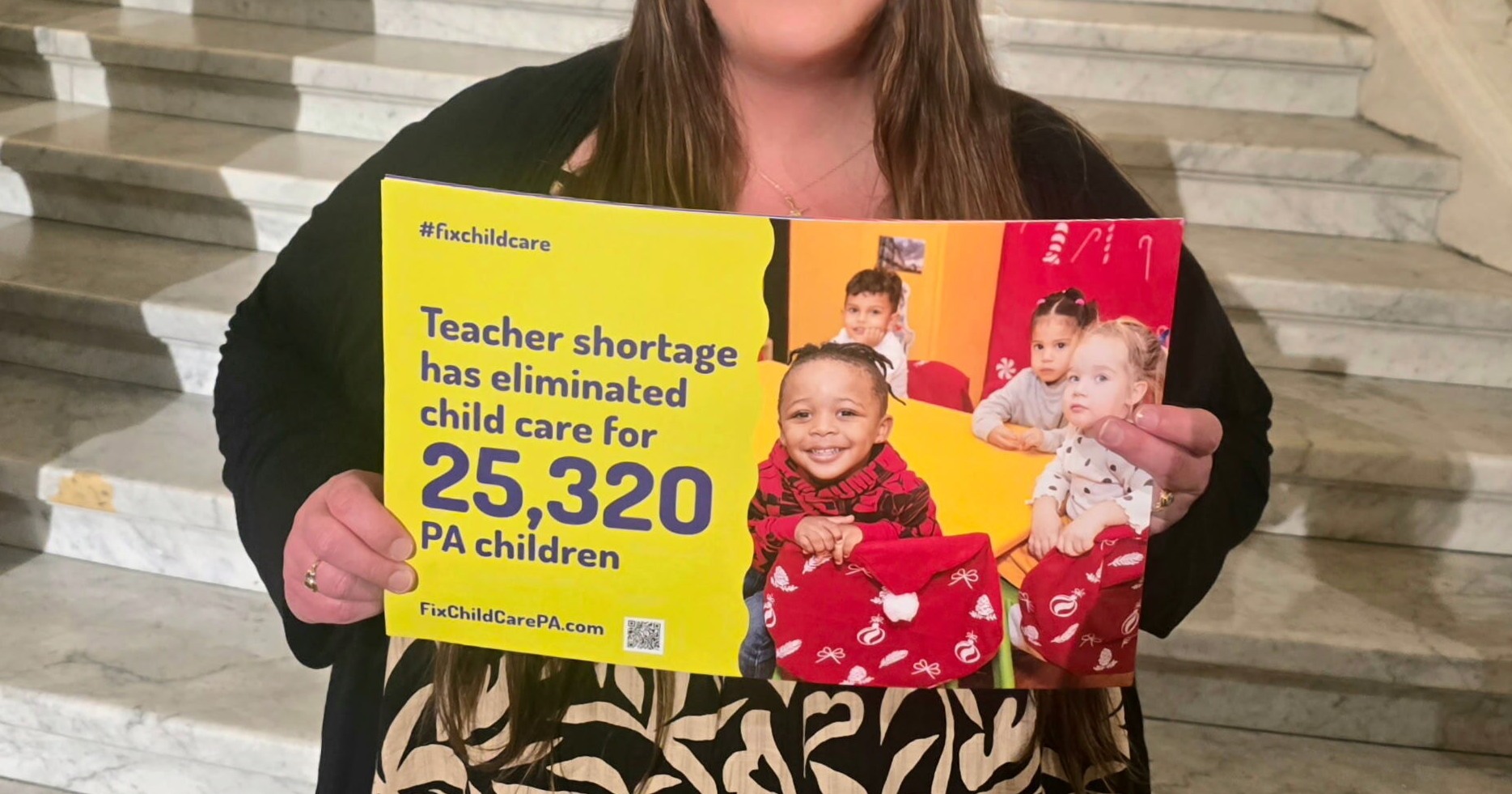
A September survey conducted by the Start Strong PA Campaign of 1,140 state child care providers showed that 92% of child care programs reported challenges in recruiting staff, with 85% struggling with teacher shortages that are leaving more than 3,000 unfilled positions statewide. Programs could serve an additional 25,320 children if they could recruit and retain the necessary staff, and these numbers represent less than 18% of the total open registered programs in Pennsylvania.

“Right now, we serve 120 children,” said Brie Rice, program specialist at Irwin’s JB’s Bright Beginnings. “But here’s the heartbreaking reality: We’re licensed for 350.”

Amy Bradley, president and CEO of the Cambria Regional Chamber of Commerce, said that in a September survey, 100% of the 23 providers that responded in Cambria County said they face challenges recruiting the staff they need, resulting in 64 unfilled staff positions and 748 child care spaces unavailable for working families.

Dr. Leah Spangler, CEO of Johnstown’s The Learning Lamp, said there are 48 unfilled child care educator jobs in Somerset, Cambria, and Fayette counties. If fully staffed, a total of 297 more children could be served.

“I wear two hats that feel impossible to balance most days,” said Sara Sisler, parent and director of curriculum, environment, and development at Judy Early Education Group. “I’m not only a parent of two young children who rely on child care, but I’m also an early educator in the field. I have witnessed the recruitment and retention challenges firsthand, as the turnover rates in our centers are at an all-time high.”

Stephanie McAdoo, director of Indiana County’s Indi Kids said it is challenging to fill open child care positions because “teachers make less than cashiers at Sheetz or Target.” 

And Dan DeBone, president and CEO of the Westmoreland County Chamber, noted that polling data has shown that Pennsylvania voters overwhelmingly support increased funding to grow early childhood care and education programs. A Susquehanna poll found that Pennsylvania voters believe that early childhood education is an important component of a child leading a healthy and productive life (98%), support increasing state funding for teacher recruitment and retention (83%), and back more funding to increase pre-k teacher compensation (72%).

The discussion between the county leaders, educators, and parents can be viewed online.