Developmentally Appropriate Parenting Series: Part V

News

March 26, 2021

Developmentally Appropriate Parenting Series: Part V

Safety

About

Though eager to explore the world around them, infants, toddlers, and children lack the skills and knowledge to protect themselves. Parents and caregivers play the most vital role in keeping their children out of harm’s way on a day-to-day basis, as well as equipping them with the safety skills they need to prevent injury and in the event of an emergency. 

Trying Together developed resource content to help guide parents and caregivers in taking steps to eliminate hazards and create safe spaces for children in and out of the home.

Featured Resources

Creating Safe Environments for Infants, Toddlers, and Young Children

Though most unintentional injuries can be prevented, they are the leading cause of morbidity and mortality among children in the United States. As a parent or caregiver, it’s important to continuously take steps to eliminate hazards and create safe spaces for children in the home and out of the home. Read this post to learn more about childproofing.

Creating a Safe Sleep Environment for Children

When you implement safe sleep practices, you can help protect your infant and babies from sudden unexpected infant death (SUID) and young children from other hazards like suffocation and strangling. Learn how to create a safe sleeping environment to reduce the risk of injuries.

Car Seat Safety

Car crashes are a leading cause of injury or death for children. The best way to keep your child safe every time you get in a vehicle is to ensure that you’re using the right car seat and that you’re using it the correct way.

Safe Interactions Between Pets/Animals and Young Children

We love our pets and animals, but it’s important to take the steps to ensure that they can coexist safely. This post explains how to use proper hygiene around animals, how to teach your child how to interact with animals, and what to do in the event of a bite or attack.

Teaching Young Children About Interacting with Strangers

The generalization of “never talk to strangers” doesn’t fully educate children about how to keep themselves safe. This post offers tips for parents and caregivers  to teach children how to identify and respond to dangerous situations.

Discussing Emergencies with Young Children in a Non-Threatening Way

Children’s abilities to cope with stressful or frightening situations improve when they know more about what is happening and feel that they are able to help protect those closest to them. This post outlines non-threatening ways to approach emergency topics while helping children feel empowered.

Creating an Emergency Kit for Your Family

Emergencies like natural disasters, fires, injuries, and other crisis situations can happen in the blink of an eye. Use this checklist to create an emergency kit together with your children. They will learn the basics of staying safe during an emergency.


More Information

To stay up-to-date on available resources, follow Trying Together on Facebook and Twitter or sign up to receive our newsletter.

 

Developmentally Appropriate Parenting Series: Part VI

News

March 24, 2021

Developmentally Appropriate Parenting Series: Part VI

Social-Emotional Development

From infancy through adulthood, social-emotional skills are intertwined with every aspect of our daily lives. These skills enable us to communicate our needs, wants, and ideas; build relationships; communicate emotions; and handle conflict effectively.

To help guide families in supporting their children’s social-emotional development, Trying Together published resources on topics including social-emotional activities, navigating difficult emotions, respecting boundaries, available resources and support services, and more.

Featured Resources

Supporting Social-Emotional Development Through Play: A Guide for Families

Supporting Social-Emotional Development Through Play: A Guide for Families explores the range of social-emotional skills and activities caregivers can use to support their children’s development.

Strategies to Support Social-Emotional Development: A Guide for Families

Strategies to Support Social-Emotional Development: A Guide for Families, Trying Together explores the meaning of social-emotional development and strategies that caregivers can use to help build their children’s social-emotional toolkits.

Navigating Difficult Emotions as Caregivers: A Guide for Families

Navigating Difficult Emotions as Caregivers: A Guide for Families lists strategies parents and caregivers can use to manage difficult emotions.

Social-Emotional Development: Family Resources

Social-emotional skills play an important role in the lives of parents, caregivers, and children. To access resources for support, read this post!

Art Activities that Encourage Social-Emotional Development

Children explore social-emotional skills during play. Art activities are a great way to introduce your child to new topics in a playful way. Learn more.

Respecting Your Child’s Boundaries

Every person has their own preferences when it comes to physical touch, and that includes young children. Learn more.

Additional Topics

Additional topics and resources are available. To view the full list, visit the Developmentally Appropriate Parenting page.

More Information

Resources will be added to the website as they are finalized, with several resources available as printable PDFs. To stay up-to-date on available resources, follow Trying Together on Facebook and Twitter or sign up to receive our newsletter.

 

Family Infant Oral Health Televisit, University of Pittsburgh

News

February 3, 2021

Family Infant Oral Health Televisit, University of Pittsburgh

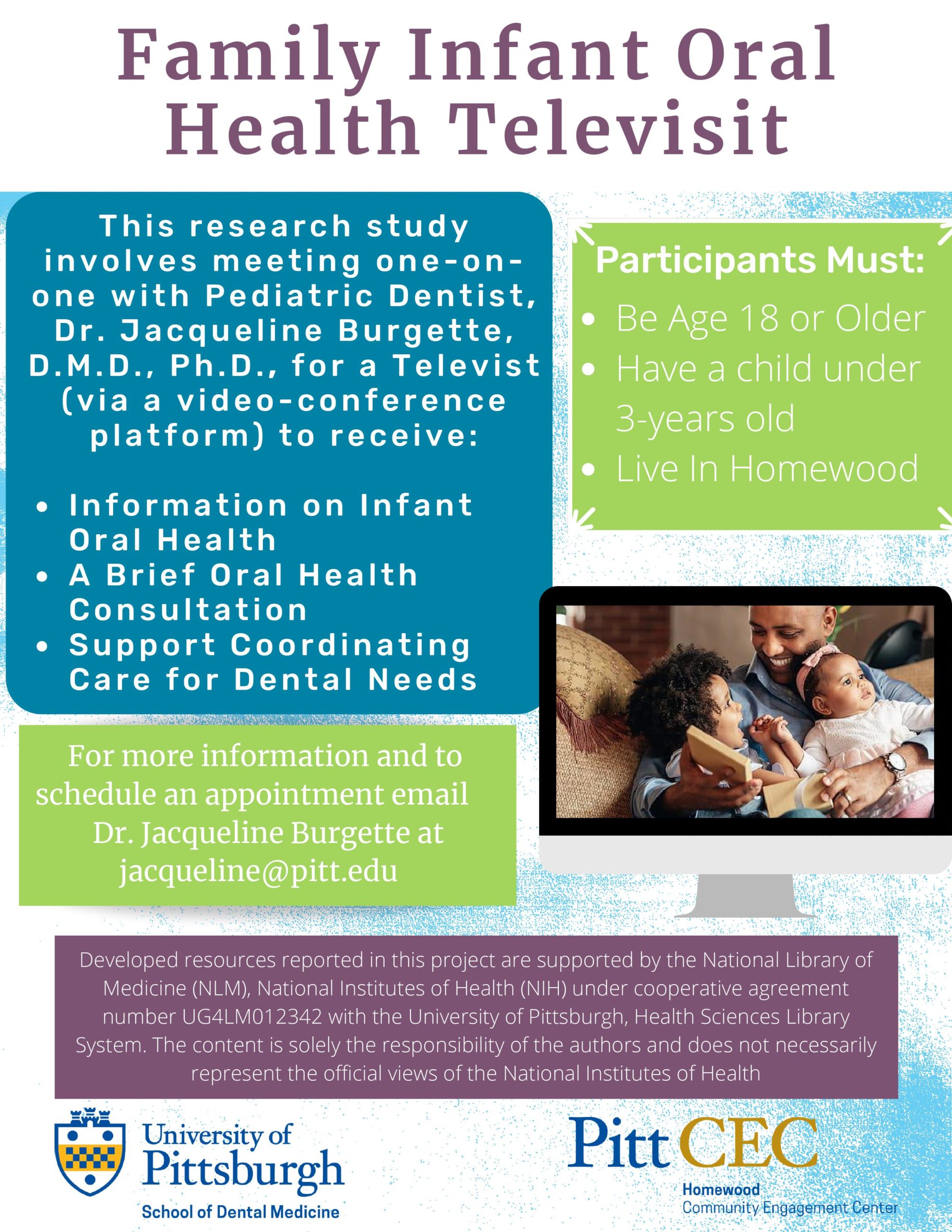
Are you interested in keeping your child cavity-free during the pandemic? Schedule a free Virtual Oral Health Visit for tips on toothbrushing for young children and getting your child dental care.

About

This research study involves meeting one-on-one with mom and Pediatric Dentist, Jr. Jacqueline Burgette, D.M.D., Ph.D., for a televisit on Zoom to receive information on Infant Oral Health, a brief Oral Health Consultation, and support coordinating care for dental needs.

This opportunity has been provided by the University of Pittsburgh School of Dental Medicine and the Pitt Homewood Community Engagement Center (CEC). Share this flyer with your family and friends.

Schedule A Visit

For more information and to schedule a televisit, email at jacqueline@pitt.edu.

Through the Eyes of a Child, Harvard Medicine

News

January 21, 2021

Through the Eyes of a Child, Harvard Medicine

About

Direct and indirect exposure to racism and discrimination during early childhood can have lifelong impacts on a child’s development, physical health, and general wellbeing.

In “Through the Eyes of a Child,” Elizabeth Gehrman explores these topics and more, including: racial trauma; the difference between positive, tolerable, and toxic stress; lifelong impacts on health; trauma-informed care; and more.

Featured Quotes

    • “We do surveys with Black youth here in Pittsburgh, and kids ages 10 to 15 are reporting that people have been racist toward them. By tenth grade, about fifty percent of them have encountered racial discrimination.” – James Huguley, Interim Director of the University of Pittsburgh’s Center on Race and Social Problems
    • “The general public belief is that early experiences don’t have lasting impacts until kids get older. But now we know that even very young kids are affected. Biology makes it clear: The body doesn’t forget. Early experiences both positive and negative literally shape the architecture of the developing brain and other biological systems from the beginning.” – Julius B. Richmond FAMRI Professor of Child Health and Development at the Harvard T.H. Chan School of Public Health and Harvard Graduate School of Education
    • “Part of the work of becoming an adult is learning how to modulate the fear response and move toward safety. But when the sense of threat never goes away, and you’re in a chronic state of seeking safety, that short circuits higher-order functions.” – Alisha Moreland, Director of Trauma-Informed Treatment, Consultation, and Outreach at McLean Hospital’s Center of Excellence in Depression and Anxiety Disorders
    • “No child can survive significant adversity by pulling themselves up by the bootstraps. But whether it’s a parent, a childcare or health care provider, a neighbor, or a teacher, just one person can confer the protective effect, bringing the stress system back to baseline by providing caring support.” – James Huguley, Interim Director of the University of Pittsburgh’s Center on Race and Social Problems

Access This Resource

To read the full article, visit the Havard Medicine website.


Housing Resources for Families in Allegheny County

News

December 23, 2020

Housing Resources for Families in Allegheny County

Housing and Eviction Resources

If your family is at risk for eviction or homelessness, resources and programs are available to help.

Housing Stabilization Program

The Urban Redevelopment Authority’s Housing Stabilization Program provides one-time or short term (up to three months) financial assistance to households who are facing a temporary, non-reoccurring housing crisis. Depending on which type of support is needed, you may be able to receive funding to cover move-in fees, utilities, rent, mortgage payments, and legal fees.

Eligibility

To qualify, individuals must:

    • be a renter or homeowner,
    • live in the City of Pittsburgh,
    • develop a stability plan with a service provider.

Apply For This Program

If you are eligible, contact Untiled Way by dialing 211 or texting your zip code to 898.211. Interested applicants may also contact United Way via chatroom (located at the bottom right of the webpage) or the online contact form.


Housing Legal Assistance Program

The Housing Legal Assistance Program assists individuals through the following services:

    • Tangled-Title: Legal assistance of up to $5,000 if you own a home but need the deed transferred to your name.
    • Eviction Prevention: Legal assistance of up to $3,000 if you are at risk of eviction or are currently experiencing eviction and need legal assistance.

Eligibility

To qualify for Tangled-Title assistance, individuals must live in the City of Pittsburgh, have an income that is at or below 80 percent of the Average Monthly Income, and not have any outstanding City, School, and County real estate taxes (or must be on a payment plan for at least three months.

To qualify for Eviction Prevention assistance, individuals must live in the City of Pittsburgh, have an income that is at or below 50 percent of the Average Monthly Income, and be experiencing wrongful threats of lock-out, eviction, or sub-standard living conditions.

Apply For This Program

To apply for Tangled-Title assistance, contact United Way by texting your zip code to 898-211 or by dialing 211. To apply for Eviction Prevention, call 412.255.6574 or email hof@ura.org.

For more information, contact Victoria Jackson at 412.255.6696 or hof@ura.org.


Just Mediation Pittsburgh

Just Mediation Pittsburgh offers free, confidential mediation services to landlords and tenants who are looking to find solutions to housing disputes. Just Mediation Pittsburgh mediators facilitate a dialogue between both parties to identify positive solutions and create a shared, legally binding agreement.

Request Services

Participation in these services is voluntary. Both parties must be willing to share their perspectives, listen to the other individual’s perspective, and create constructive solutions. To request services, visit the Just Mediation Pittsburgh page. For more information, contact 412.228.0730 or info@justmediationpgh.org.


Allegheny Link

If you are experiencing a housing crisis, the Allegheny Link can help connect you to resources. The Allegheny Link will assess your eligibility for homeless supports such as rental assistance, utility assistance, and homeless services.

Range Of Services

The Allegheny Link assists Allegheny County residents:

    • who are experiencing or at risk of homelessness in finding stable housing,
    • who are pregnant, or parents and caregivers of children up to age six years of age, get referrals to home visiting programs,
    • who are over the age of 60 live safely in their community, and
    • with any disability find services that meet their needs.

Contact

If you are in need of services, contact the Allegheny Link at 1.866.730.2368. This line will be open Monday through Friday from 8 a.m. to 7 p.m. Callers between 7 p.m. and 8 a.m. will be directed to appropriate supports by an automated message. Individuals can also contact the Allegheny Link via email. This method is especially suggested for individuals who are deaf or hard of hearing.


Rental Payment Assistance

The Department of Public Assistance has an Emergency Shelter Fund that provides financial assistance to help individuals prevent eviction or foreclosure, obtain permanent housing, or obtain temporary shelter. Individuals must be receiving public assistance benefits to qualify. For more information, contact 412.565.2146.


Fair Housing Partnership of Greater Pittsburgh

Do you feel you have been the victim of housing discrimination? Fair Housing Partnership of Greater Pittsburgh investigates allegations of housing discrimination. If you have been a victim of housing discrimination, all of their services are free of charge.

Report Discrimination

To file an anonymous complaint, or to speak with a member of their staff, call 412.391.2535. Individuals can also report discrimination by completing this online form.


Shelter Directory

Pennsylvania’s Education for Children and Youth Experiencing Homelessness (ECYEH) Program has a Shelter Directory on its website that contains a filterable list of emergency shelters and housing providers. Shelters and providers included on the list accept homeless families and/or homeless youth. Some shelters and providers may admit single adults. Access the Directory.


More Information

Visit the Allegheny County website to learn more about housing subsidies, mortgage assistance, homelessness, discrimination support services, and more. If you are experiencing homelessness, visit the Homeless Services page.


Physical Education Vocabulary for Kids

News

December 21, 2020

Physical Education Vocabulary for Kids

About

In addition to teaching exercises, physical education teaches children vocabulary words such as muscle, pulse, and endurance to help them better understand their bodies. To help your child better understand healthy activities, check out this resource from PlaygroundEquipment.com! For extra fun, try making and decorating vocabulary flashcards to practice at home!

View This Resource

To view the list, visit PlaygroundEquipment.com.


Child Care Emergency Plan, Child Care Aware of America

News

December 14, 2020

Child Care Emergency Plan, Child Care Aware of America

About

Child Care Aware of America reported that 38 percent of parents were unsure of their child care provider’s emergency plan, with another 7 percent stating that their program doesn’t have one. To ensure your child’s safety, Child Care Aware recommends that caregivers be proactive by asking their child care provider these 10 questions.

Recommended Questions

    • Do you have an emergency preparedness plan for disasters that are likely to occur in our area?
    • How will you safely evacuate my child to a safe, predetermined location?
    • How and when will I be notified if a disaster occurs when my child is in child care?
    • If I can’t get to my child during or after a disaster, how will you continue to care for my child?
    • Have you and your staff received training on how to respond to my child’s physical and emotional needs during and after a disaster; for example, are all staff first aid and CPR-certified?
    • Will you teach my older child what to do in an emergency?
    • Do you have a disaster/supply kit with enough items to meet my child’s needs for at least 72 hours?
    • Do the state and local emergency management agencies and responders know about your child care program and where it is located?
    • How may I help you during and after a disaster?
    • After a disaster occurs, how will I be notified about your plan to reopen?

More Information

This information was provided by Child Care Aware of America. Visit their website for more information about emergency preparedness!


What Types of Child Care Are Available?

News

What Types of Child Care Are Available?

About

Did you know that there are several types of early childhood education and care programs that you can enroll your child into? To find a program type that works best for your family, review the options listed below.

Available Program Types

Child Care Center

At a child care center that is state-certified by the Office of Child Development and Early Learning (OCDEL), care and education services are provided to more than seven children.

Family Child Care Home

In a family child care home that is state-certified by OCDEL, one caregiver provides care and education services for three to six children who are not related to them in a home setting.

Group Child Care Home

In a group child care home that is state-certified by OCDEL, care and education services are provided for up to 12 children in a home or commercial setting.

Relative Care

Through relative care, one caregiver provides care and education services for no more than three related children in a home setting who may be eligible for subsidy reimbursement.

Public School

A public school provides pre-kindergarten programming. These schools may be publicly or privately funded.

Private School

A private school provides pre-kindergarten programming. These schools are funded by the individual family or school.

Other Things to Consider

Child Care Works

Through Child Care Works, federal and state-supported child care subsidies are provided to income-eligible families who either work or attend school or training programs and pay a co-pay. Subsidies are paid directly to a provider in a home, child care center, or community-based setting. To see if you are eligible or to receive assistance in finding child care, contact your local Early Learning Resource Center (ELRC).

Head Start

Head Start is a federally-funded comprehensive early childhood education program supplemented by state investment. Through the program, infant, toddler, and pre-kindergarten opportunities are provided at no cost to income-eligible families (100% of poverty). Children with developmental delays or disabilities, as well as children who are learning English as a second language, may also qualify. Programs are found in homes, child care centers, schools, and community-based settings. To see if you are eligible or to receive assistance in finding child care, contact your local ELRC.

Pre-K Counts

Pre-K Counts provides state-supported high-quality pre-kindergarten opportunities at no cost to income-eligible families (300% of poverty). Children with developmental delays or disabilities, as well as children who are learning English as a second language, may also qualify. Pre-K Counts classrooms are found in child care centers and schools. To see if you are eligible or to receive assistance in finding child care, contact your local ELRC.

School Districts

School districts allocate funds from their general fund to support their pre-kindergarten programs.

Privately Funded Birth to Kindergarten

Privately Funded Birth to Kindergarten is user-funded programming that is often provided by a nonprofit, for-profit, religious organization, or university.

Child and Adult Care Food Program

The Child and Adult Care Food Program (CACFP) provides aid for the provision of nutritious foods for children birth through school age. To learn more about this program, visit the Pennsylvania Department of Education website.

Quality Assurance

Keystone STARS is Pennsylvania’s quality rating and improvement system for early learning programs. NAEYC, NAFCC, and NECPA accreditation are voluntary private-pay national initiatives. Each ELRC offers access to information, services, and resources to promote high-quality early childhood education. Quality Coaches provide support and technical assistance to programs working to build quality.

Home Visiting Programs and Support Services

Home visiting services give parents and others raising children the support necessary to improve their health, safety, literacy, and economic self-sufficiency. Trained professionals visit women, families, and children to provide parent education and support in order to promote child well-being and development. The six evidence-based home visiting models in Pennsylvania include Early Head Start, Family Check-Up, Healthy Families America, Nurse-Family Partnership, Parents as Teachers, and SafeCare Augmented.

Early Intervention

Early Intervention is a system of publicly-funded services for children birth to age five with developmental delays or disabilities. Early Intervention supports and services are embedded in typical routines and activities within the family, community, and/or early care and education settings. Parents who have questions about their child’s development can call the CONNECT Helpline at 1.800.692.7288.

Print This Resource

This resource is available as a printable PDF. For additional assistance in finding an early learning program that meets your needs, check out our family guide, “How to Find, Choose, and Pay for High-Quality Child Care.”


The Science of Early Childhood Development, Center on the Developing Child

News

The Science of Early Childhood Development, Center on the Developing Child

About

Are you interested in learning why early childhood is such an important period of growth? Watch this video from the Center on the Developing Child at Harvard University!

Featured Quotes

    • “If a child is preoccupied with fears or anxiety, or is dealing with considerable stress, no matter how intellectually gifted that child might be, his or her learning is going to be impaired by that kind of emotional interference.”
    • “When we talk about healthy development in the early years, and particularly when we talk about preparing children to succeed at school, we cannot separate cognitive development from social and emotional development. You can’t have one without the other.”
    • “Excessive prolonged stress early in life is associated with a higher prevalence later, not only of learning problems and behavioral difficulties but also physical and mental health problems.”

Watch the Video

More Information

To learn more, visit the Center on the Developing Child website.


The Brain Architects Podcast, Center on the Developing Child

News

The Brain Architects Podcast, Center on the Developing Child

About

Launched in January 2020 by the Center on Child Development at Harvard University, The Brain Architects Podcast explores common questions that parents and caregivers have during the early periods of their child’s life. The podcast brings together experts and practitioners from pediatrics, social services, education, and other fields of study to help guide caregivers in improving the lives of their young children.

Featured Topics

The podcast explores a variety of early childhood topics, including, but not limited to self-care, toxic stress, serve and return, brain architecture, mental health during COVID-19, and more.

Learn More

To start listening, visit the podcast webpage.