News

June 22, 2026

Thriving Kids Episode Discusses How to Support Children’s and Your Own Mental Health

Most people don’t want to just exist to get through life – but rather, they would at some point like to thrive, a notion that is explored in the latest Thriving Kids podcast.

Learn More

Psychologist Alfiee Breland-Noble, PhD, MHSc, has spent years studying what gets in the way of thriving for young people and what helps. One of her key takeaways is that the way we care for our own mental health teaches children how to care for theirs.

On the latest Thriving Kids podcast, Dave Anderson, PhD, senior psychologist and vice president of public engagement and education for The Child Mind Institute, joins Breland-Noble, founder of the mental health nonprofit The AAKOMA Project and author of “Rise and Thrive,” to discuss this topic.

The discussion focuses on what her research reveals about the pressures on young people – including the nonstop news cycle – as well as why social media can be a risk and, for others, a genuine lifeline. They also discuss how trusted voices and community can chip away at stigma.

Some of their tips on how to support a child’s mental health and one’s own include:

  • Get children used to talking about feelings before there is a problem; talking openly and regularly about emotions helps to normalize mental health, so it feels less scary or shameful when something harder comes along.
  • Show children how to cope and don’t just tell them what to do; children pick up coping habits by watching the adults around them, so name your own feelings and what you do about them aloud.
  • Taking care of your mental health is part of parenting, not a luxury; managing your own stress is one of the best ways to keep children from absorbing it and tending to your own well-being shows them that practicing mental health care is something grown-ups do.
  • When upsetting news comes up, help children process it; if something is frightening in the news, it’s better for children to hear it from you – calmly present the facts – so you can set the emotional tone.
  • Take their online life seriously and stay curious about it; rather than dismissing social media’ impact, check in regularly and ask children about notice how particular apps, feeds, and comments make them feel.

For more information, listen to the Thriving Kids podcast.

News

May 4, 2026

Report Details Trying Together’s Participation in Child Care Sector Quality Initiative

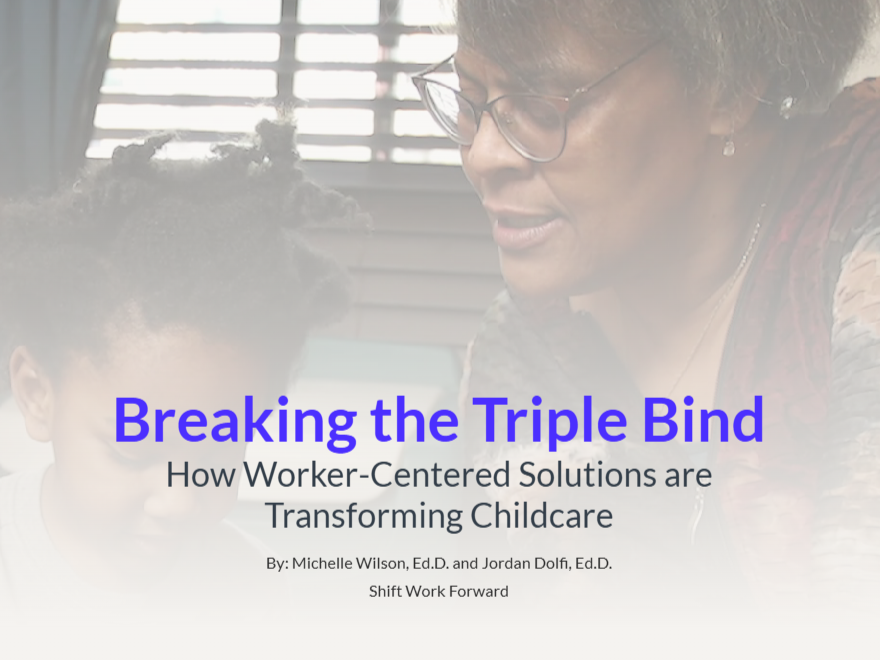
Shift Work Forward – a national organization aimed at redesigning workforce systems to advance racial equity and improve job quality – recently released a report on the national crisis facing the child care sector and the work done in four communities that focused on the workforce.

Learn More

The report, Breaking the Triple Bind: How Worker-Centered Solutions are Transforming Childcare, details the partnerships between Shift Work Forward and organizations from Pittsburgh, Baltimore, Akron, and Des Moines. As part of the Shifting the Childcare Industry initiative, local partners worked in their communities to build or strengthen cross-sector coalitions that took on a shared challenge: improving job quality in childcare by centering the people who do the work.

Each community involved in the initiative approached it from a different starting point and pursued a different intervention that was shaped by local conditions. 

Trying Together was part of a tri-sector coalition in Pittsburgh that also included Partner 4 Work and the Allegheny Department of Children Initiatives. This coalition focused on educator mental health and co-designed workplace-based supports to improve teacher retention and job quality. 

During the project, 168 frontline educators across 10 Pittsburgh programs shared their experiences, providing data for the initiative and helping to shape its direction. These educators identified mental health support as the priority.

The Pittsburgh organizations launched mental health supports with a shared coach across 14 centers and co-created an onboarding passport that standardized onboarding and aimed to ensure that new hires felt capable and confident in doing their jobs.

The coalition also created a Wellness Navigation model designed around how workers experience stress, burnout, and other mental health concerns on the job that was piloted by eight child care centers that embedded mental health support directly into child care workplaces.

Each participating program chose an educator to serve as a wellness navigation champion – a peer who was trained and compensated for their time. Champions provided support to their colleagues, helping them navigate wellness resources and connect to the type of help they needed. The local coalition also partnered with a licensed therapist to develop on-demand, one-on-one mental health coaching support through a team of practitioners for early educators. 

“We ask educators to hold so much – children’s emotions, families’ stress, systems that are under-resourced,” explained Cara Ciminillo, executive director for Trying Together. “This project starts with a simple truth: If we want children to thrive, we have to care for the health of the people who care for them.”

Shift Work Forward supported the coalition through the process with equity-centered coaching and technical assistance that helped the partners navigate their differences and stay focused on job quality as the through-line from design to implementation.

To learn more about the initiative and the work that was accomplished by the Pittsburgh coalition, read Shift Work Forward’s report.

News

March 4, 2026

Disability and Mental Health Summit

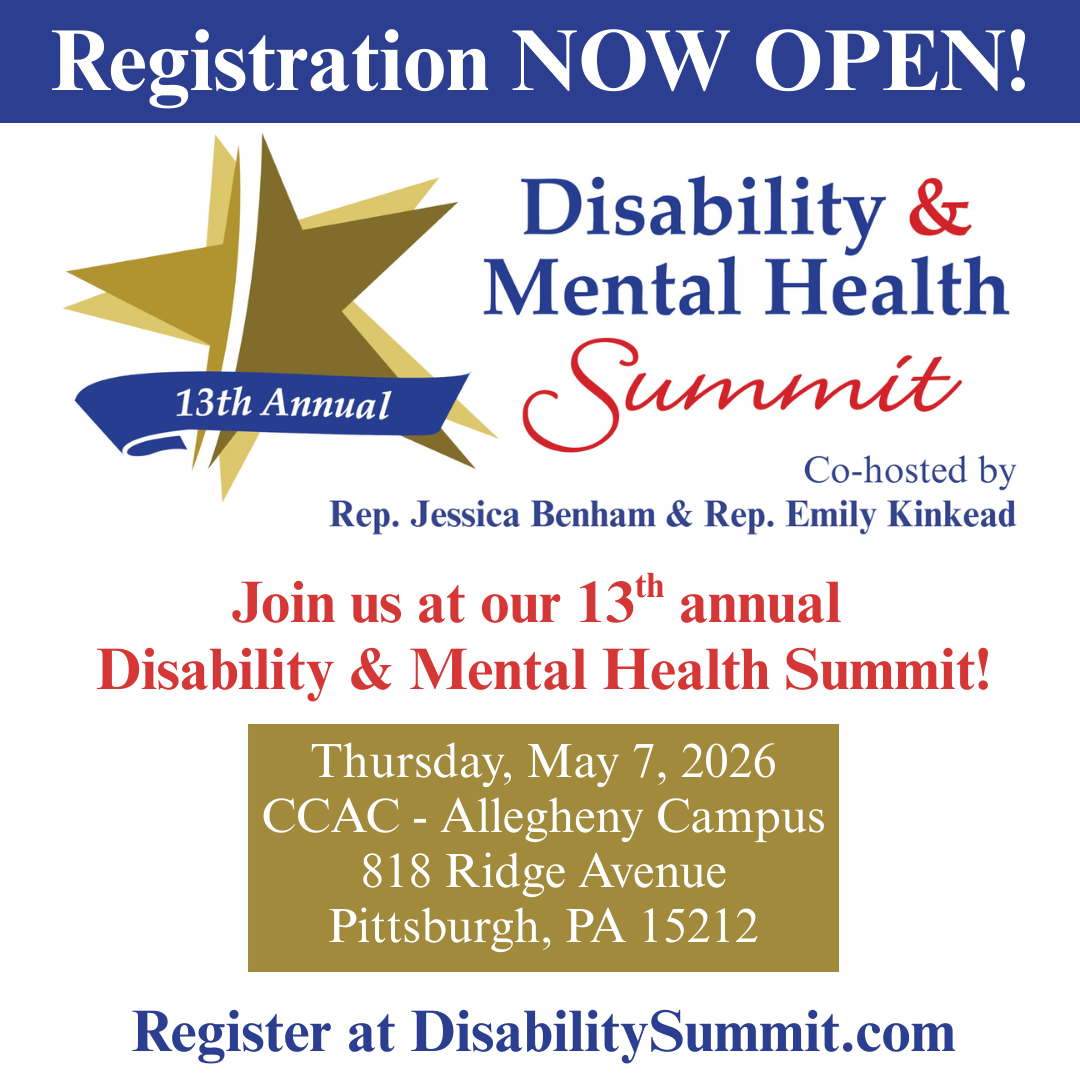
Trying Together will present a session at the 13th Annual Disability and Mental Health Summit on Thursday, May 7 and have a table at its resource fair.

Learn More

The summit will be co-hosted by state Reps. Jessica Benham (D-36th District) and Emily Kinkead (D-20th District) at the CCAC – Allegheny Campus, located at 818 Ridge Avenue.

Trying Together will host one of the sessions at the summit and set up a table during its resource fair.

The summit is a free event that brings hundreds of people and participating organizations together to share information on a wide variety of topics in the disability and mental health arena. Its aim is to bring resources and experts out of their office and into a single, easy-to-access environment in which people can meet face-to-face to better solve problems and enhance futures.

This year will have a larger resource fair, more free information sessions than last year, and a greater partnership with schools that will bring even more transition-aged young adults to the event to help them figure out their next steps.

Registration is open. The full schedule for the summit is available on its website.

News

January 30, 2026

Trying Together Calls for Presentation Proposals for June UnConference

Trying Together invites those interested in presenting at its June 11 UnConference, “Out-of-School Time,” to submit proposals for presentations relating to that topic by Friday, March 6.

Learn More

Trying Together’s UnConference is an innovative, hands-on professional development training format where a deeper experience is provided around a particular theme related to early childhood education. Speakers are invited to present and participants are encouraged to engage hands-on in the workshops.

Trying Together, in partnership with APOST and Allegheny County DHS, will host UnConference: Out-of-School-Time, on Thursday, June 11. More details will follow on the location and time. PQAS and Act 48 credits will be available for attendees.

Presentation Topics

Trying Together is seeking a focused range of topical presentations for the UnConference, which will focus on the topic of out-of-school-time. The audience for the UnConference will be educators, staff, and administrators working with children in summer programs, engaged parents and caregivers, and early childhood education and out-of-school time advocates.

Those submitting proposals should design them to fit a 90-minute session. Appropriate topics include – but are not limited to:

  • Mental health and social-emotional well-being
  • Poverty responses
  • Trauma-informed practices for OST programs
  • Positive behavior management
  • Game-based learning strategies
  • Project-based learning for after school and summer programs
  • Managing interpersonal conflict among staff
  • Parent and family engagement for OST programs
  • The importance of play

Proposals will be selected based on a variety of criteria, including the extent to which the proposal targets and is relevant to the ECE workforce, experience or expertise of presenters, definition and focus of the topic, ability to engage participants in discussion and hands-on learning experiences, practical application of material and takeaways, and timeliness and importance of the topic.

Each workshop proposal should encourage active learning; present culturally inclusive ideas, practices, and/or relevant research aimed at positioning attendees as leaders at the early learning programs in which they work; offer strategies for effective implementation of information acquired; include presenters who have significant expertise in the topic area; and cover a 90-minute block of time.

Submitting a Proposal

Trying Together will offer a stipend of $250 for any organization or individual whose proposal is chosen to be presented at the UnConference. Proposals will be due on March 6 and, on March 16, applicants will be notified about the status of their proposal. Presentation slides and materials as well as an overview of the presentation will be due on May 28.

To submit a proposal, applicants should download the submission form and save it to their desktop. Then, submit the proposal as an attachment to learning@tryingtogether.org with the subject line “June 2026 UnConference Proposal” no later than 11:59 p.m. on March 6.

For more information on submitting proposals for Trying Together’s UnConference, check out this flyer

Trying Together recognizes that summer programs may not have hired their summer staff yet. If you know how many staff you plan to send to the UnConference, we strongly encourage you to reserve their spots now. We will follow up later to get staff contact information. To reserve spots for your staff, email Gabby Lisella at gabby@tryingtogether.org.

News

January 19, 2026

Child Mind Institute Resources Focus on Seasonal Affective Disorder in Children

Seasonal affective disorder – also known by the acronym SAD – is a type of depression that comes and goes with the seasons. 

For most people, the disorder appears in the winter months and fades when the weather gets warmer. The Child Mind Institute has put together some resources on how to tell if a child is feeling down due to the season or if they are dealing with something more serious.

Learn More

Experts aren’t exactly sure what causes SAD, but some believe that a lack of sunlight affects chemicals in the brain that impact mood and energy levels. However, a lot of people experience symptoms that look like depression during the winter.

SAD and other types of depression can be challenging to identify depending on how or when they appear. The institute provides resources on premenstrual dysphoric disorder, a type of depression tied to the menstrual cycle that is a severe form of the more common PMS.

There are articles on treatments for depression, including different types of therapy and medication, and a video in which experts explain how to recognize signs of mental health challenges in teens. 

There is also a resource on behavioral activation, a therapy commonly used to treat SAD. The therapy involves getting children to do things – such as take a walk or talk to a friend – even if they don’t feel like it.

Below are the Child Mind Institute’s resources on seasonal affective disorder.

News

May 21, 2025

Theiss Training Center to Hold Three-Part Online Course on Childhood Trauma

The University of Pittsburgh’s Theiss Training Center for Trauma and Early Childhood Mental Health will host a three-part online course revolving around trauma in August and September.

Learn More

Becoming Trauma Aware, Informed, and Proficient is a virtual training series that is designed specifically for professionals working with young children and their families in early childhood settings. The courses in the series can act as standalone classes or participants can attend all three.

Teri Pentz, LCP, IMH-E® Mentor (Clinical), will lead the three courses on Microsoft Teams. Links for the courses will be shared with participants after they register.

Becoming Trauma Aware

The first course, Becoming Trauma Aware, will discuss the path to becoming trauma proficient and begins with a basic understanding of trauma and what children’s reaction to trauma can look like in the context of play and behaviors.

The session will lay the foundation for understanding trauma by developing an awareness of what it is and how it reveals itself. Attendees will discuss the basic definition and different types of trauma and reactions to it. They will also explore trauma in early childhood and what it can look like when processed through behavior.

The class will run from 1 p.m. to 2 p.m. on Thursday, August 21. Other details include:

  • One hour of PQAS or Act 48 credit will be available. There is no cost to attend or for PQAS hours, but Act 48 hours will incur a separate fee.
  • PD Registry Course: 153308
  • Event ID: 379298
  • Register

Becoming Trauma Informed

With a basic awareness of what trauma looks like in children, this second session will take a look at recent understanding of early brain development. It will discuss how babies’ brains develop in tandem with close relationship building, how trauma disrupts relationships and the building of “brain architecture” during this stage, and how strong relationships can build resilience when trauma is present.

The session will run from 1 p.m. to 2:30 p.m. on Thursday, September 4. Other details include:

  • Attendees can receive 1.5 hours of PQAS or Act 48 credits. There is no cost to attend or for PQAS hours, but Act 48 hours will incur a separate fee.
  • PD Registry Course: 153309
  • Event ID: 379301
  • Register

Toward Trauma Proficiency

The third training applies information presented in the second session. Looking at a case study, the group will analyze trauma and relationship information that may indicate early traumatic experiences impacting the child’s current psychological functioning. 

It will then assess behaviors presented to identify classroom strengths that support children whose needs are met and understand how to identify children whose history and behaviors may indicate a need to refer for services.

The class will run from 1 p.m. to 2:30 p.m. on Thursday, September 18. Other details include:

  • Attendees can receive 1.5 hours of PQAS or Act 48 credits. There is no cost to attend or for PQAS hours, but Act 48 hours will incur a separate fee.
  • All can attend but prior completion of “Becoming Trauma Informed” is required to receive PQAS or Act 48 credits.
  • PD Registry Course: 153312
  • Event ID: 379303
  • Register

News

April 17, 2025

Black Families and Youth Mental Health: Panel Discussion

The Child Mind Institute will host a virtual panel discussion on Wednesday, May 14 to discuss findings of a study on mental health support for Black families.

Learn More

The institute, in partnership with The Steve Fund, recently released findings from its mental health support for Black families study. The comprehensive literature review and nationally representative survey exposes a shift in views toward mental health within the Black community – and highlights significant gaps in access and quality of mental healthcare. The study was made possible by the Morgan Stanley Alliance for Children’s Mental Health.

During the panel discussion, experts will discuss the findings of the study and how mental health professionals, organizations, and communities can break down barriers and improve the quality of mental health care for Black children and young adults.

Topics will include:

  • Shifts in views toward mental health
  • Parent vs. young adult response to stigma
  • Barriers to quality care
  • Medication skepticism
  • Intervention and prevention initiatives

Continuing medical education credits for psychiatrists and continuing education credits for psychologists and social workers are available to registered course participants.

The event will run from noon to 1:30 p.m. ET on May 14. Register now.

News

June 4, 2024

Brazelton Touchpoints Center: Supporting Social-Emotional Development and Well-Being

Brazelton Touchpoints Center is hosting a workshop that will explore strategies to cope with the impact of the challenges that the world is facing. The workshop will also discuss how to heal through relationship-based care practices.

Learn More

Supporting Social-Emotional Development and Well-Being is a three-part interactive workshop series.

The cumulative stresses of the modern world affect everyone’s mental health, from children to families and providers. Support for social-emotional development enables us to enhance the relationships necessary for everyone’s mental health.

The webinar will take place on Tuesdays from 9:30 a.m. to 11:30 a.m. ET on the following dates:

  • July 16: Development of Social-Emotional Competence in the Context of Trauma
  • July 23: Relationship-based Practices for Enhancing Family-Child Relationships and Mental Health
  • July 30: Building Your Own Resilience and Mental Health

More Details

The course is aimed at professionals who work with families of young children, including child care educators, family child care providers, home visitors, pediatricians, and early intervention educators.

The webinar is $170 per seat.

News

Brazelton Touchpoints Center: Supporting Social-Emotional Development and Well-Being

Brazelton Touchpoints Center is hosting a workshop that will explore strategies to cope with the impact of the challenges that the world is facing. The workshop will also discuss how to heal through relationship-based care practices.

Learn More

Supporting Social-Emotional Development and Well-Being is a three-part interactive workshop series.

The cumulative stresses of the modern world affect everyone’s mental health, from children to families and providers. Support for social-emotional development enables us to enhance the relationships necessary for everyone’s mental health.

The webinar will take place on Tuesdays from 9:30 a.m. to 11:30 a.m. ET on the following dates:

  • July 16: Development of Social-Emotional Competence in the Context of Trauma
  • July 23: Relationship-based Practices for Enhancing Family-Child Relationships and Mental Health
  • July 30: Building Your Own Resilience and Mental Health

More Details

The course is aimed at professionals who work with families of young children, including child care educators, family child care providers, home visitors, pediatricians, and early intervention educators.

The webinar is $170 per seat.

News

Brazelton Touchpoints Center: Supporting Social-Emotional Development and Well-Being

Brazelton Touchpoints Center is hosting a workshop that will explore strategies to cope with the impact of the challenges that the world is facing. The workshop will also discuss how to heal through relationship-based care practices.

Learn More

Supporting Social-Emotional Development and Well-Being is a three-part interactive workshop series.

The cumulative stresses of the modern world affect everyone’s mental health, from children to families and providers. Support for social-emotional development enables us to enhance the relationships necessary for everyone’s mental health.

The webinar will take place on Tuesdays from 9:30 a.m. to 11:30 a.m. ET on the following dates:

  • July 16: Development of Social-Emotional Competence in the Context of Trauma
  • July 23: Relationship-based Practices for Enhancing Family-Child Relationships and Mental Health
  • July 30: Building Your Own Resilience and Mental Health

More Details

The course is aimed at professionals who work with families of young children, including child care educators, family child care providers, home visitors, pediatricians, and early intervention educators.

The webinar is $170 per seat.