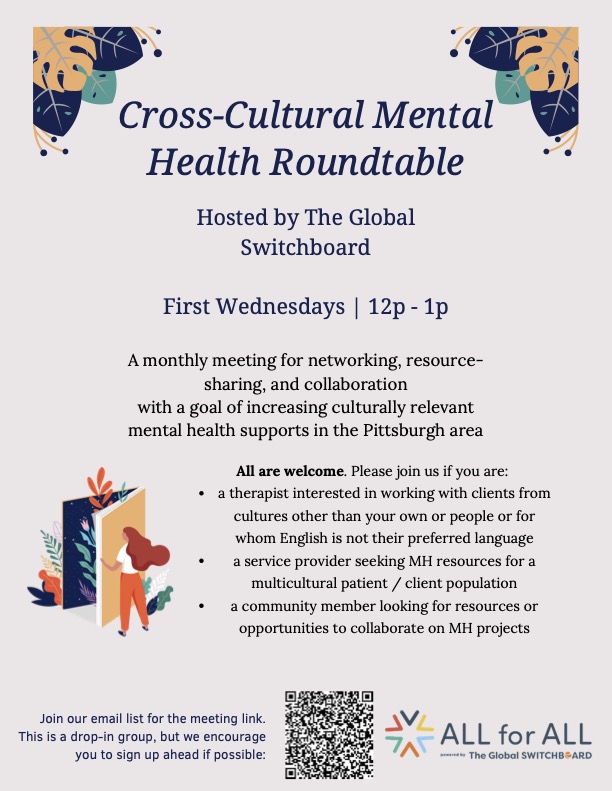
Join The Global Switchboard for a monthly meeting for networking, resource-sharing, and collaboration to increase culturally relevant mental health support in the Pittsburgh area. All are welcome.
Roundtables are recommended for
- therapists interested in working with clients for whom English is not their preferred language
- service providers seeking MH resources for a multicultural patient/client population
- community members looking for resources or opportunities to collaborate on MH projects
Event Details
- First Wednesday of the month
-
Wednesday, 03/06
-
Wednesday, 04/03
-
Wednesday, 05/01
-
Wednesday, 06/05
- 12 – 1 p.m.
- Virtual Meeting
- Register today!
Additional Details
Please share this flyer with your networks.

Join The Global Switchboard for a monthly meeting for networking, resource-sharing, and collaboration to increase culturally relevant mental health support in the Pittsburgh area. All are welcome.
Roundtables are recommended for
- therapists interested in working with clients for whom English is not their preferred language
- service providers seeking MH resources for a multicultural patient/client population
- community members looking for resources or opportunities to collaborate on MH projects
Event Details
- First Wednesday of the month
-
Wednesday, 03/06
-
Wednesday, 04/03
-
Wednesday, 05/01
-
Wednesday, 06/05
- 12 – 1 p.m.
- Virtual Meeting
- Register today!
Additional Details
Please share this flyer with your networks.
Join The Global Switchboard for a monthly meeting for networking, resource-sharing, and collaboration to increase culturally relevant mental health support in the Pittsburgh area. All are welcome.
Roundtables are recommended for
- therapists interested in working with clients for whom English is not their preferred language
- service providers seeking MH resources for a multicultural patient/client population
- community members looking for resources or opportunities to collaborate on MH projects
Event Details
- First Wednesday of the month
-
Wednesday, 03/06
-
Wednesday, 04/03
-
Wednesday, 05/01
-
Wednesday, 06/05
- 12 – 1 p.m.
- Virtual Meeting
- Register today!
Additional Details
Please share this flyer with your networks.
Generations United, with support from Humana, recently developed tip sheets on self-care and youth mental health for grandfamily caregivers.
Tip sheets include specialized information and resources for grandfamilies and grandparents who care for young children.
About Grandfamily Caregiver Tip Sheets
According to Generations Untied, there are 2.6 million children in the U.S. living in households headed by a grandparent, another relative, or close family friend without a parent present. Consequently, these families, often referred to as “grandfamilies,” require unique supports.
Tip sheets, tailored to grandfamilies, serve Generations United’s mission to improve the lives of children, youth, and older people through intergenerational collaboration.
Thus far, two grandfamily caregiver tip sheets have been developed:
- Grandfamily Caregiver Tip Sheet: Self-Care, and
- Grandfamily Caregiver Tip Sheet: Youth Mental Health.
Both are available in English and Spanish.
Grandfamily Caregiver Tip Sheet: Self-Care
The grandfamily caregiver tip sheet on self-care:
- defines self-care,
- explains the need for grandfamily self-care,
- estabilishes challenges grandfamilies face in receiving self-care,
- provides self-care tips for grandfamily caregivers, and, also
- provides examples of self-care.
Grandfamily Caregiver Tip Sheet: Youth Mental Health
The grandfamily caregiver tip sheet on youth mental health:
- explains the impacts of childhood trauma,
- shares recommendations on mitigating the impact of trauma,
- highlights warning signs of child mental health challenges,
- shares recommendations for talking to children about mental health, and, additionally,
- provides mental health resources.
Access the Tip Sheets
To access the tip sheets, utilize the following links:
Additionally, tip sheets are available on the Generations United website.
Learn More
To learn more, visit the Generations United website.
Related Content & Resources
Various organizations, states, and nations recognize a number of observances each month. Resources help parents, caregivers, and child care professionals acknowledge and navigate them.
Here is a list of resources for July observances:
Month-Long Observances
- City of Pittsburgh Department of Parks & Recreation, CitiParks
- Summer Program Guide, Pittsburgh Parks Conservancy
- Top Green Spaces and Public Parks in Pittsburgh, Visit Pittsburgh
- Growing Equity in City Green Space, Eos
- Rocking and Rolling. Fresh Air, Fun, and Exploration: Why Outdoor Play Is Essential for Healthy Development, National Association for the Education of Young Children (NAEYC)
- Why Kids Need to Spend Time in Nature, Child Mind Institute
- Free Worksheet: Thank a Park Ranger Card, Education.com
- Become a Junior Ranger, National Park Service
- Five Fun Activities for Teaching Kids About Conservation, National Recreation and Park Association
- Allegheny County Shares Summer Safety Guidance, Trying Together
- 5 Pittsburgh Organizations supporting Our Most Vulnerable Children–and Inspiring Us to Help, Kidsburgh
- Most Popular Pittsburgh Children & Youth Nonprofits and Charities, Great Nonprofits
- Positive Parenting, National Institute of Health
- The Power of Positive Parenting, UC Davis Health
- 8 Ways to Strengthen a Parent-Child Relationship, Family Services of Northeast Wisconsin
- Bonding with Stepchildren: 7 Tips for Building a Strong Relationship, Care.com
- Three Principles to Improve Outcomes for Children and Families, Harvard University Center on the Developing Child
- Strategies to Support Black Students, Teachers, and Communities in Schools, Education Northwest
- 12 Powerful Statistics That Prove Why Teachers Matter, We Are Teachers
- Family Engagement, Office of Head Start and Early Childhood Learning & Knowledge Center
- Raise Child Care, Start Strong PA
- Prioritizing Minority Mental Health, Centers for Disease Control and Prevention (CDC)
- BIPOC Mental Health, Mental Health America
- Mental Health Disparities: Diverse Populations, American Psychiatric Association
- Contextualizing BIPOC Youth Mental Health, National Black Women’s Justice Institute
- Mental Illness Doesn’t Discriminate, so Why Do BIPOC Communities Have Difficulty Accessing Care?, Jefferson Center for Mental Health
- Erasing Mental Health Stigma in the Black Community, National Alliance on Mental Illness (NAMI)
- BIPOC/AAPI Mental Health Resources, NAMI New Hampshire
- Where to Find Mental Health Services for Children and Adolescents in Pittsburgh, The University of Pittsburgh: Youth and Family Research Program
- Anti-Racism Resources for Families, Trying Together
- Multilingual Trauma Resources, The Child Mind Institute
Days of Recognition
- Drowning Prevention, Centers for Disease Control and Prevention
- Drowning Prevention & Facts, American Red Cross
- Water Safety at Home, Safe Kids Worldwide
- Water Safety Tips for Families, Seattle Children’s Hospital
- Toddler Water Safety: 14 Ways to Keep Safer, Stop Drowning Now
- Water Safety for Your Special Needs Child, Children’s Hospital of Philadelphia
- Resources: Learn to Swim, Allegheny County
- 4 Places To Get FREE Summer Swim Lessons For Kids In The ‘Burgh, Macaroni Kid
- How to Perform Child and Baby CPR, American Red Cross
- Trying Together and ELRC Region 5 Partnering to Offer First Aid & CPR Training, ELRC Region 5
Join the Brazelton Touchpoints Center and Burke Foundation for the second episode of their Learning to Listen: Conversations for Change webinar series, featuring Dr. Warren Ng, president of the American Academy of Child and Adolescent Psychiatry.
Attendees will learn about the mental health of Asian American and Pacific Islander (AAPI) and LGBTQ+ children, the harms they experience, how those harms have been exacerbated by the pandemic and political polarization, and the ways that we can help them heal.
Session Details
Wednesday, March 15 | 3 – 4 p.m.
Virtual
Register
Learn More
To learn more, visit the Brazelton Touchpoints Center website.
Are you pregnant or a new mom who is feeling overwhelmed, sad, anxious, or exhausted? Are you finding it hard to care for yourself, care for your baby, or even do basic daily tasks? The National Maternal Mental Health Hotline can help.
About the Hotline
The National Maternal Mental Health Hotline provides 24/7, free, confidential support before, during, and after pregnancy. The hotline offers callers:
-
Phone or text access to professional counselors
-
Real-time support and information
-
Response within a few minutes, 24 hours a day, 7 days a week
-
Resources
-
Referrals to local and telehealth providers and support groups
-
Culturally sensitive support
-
Counselors who speak English and Spanish
-
Interpreter services in 60 languages
Call or text 1-833-9-HELP4MOMS (1-833-943-5746). TTY users can use a preferred relay service or dial 711 and then 1-833-943-5746. Frequently Asked Questions about the National Maternal Mental Health Hotline also are available.
Join Brazelton Touchpoints Center for their virtual webinar series, “Parenting While Black: Reclaiming, Centering, and Affirming our Joy in Raising Black Children.” Events will take place every other Monday from March 7 to May 16.
This free webinar series offers a safe and welcoming space to hold conversations for and by Black families. Topics will include Embracing Black Joy and Excellence; Parenting While Black in White Spaces; Birthing While Black; Black Mental Health and more. All are welcome to join and engage in these powerful conversations.
Registration is required to access this event virtually.
Are you interested in learning more about promoting familial mental health and well-being? Join Brazelton Touchpoint Center for a series of three sessions on various ways that professionals can support the families that they serve.
Sessions
This series features three sessions, each costing $35 or $90 for all three sessions. Registration is available online.
- October 20: Enhancing Partnerships Between Parents and Staff
- October 27: Understanding Depression and Fostering Resilience
- November 3: Talking with Children about Difficult Issues
More Information
Social-emotional wellness is essential for young children, their families, and the providers who work with them. Yet, promoting wellness and responding to the mental health needs of children and families may be challenging, especially during the ongoing pandemic. In this three-part series, you will learn knowledge and skills to strengthen relationships with adults and children and promote family well-being. You will:
- Learn practical strategies for building strong partnerships with families
- Learn the signs, symptoms, and causes of depression
- Explore communication challenges that can occur between staff and parents, and how to overcome them
- Enhance your understanding of resilience and how to partner with families to strengthen their resilience
- Learn how to talk more effectively with children about difficult issues
- Enhance your ability to support families seeking access to mental health services
This series is for all professionals who work with families of young children, including early care and education providers, family child care providers, home visitors, and more.
New resources have been added to the Trying Together website for families and caregivers. These resources further Trying Together’s mission to supports high-quality care and education for young children by providing advocacy, community resources, and professional growth opportunities for the needs and rights of children, their families, and the individuals who interact with them.
New Resources
DAP Series Parts VII, VIII, and IX
As an early childhood nonprofit, Trying Together recognizes that a child’s parent is their first and most important caregiver. That’s why we created the Developmentally Appropriate Parenting (DAP) Series to assist parents and caregivers in creating high-quality learning experiences at the earliest stages of their child’s life. The series features digital and print content that provides information on critical early childhood topics.
New topics in the DAP Series include Part VII: Childhood Mental Health; Part VIII: Race and Equity; and Part IX: Transitions & Routines. Families and caregivers may also access previous parts of the DAP Series: Part I: Developmentally Appropriate Practice; Part II: Childhood Physical Health; Part III: Child Care; Part IV: Early Intervention and Inclusion; Part V: Safety and Emergencies; and Part VI: Social-Emotional Development. Resources will continue to be added through 2022 as additional Parts are finalized.
Additionally, families and caregivers may now request a set of cards in the mail at no cost. These cards provide an overview of each part of the DAP series with a quick reference to local and regional organizations.
Parenting Together Pathway
The Parenting Together Pathway is a video-based learning series to provide high-quality information on early childhood development to parents and caregivers in Allegheny County and surrounding areas. Launched in April 2021, the Parenting Together Pathway provides families the opportunity to learn more about: brain development; play; interactions and relationships; technology; child care; and advocacy to better support their children’s healthy growth.
Two additional videos have been added to the Parenting Together Pathway: Early Intervention and Safety and Emergencies.