News

February 4, 2019

Ask Congress to Increase Federal Child Care Funding

Trying Together and our partners are advocating for greater investments in federal child care funding, and we need your organization to join us.

What is happening?

Your voices helped achieve historic increases in funding for the Child Care and Development Block Grant (CCDBG) funds in federal fiscal years 2018 and 2019. We need to build off that success and advocate for increased discretionary CCDBG funding in the federal fiscal year 2020 so that we can continue to address unmet needs. Advocates across the country are asking Congress to increase CCDBG funding by $5 billion.

To accomplish this goal, the Budget Control Act caps on non-defense discretionary spending would need to be lifted to provide for such an increase in the Labor/Health and Human Services/Education appropriations bill.

Why does it matter?

The additional funding would help Pennsylvania children and families access and afford high-quality child care and further support child care programs and teachers. Trying Together, along with our partner early care and education advocacy organizations in Pennsylvania, is gathering signatures for a letter to our congressional delegation.

Sign-On Your Support

To support an increase in federal child care funding, sign your organization on to the letter by Wednesday, February 20th!

News

January 29, 2019

Start Strong PA Hosts Statewide Campaign Launch in Harrisburg

On January 29, Start Strong PA hosted their official statewide campaign launch event at the Pennsylvania State Capitol Complex in Harrisburg.

What is Start Strong PA?

Guided by evidence-based research, the Start Strong PA campaign was launched to help ensure that every Pennsylvania infant and toddler starts off strong. By advocating for increased access to and affordability of high-quality child care programs, the campaign aims to support healthy childhood development, working families, and the Pennsylvania economy.

Speaking on behalf of the campaign, Jodi Askins, Executive Director of PennAEYC, stated:

“Infant-toddler brains make over a million neural connections every second – forming brain architecture for life. At no other time in a human’s life will the brain develop at this remarkable speed or with such intricacy. This is the foundation upon which all later learning, behavior, and health depend. That’s why we need Pennsylvanians to join us and help our infants and toddlers ‘start strong’!”

At the Launch

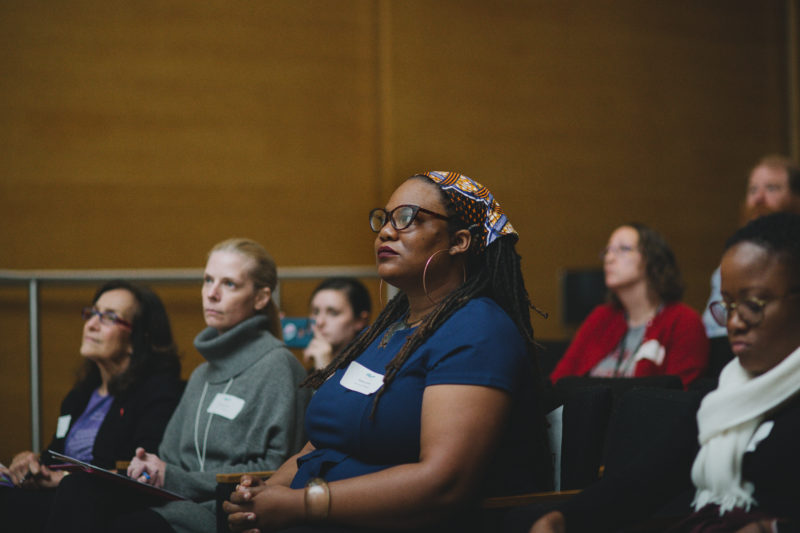
With approximately 75 early childhood advocates in attendance, including state legislators, professionals, and families with children in child care, the launch began with a complimentary coffee bar (made possible by Little Amps Coffee Roasters), pictures of legislators’ young children, and conversations on the important role that high-quality child care plays in the lives of our infants and toddlers.

A press conference was held later in the afternoon, featuring representatives from partner organizations, state legislators, administration, parents, and high-quality child care programs. Various early childhood education and care topics were highlighted, including issues of access, affordability, low wages, and a need for more high-quality early childhood staff.

Parent Lauren Bethea spoke about her experiences waiting for care for her daughter Lorraine:

“The weight of the world was on my shoulders until my child got into a high-quality program. Every young child like Lorraine deserves this opportunity. Waiting for space in a program until your child is 2, 3, or even older before enrollment is not an option for so many families.”

Deputy Secretary Suzann Morris spoke to her role as a mother and to her leadership role over current initiatives of the Office of Child Development and Early Learning, sharing that work is underway to make early childhood programs more efficient such as program coordination in regional Early Learning Resource Centers.

Watch the full press conference here.

Quotes from Pennsylvania Legislators

At the press conference, state legislators spoke out on the following topics:

Senator Pat Browne, Co-Chair, Early Childhood Education Caucus

“This is the type of results-based thinking that’s necessary to maximize where the state spends its limited amount of discretionary revenue. These early learning programs have a proven track record of helping prevent at-risk young people from falling behind or dropping out of school. Looking long-term, young people who receive early learning assistance are more likely to become productive members of our community. By prioritizing spending on these vital programs it will save the Commonwealth long-term costs.”

Senator Jay Costa

“Paying [early childhood professionals] some of the lowest wages in the service industry is simply unacceptable and needs to change.”

Representative Mark Longietti, Co-Chair, Early Childhood Education Caucus

“Programs provide a safe and secure environment and teachers help children learn the “executive function” and self-regulation skills that are necessary for life success – from being able to pay attention, plan, and prioritize to recognizing, naming and controlling their emotions.”

Representative Lynda Schlegel Culver

“The state has a waiting list of over 4,300 kids for a subsidy and an average waiting time of 88 days as of November. And only one-third of children receiving subsidized care were in Keystone STAR 3 or 4 programs.”

How You Can Support

Help us inform and engage Pennsylvania policymakers on the changes necessary to increase access, affordability, and quality in infant/toddler child care programs and sign-on your support here or download, complete, and email this sign-on form to info@startstrongpa.org.

For updates on the campaign, follow Start Strong PA on Facebook and Twitter.

Questions

For questions or to schedule an interview with campaign launch speakers or Start Strong PA partner organizations, please contact Lissa Geiger Shulman at 717.802.1881 or lissa@tryingtogether.org.

News

January 16, 2019

DHS Will Issue February SNAP Benefits Early

On January 8, the United States Department of Agriculture (USDA) notified states that February benefits for the Supplemental Nutrition Assistance Program (SNAP) will be fully funded.

In order to receive funding however, February benefits must be issued by January 20, 2019. The Department of Human Services (DHS) has determined that they will be able to issue February SNAP benefits by January 20 in order to meet the federally imposed deadline. Below is what you need to know about SNAP benefits in January and February.


Receiving February Benefits

All SNAP recipients who did not have a renewal due in January, or whose renewal for January was completed by January 14, will receive their February benefits on their electronic benefit transfer (EBT) cards on January 18, 2019.

For those (with January renewals due) who completed their renewal after January 14, February benefits will be available on their EBT card one day after their renewal is processed.

What This Means for SNAP Recipients

These benefits will be the only benefit payment SNAP recipients will receive for the month of February. Recipients will not receive a payment on their regularly scheduled February payment date. This payment is not a bonus or increase in a recipient’s monthly payment. Rather, this payment is their benefit for the month of February.

Recipients will need to make this early payment last through an undefined period of time if the government shutdown persists. DHS is awaiting further guidance from the USDA regarding the availability of benefits for March. Because of this, recipients experiencing food insecurity may have greater challenges during this period. This will likely result in a higher number of individuals seeking aid from charitable food organizations around the commonwealth.

Applications and Renewals

DHS will continue to accept SNAP applications and process renewal applications. Recipients should continue reporting any changes and should submit the semi-annual reviews or renewals that they receive. DHS will continue to issue benefits to applicants found eligible in February until they are told to stop issuing by USDA.

Questions and Concerns

All County Assistance Offices remain open and staff are available to assist applicants and recipients during this time.

For any questions about benefits, please contact the statewide customer service center at 1.877.395.8930. For residents of Philidelphia, contact 1.215.560.7226.

Resources

For any individual seeking additional food assistance, the Carnegie Library of Pittsburgh has compiled a list of community resources and organizations.

News

December 20, 2018

PA Wins Brandon Hall Group Excellence Bronze Award

In August 2018, the PA Office of Child Development and Early Learning (OCDEL) and PA Key course, Assessment: Beyond the Basics of Observation and Data Utilization, won the prestigious Brandon Hall Group Excellence Bronze Award for best in Custom Content.

The Excellence Awards

The Excellence Awards recognize the best organizations that have successfully deployed programs, strategies, modalities, processes, systems, and tools that have achieved measurable results. Award entries were evaluated by a panel of veteran, independent senior industry experts, Brandon Hall Group analysts, and executives based upon the following criteria:

  • Fit the need
  • Design of the program
  • Functionality
  • Innovation
  • Overall measurable benefits.

See the full list awardees.

About the Course

The winning self-paced online course for early learning teachers provides an overview of classroom assessments of young children and how information from assessments can be used to inform instruction. The course was developed in collaboration with CyperhWorx, Inc. and was made possible through Pennsylvania’s Race to the Top Early Learning Challenge grant.

Professional Development

To register for the winning course (and others), visit the PA Professional Development Registry.

*Information provided by the PA Early Ed News

News

OCDEL Reports Progress on Infant/Toddler Policies

In 2017, the PA Office of Child Development and Early Learning (OCDEL) and stakeholders completed a policy scan with National State Capacity Building Center that identified short, medium, and long-term policy goals to support infants and toddlers in Pennsylvania.

Goal Progress

OCDEL is proud to report progress on those goals:

Short-Term Goal

The short-term goal to “adopt a shared definition of relationship-based care” across the ECE system is underway. OCDEL and Early Learning Resource Center (ELRC) staff, in partnership with the National Center on Parent, Family, and Community Engagement, are focusing on Relationship-Based Competencies and developing shared definitions and language across systems.

Medium-Term Goal

The medium-term goal is to “develop a triaging protocol that creates a system akin to Early Head Start that will connect families of infants and toddlers in child care with comprehensive health (including oral) and family support services in their community.” This goal is reflected in the work of the ELRCs which are charged with ensuring all families have access to needed services beyond child care, such as CHIP, WIC, and family supports, including home visiting.

Long-Term Goal

The long-term goal is to “explore vouchers and contracts that fund the true cost of serving infants and toddlers.” Through the Infant/Toddler Contracted Slot Pilot, OCDEL is piloting contracted slots for infants and toddlers in Keystone STAR 3 and 4 programs. The pilot seeks to understand how contracted slots can support continuity of care for infants, toddlers, and their families and the financial impact on high-quality providers interested in seeking financial stability for the classrooms serving their youngest learners.

More Information

Additional details will be released in later editions of the PA Early Ed News.

*Information provided by the PA Early Ed News

News

December 13, 2018

DHS Releases Request for Information

The Department of Human Services (DHS) recently released a Request for Information (RFI) to explore existing individual or family needs assessments, methods of connecting individuals and families to community resources, and models for providing whole-person or whole-family case management.

Purpose

The department recognizes the frustration individuals and families may experience while trying to access much-needed services in a timely manner when receiving case management from multiple agencies. DHS wants to make it easier for individuals to obtain meaningful information and access to the services they need to achieve overall wellbeing, positive health outcomes, and financial self-sufficiency. Their goal is to build a system that addresses each family’s needs and amplifies the work of health care providers and community organizations.

Submissions and Deadlines

If your organization has experience in any of the areas outlined in this RFI, respond by January 18, 2019 by visiting the Pennsylvania eMarketplace website.

*Information provided by PA Early Ed News

News

December 6, 2018

100,000 Books Campaign: Free Book Fair

United Way’s 100,000 Books initiative is giving away new and gently used books to support your students’ developing reading skills.  A variety of books are available for various age groups, although this year’s selection appears to have more in the pre-k to 3rd-grade range.

To qualify, your program must use a mentor – reader model. This event is first come – first serve, so show up early. Bringing boxes is recommended. Register here.

What is 100,000 Books?

100,000 Books builds on research that demonstrates the importance of connecting a caring adult or older student with a child.  This mentor model has been shown to have a significant impact on the life of a child and will be the primary model that 100,000 Books uses to support reading skills development.  Mentors (teachers, librarians, youth workers, caring adults, older students…) will reinforce reading skills through one time and on-going read-along opportunities that will help kids to build this critical love of reading.

Questions

If you have any questions, please contact Tanya Baronti at tanya.baronti@unitedwayswpa.org or Joe Welsh at joe.welsh@unitedwayswpa.org.

News

November 29, 2018

Remind Your Legislator to Prioritize Young Children

Just a few weeks ago on election day, many Pennsylvania legislators and early childhood champions were re-elected and will soon be voting on issues affecting our children and families.

Trying Together and its statewide partners at First Up and PennAEYC are asking advocates to contact their legislators to congratulate them on their re-election. If you have newly elected officials and are an administrator, director, or other early care and education professional who wants to invite them for a tour of your program, Trying Together can help. Just complete and submit this form and someone will be happy to help coordinate a visit or join you!

As the year winds down and preparations are made to get ready for the holidays, it is important to keep our legislators’ inboxes and social media full of reminders about the importance of children. Please take two minutes to contact your legislator in support of early learning programs!

News

The VOICE for Children Awards Celebration

The Pennsylvania Association for the Education of Young Children (PennAEYC) announced that their 2019 VOICE for Children Award Celebration will be held at the historic Hotel Hershey on April 5, 2019.

About the Award

PennAEYC recognizes the critical role advocacy plays in high-quality early learning settings and celebrates those who speak on behalf of Pennsylvania’s children. As the voice for early care and learning, community advocates play an important role in assuring all Pennsylvania’s children get the start that they deserve in school and in life.

The VOICE for Children Award is the only statewide award in Pennsylvania recognizing the grassroots leaders whose work impacts the quality of care for young children. Now in its 9th year, the VOICE Award celebrates not only individual award recipients, but the early childhood profession.

Hotel Reservations

If you plan to stay at the Hotel Hershey, reserve your room online or call (855.729.3108) today as rooms are limited. If calling, ask for the room block for the PA Association for the Education of Young Children at The Hotel Hershey, April 5-6, 2019. Other area hotels are also available.

Questions

For more information, contact Rose Snyder via email (rsnyder@pennaeyc.org).

*Information provided by PennAEYC*

News

November 20, 2018

KaBOOM! Announces Let’s Play Everywhere Challenge Winners

KaBOOM! recently announced the winners of the Let’s Play Everywhere Challenge. As part of the Challenge, 10 grantees in Allegheny County were selected to receive a combined total of $200,000 in prize funds. Trying Together is pleased to announce that the Playful Pittsburgh Collaborative was awarded one of these grants for The Neighborhood Play Stop Project. Learn more about it and the other grantees below.


Challenge Winners

The Let’s Play Everywhere Challenge selected nine organizations as winners, with a total of ten ideas:

  1. Trying Together (Playful Pittsburgh Collaborative)
    • The Neighborhood Play Stop Project
  2. Glassport Community Outreach, Inc.
    • Families Will Go Gaga to Play GaGa
  3. Pittsburgh Fulton PTO
    • From Pittsburgh to Paris and Beyond!
  4. Garfield Jubilee Association, Inc.
    • James Sensory Park
  5. Grounded Strategies
    • MACS Discovery Walk
    • Race Me! Pitcairn Green Playce
  6. Community Forge
    • Number Mountain
  7. Pittsburgh Parks Conservancy
    • Ping Pong in the Plaza
  8. UniversalWit
    • Play! to End Blight
  9. Focus on Renewal
    • POW! (Place of Wonder)

The Neighborhood Play Stop Project

The Neighborhood Play Stop Project will reimagine existing spaces within Hazelwood by using play stops to encourage community engagement and playful interaction. These play stops may be featured in public spaces near businesses and civic locations such as grocery stores, green spaces,  fire stations, and more. Conversations are underway to identify the finalized play stop locations.

Impact

By placing play stops in spaces that are not typically associated with play, this project will prompt community members of all ages to rethink their daily routines. For children, it’s an opportunity for imaginative play. For adults, it may be a space where they can take a mental break and play chess or engage in a calming playful activity. Similar to the Little Free Library movement, these play stops will be stewarded by various entities (the businesses where they are located, Playful Pittsburgh Collaborative member organizations, interested community members, etc.).

A Closer Look

Each stop will be based upon the common concept of play and will have playful interactive parts that relate to the location and the party stewarding the installation. For example, a stop outside a grocery store may include play items such as plastic fruits and vegetables to “purchase,” paper and pencils to create grocery lists, and laminated sheets of information about grocery store products.  However, if a stop is located outside of a fire department, their play items may include play items such as firefighter helmets, a mini fire drill tower, and fire safety facts.

Each stop will include a chalkboard with permanently affixed prompts for participants to write their thoughts. Prompts may include statement starters such as “When I play outside I like to…” or “At the grocery store I can find these colors…”

About the Challenge

The Let’s Play Everywhere Challenge is a design competition that took place in Allegheny County, Pennsylvania—presented by Keurig Dr. Pepper and KaBOOM!—to develop innovative ideas for making play easy and available for kids and families. This challenge is about creating opportunities for free, unstructured, unplanned play to ensure that all kids, no matter where they come from or where they live, get the active play they need to thrive.

Learn More

To learn more about the challenge winners and their ideas, read KaBOOM’s post.