Panelists Explore “The Freedom to Fail” at Meaningful Play Conference

News

October 16, 2026

Panelists Explore “The Freedom to Fail” at Meaningful Play Conference

How do we protect the freedom to take chances and the right to fall short?

A panel discussion explored this question and more during Carnegie Mellon University’s Meaningful Play Conference on October 15. 

The panel, titled The Freedom to Fail: Understanding the Role of Risk in Play, addressed the specific benefits of risk and failure in play, from early learners to adults. Cara Ciminillo, Trying Together’s executive director, was one of three panelists. She was joined by Shannon Merenstein, founder of Hatch Partners in Play, and Rae Sookhoo, senior undergraduate and Failure Games research team member at Carnegie Mellon University. 

The panel was moderated by Kristen Burns, the associate director of the Grable Foundation. 

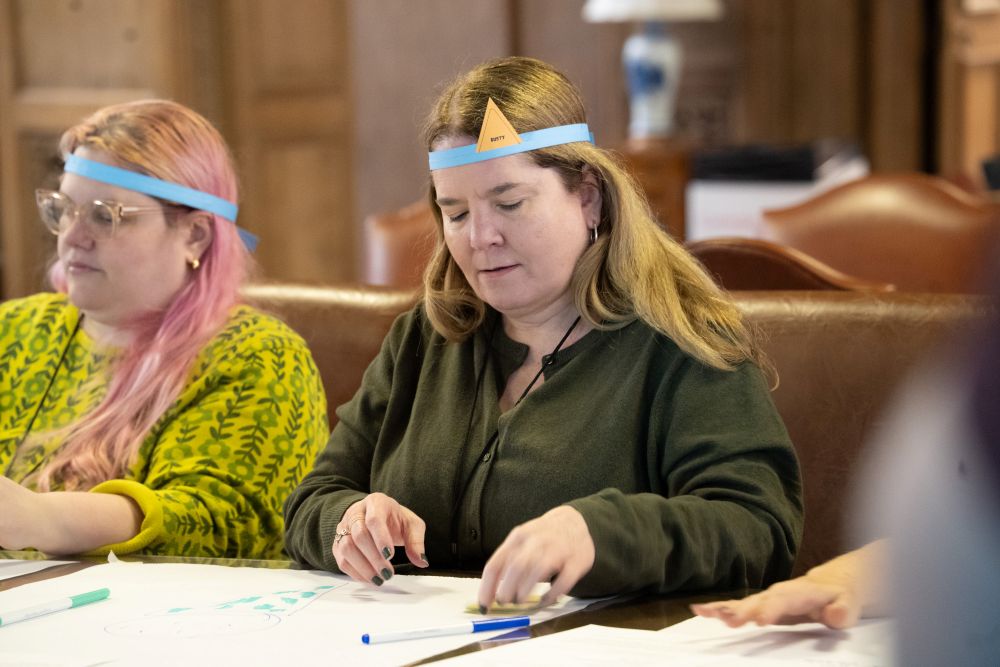
Drawn to the Crown Demonstration

Before the discussion began, Sookhoo led a demonstration of her original game “Drawn to the Crown.” The game was simple: First, a single card with a noun was drawn – in this instance, the word “dessert.” The players then drew their interpretation of the word with a time limit of 45 seconds. Then, a second card was drawn – an adjective to describe the noun. In this demonstration, the word was “rusty.” 

The challenge of the game is that once you begin drawing, you cannot cross anything out or begin again. Once the drawings were complete, a judge chose which drawing they believed was best. The winner placed the card into her crown, and the next round began.

While simple, this game relies on vulnerability and risk. Because the players have limited time and unexpected word choices, failure is an expected and humorous outcome. 

Panel Discussion

The panelists began the discussion talking about risky play and the benefits for children, which led to a rich conversation about failure. A running theme throughout the discussion was that it’s OK to do something and fail immediately – especially when we learn and try again.

“Failure isn’t who you are as a person,” explained Ciminillo. “The focus is on the trying, not the outcome.” 

For children especially, this is an important part of growth and development. Merestein pointed out that children should have the freedom to “tinker, dabble, experiment, and assume new roles.” 

“Free play is the time you build your identity and discover what you’re interested in and connected to. It’s a critical part of early childhood – but good for all of us,” she said.

The panel also discussed the tension between allowing young children the autonomy to engage in risky play, while at the same time considering their safety.  Children are perceptive to how adults are feeling – and if they are with an adult who is rigid or overly cautious, their experience can be affected. 

“Risk, agency, and trust go hand in hand with children,” explained Merestein. “We all want to feel trusted and respected, and have agency and choice. Adults can allow that safe risk to happen, to pull back.” 

Ciminillo encourages caregivers to be aware of themselves and to bring neutral judgement about what’s unsafe when interacting with children. This gives them more space to learn and explore. Learning cannot occur if adults are constantly stopping play.

Sookhoo connected risk in play to more developed creativity and a willingness to forgo perfection. 

“Try fast and fail fast,” she encouraged. “Free play is a big part of the brainstorm. It’s important for people to go with their ideas and not hinder the thinking process.” 

This provides the opportunity to move on quickly and try new things – for both adults and children.

The discussion then shifted to different risks across various demographics, including socioeconomic, racial, cultural, gender, physical ability, and more. Ciminillo urged game creators to be mindful of their biases and belief systems when creating. 

The discussion wrapped up with a question to the audience: How do we as adults perceive, embrace, and speak about play? 

Participants cited video games, cosplay, sports, and board games as typical methods of play for adults. However, adults may be less likely to consider things like baking or crafting as “play,” despite the incredible opportunity to experiment and learn. 

The ultimate takeaway from the discussion is that risky play should be embraced and encouraged for people of all ages. With risky play comes the potential for failure – and this is a good thing. When we embrace that failure, we open ourselves up to greater learning, creativity, and possibility. 
The Freedom to Fail: Understanding the Role of Risk in Play

News

October 2, 2026

The Freedom to Fail: Understanding the Role of Risk in Play

The Freedom to Fail: Understanding the Role of Risk in Play is a panel discussion offered during the Meaningful Play 2o26 conference hosted by Carnegie Mellon University.  This discussion will explore play as vital for learning and practicing resilience. Cara Ciminillo, Trying Together’s executive director, will be one of the panelists alongside experts from Hatch Partners in Play and Carnegie Mellon on the panel.

By reframing play as a “place of practice,” the discussion examines how the physical stakes of risky play and the psychological experience of failure work in tandem to reduce perfectionism, cultivate curiosity, and ground the belief that growth is impossible without both.

The discussion will address the specific benefits of risk and failure in play from early learners to adults. Attendees will gain a deeper understanding of how “uncomfortable” experiences – risk, failure, disappointment, frustration – can be explored through play and why play can be an especially fertile environment for growth and learning. Participants will leave with practical strategies and resources to advocate for and implement risky play in their own games, classrooms, and communities.

The panel discussion is scheduled for 3 p.m. to 4:30 p.m. on Thursday, October 15 at 5000 Forbes Avenue.

Meaningful Play 2026  will run from October 13 to 15. It brings together academics, game designers, and educators to explore how games and play can change people’s lives.

KidsPlay at Market Square

News

April 8, 2026

KidsPlay at Market Square

KidsPlay provides free interactive and educational programming for children in Market Square, with local partners including Science Tots, the Carnegie Library of Pittsburgh, KidsBurgh, the Senator John Heinz History Center, and more.

Active Dates

  • Tuesdays, June 4 – August 27, 2019 | 10 – 11:30 a.m.
  • Saturdays, June 8 – August 31, 2019 | 10 a.m. – 1 p.m.

Learn More

To see a list of upcoming activities, visit the Pittsburgh Downtown Partnership website.

Harvard University Podcast Focuses on Building Resilience Through Play

News

December 2, 2024

Harvard University Podcast Focuses on Building Resilience Through Play

Harvard University’s Center on the Developing Child recently hosted a podcast on the importance of resilience and how play can help to build it.

Learn More

According to the Center on the Developing Child, play helps to create sturdy brain architecture and contributes to the foundations of lifelong health. It is also an important building block for resilience.

In the podcast, Dr. Jack Shonkoff explains the role of play in supporting resilience and five experts discuss ideas and personal stories. The discussion revolves around applying the science of play in homes, communities, and crisis environments around the world.

Panelists include professors, directors, and researchers from the University of California Irvine’s School of Education, Institute for Museum and Library Services, Harvard Graduate School of Education, BRAC Institute of Educational Development, and Harvard Medical School’s Cambridge Hospital.

The podcast is coupled with a variety of resources – including those focused on play in humanitarian settings and information on how to prevent childhood toxic stress. Both the podcast and its transcript are available on the Center on the Developing Child’s website.

Worldwide Day of Play

News

September 24, 2024

Worldwide Day of Play

Neighborhood North will host the Worldwide Day of Play on the last Saturday in September.

Learn More

Neighborhood North will join Nickelodeon and the Association of Children’s Museums for fun and active play for the event. There will be special activities for children, ages 1 to 10, and their caregivers.

The Worldwide Day of Play runs from 10 a.m. to 2 p.m. on Saturday, Sept. 28.

More information can be found on Neighborhood North’s website.

NAEYC Encourages Early Childhood Education Experts to Become Subject Matter Experts

News

August 26, 2024

NAEYC Encourages Early Childhood Education Experts to Become Subject Matter Experts

Early childhood education experts are encouraged to share their knowledge and expertise in the field by becoming a subject matter expert (SME) for the National Association for the Education of Young Children (NAEYC).

Learn More

NAEYC is expanding its pool of SMEs to support creating professional development, training, and webinars for early education leaders and educators. It aims to bridge the gap between theory and practice by drawing on the insights of SMEs in regard to practical applications, best practices, and lessons learned in the field.

A subject matter expert is defined as someone who has mastery of a particular early education topic, hands-on experience and the ability to translate both to support early education professionals. The SMEs should know how to implement realistic and practical strategies for creating culturally relevant and developmentally appropriate experiences for young children.

To become an SME for NAEYC, the following criteria is required:

  • Hold a master’s degree or doctorate in early childhood education, developmental psychology, child development and family studies, early childhood special education, elementary education, or other related degree
  • Have experience as an early childhood professional, preferably as a direct service provider – program administrator, teacher, or family childcare provider – or ability to adapt a specific knowledge base to an early childhood audience
  • Have knowledge of adult learning theory

Applying and the Selection Process

To apply, complete the NAEYC SME Pool Application and attach a resume, cover letter, and writing sample. Incomplete applications will not be considered.

Candidates who meet the SME criteria will be added to the SME pool. When NAEYC seeks expertise, candidates will be selected and retained on a contractual basis. Applications will be active for two years; after that time, a new application will be required to maintain active status.

NAEYC is seeking SMEs on the following topics:

  • Advocacy/public policy
  • Art
  • Child Development
  • Children with disabilities and/or early intervention
  • Cognitive development
  • Community partnerships
  • Curriculum theories and approaches
  • Diversity, equity, inclusion, and belonging
  • Emergent bilingual/multilingual learners
  • Family engagement
  • Guidance or classroom management
  • Health and safety
  • Infant/toddlers
  • Kindergarten
  • Leadership
  • Learning environments
  • Language and literacy
  • Mathematics
  • Observation and assessment
  • Physical development
  • Play
  • Professionalism and ethics
  • Program administration
  • Science
  • Social and emotional development
  • Social studies
  • Teaching and instructional practices
  • Technology 

For more information, visit NAEYC’s website.

Call for Participation Open for Meaningful Play 2024

News

May 14, 2024

Call for Participation Open for Meaningful Play 2024

The Center for Transformational Play is now accepting applications for volunteers to help with the Meaningful Play 2024 conference.

Learn More

Meaningful Play 2024 is a conference about theory, research, and game design innovations, principles, and practices. It brings scholars, industry professionals and games practitioners together to understand and improve upon games to entertain, inform, educate, and persuade.

The conference is looking for volunteers to help run the Full Papers track. It welcomes contributions from researchers and practitioners in industry and academia who advance the understanding of meaningful play.

The purpose of the track is to present the community’s understanding of the current state of the art, practice, science, and/or discipline of meaningful play. Submissions should present original, unpublished research or design work that is not currently under review by any other venue.

Game exhibition and competition

The Meaningful Play Game Exhibition and Competition invites academic, independent, experimental, serious, transformational, and/or student game developers to showcase and gain recognition for their innovative work in game design and development. Analog and digital games are welcome.

The purpose of the games and prototypes track is to highlight the things that the community has built and allow attendees to play with each other’s work. Games and prototypes at Meaningful Play will be showcased in an exhibition during the conference. Attendees will have opportunities to play them.

Microtalks

The microtalks track encourages individuals to submit proposals to discuss any of the subtopics related to the conference. Its aim is to present perspective or pose challenges to the community toward energizing new or ongoing work. Content that is insightful, speculative, or creative is encouraged.

Hosted sessions

The hosted sessions track invites submissions of engaging interactive sessions to be organized by members of the community. Its purpose is to provide opportunities for community building and community engagement around topics of interest to the broader community.

These sessions could take the form of a panel or roundtable discussion among community members, a game play session, or an interactive workshop to get people working together.

More Details

Those interested in participating should fill out a volunteer form. For more information, visit Meaningful Play’s website or email meaningfulplay@andrew.cmu.edu. 

The submission deadline is June 5. The conference will take place from Oct. 16 to 18 at Carnegie Mellon University.

Seeking Input on Recess and Play for Advocacy Toolkit

News

May 7, 2024

Seeking Input on Recess and Play for Advocacy Toolkit

Trying Together and Playful Pittsburgh are seeking input on recess and play for the creation of an advocacy toolkit on the topics.

Learn More

As part of their play advocacy research, Trying Together and Playful Pittsburgh are asking parents and caregivers of children, teachers, school administrators, and community members for input.

In the survey, participants will discuss how their child’s school perceives and implements recess. Collected input will go toward devising a comprehensive, community-based Play Advocacy Toolkit that will be widely shared and easily accessible.

The deadline to complete the survey is June 21. The survey is now available to complete.

Community Conversations on Play

Parents and caregivers of children, teachers, school leaders, and community members are also invited to join Trying Together and Playful Pittsburgh for upcoming community conversations on play.

Physical movement, the freedom to play, and playful learning during the school day improves a child’s social, emotional, physical, and cognitive skills. However, many American children engage in less than one hour of unstructured play per day.

The conversations will focus on how play is an important part of a child’s school life. The events will help attendees learn how to advocate for play and developmentally appropriate practices in early childhood.

In person event
Thursday, May 30, 2024 | 5 – 7 p.m.
Spartan Community Center of Hazelwood, 134 East Elizabeth Street
Registration is now open

Dinner and child care will be provided.

Virtual event
Monday, June 10, 2024 | 7-8 p.m.
Zoom
Registration is now open.

Recess and Play: Community Conversations

News

May 1, 2024

Recess and Play: Community Conversations

Parents and caregivers of children, teachers, school leaders, and community members are invited to join Trying Together and Playful Pittsburgh for community conversations on play.

Learn More

Physical movement, the freedom to play, and playful learning during the school day improves a child’s social, emotional, physical, and cognitive skills. However, many American children engage in less than one hour of unstructured play per day.

We’d like to know how much your child is able to play. A community conversation being held on May 30 will discuss how play is a part of a child’s school life. The event will help attendees learn how to advocate for play and developmentally appropriate practice in early childhood.

Dinner and child care will be provided to participants at the in-person event. There will also be a virtual event in June.

Details

Thursday, May 30 | 5 – 7 p.m.
Spartan Community Center of Hazelwood, 134 East Elizabeth Street in Pittsburgh
Register

Monday, June 10 | 7 – 8 p.m.
Virtual
Register

Can’t attend? Take the play advocacy survey to share your thoughts.

Recess and Play: Community Conversations

News

Recess and Play: Community Conversations

Parents and caregivers of children, teachers, school leaders, and community members are invited to join Trying Together and Playful Pittsburgh for community conversations on play.

Learn More

Physical movement, the freedom to play, and playful learning during the school day improves a child’s social, emotional, physical, and cognitive skills. However, many American children engage in less than one hour of unstructured play per day.

We’d like to know how much your child is able to play. A community conversation being held on May 30 will discuss how play is a part of a child’s school life. The event will help attendees learn how to advocate for play and developmentally appropriate practice in early childhood.

Dinner and child care will be provided to participants at the in-person event. There will also be a virtual event in June.

Details

Thursday, May 30 | 5 – 7 p.m.
Spartan Community Center of Hazelwood, 134 East Elizabeth Street in Pittsburgh
Register

Monday, June 10 | 7 – 8 p.m.
Virtual
Register

Can’t attend? Take the play advocacy survey to share your thoughts.