News

May 8, 2023

Child Care Providers Invited to Participate in ‘Imagine a Day Without Child Care’

Throughout the month of May, the Start Strong PA and Pre-K for PA Provider Advisory Board (PAB) is inviting Pennsylvania child care providers to participate in Imagine a Day Without Child Care. 

Presented in conjunction with the national Day Without Childcare movement on May 8, Imagine a Day Without Child Care offers advocacy activities for providers to engage their teachers, staff, and families in their early learning programs.

About PAB and Imagine a Day Without Child Care

Since 2022, the Start Strong PA and Pre-K for PA Provider Advisory Board has aimed to elevate the influence of early care and education providers by strengthening the policy-to-practice feedback loop, and growing the network of providers willing to mobilize and advocate on behalf of the early childhood field.

Inspired by the Day Without Child Care movement, PAB introduced Imagine a Day Without Child Care to enable child care providers unable to close on May 8 to advocate for their programs and encourage families to raise awareness around the workforce crisis, as they care for children. 

This year, Imagine a Day Without Child Care will address the following themes:

  • Families on the waiting list aren’t forgotten, and we’re trying everything to get you in our doors. 
  • What will higher wages mean for our early childhood educators?
  • How can we give our families and staff an outlet and opportunity to share their stories?
  • Connecting the workforce crisis to those who are affected by it — but might not otherwise realize it — such as business owners.

Participate in Imagine a Day Without Child Care

To support provider participation in Imagine a Day Without Child Care, PAB developed a toolkit with posters, stickers, social media posts, and an action alert for families—both currently enrolled and on waitlists.

Access the toolkit on the Start Strong PA website and join PAB in Imagine A Day Without Child Care.

Learn More

May 8, and throughout the month of May, Strong Strong PA and Pre-K for PA encourage child care providers to use their voices to advocate for increased funding in the state budget to address higher wages for early childhood educators. Please tag Start Strong PA and Pre-K for PA when posting, so these organizations can elevate provider posts and ensure elected officials hear this collective message.

To learn more, visit the Start Strong PA website.

News

April 25, 2023

Advocacy Organizations Release Report on Rural Early Care and Education

Trying Together, in partnership with Start Strong PA and Pre-K for PA, recently released a report on the current state of early child care and education in Pennsylvania’s rural counties.

Entitled, “A Snapshot of the Rural Early Care and Education Landscape: Examining data from 13 counties in Pennsylvania,” the report shows that families in rural Pennsylvania communities have limited access to quality care, despite having a higher proportion of parents in the workforce, and a greater prevalence of long and nontraditional hours and commutes.

About Rural Counties and the Rural Early Care and Education Report

Authors of the report considered counties in which the number of people per square mile amounted to less than 291 (the statewide average), rural. Of Pennsylvania’s 67 counties, 72% met this definition, and just over 162,000 children under five live in them.

This report highlights data in the following rural counties: Armstrong, Butler, Centre, Clarion, Fayette, Franklin, Greene, Indiana, Somerset, and Washington. It also includes data from Lancaster, Westmoreland, and York counties. These counties aren’t classified as rural based on the population, but include pockets of rural communities facing similar challenges.

Report Findings

Rural families and child care providers have some of the greatest challenges in accessing and providing child care in Pennsylvania. This is due to the unique realities of rural areas, including fewer high-quality options, distance and travel, limited transportation, higher teacher turnover, fewer qualified individuals living in the region, and lower family incomes.

Specifically:

Working Families Child Care Needs

  • Nearly every rural county in PA shows a majority of all available parents in the labor force.
  • Seven of the counties reviewed have a higher proportion of working parents than does the state.
    • Over 80% of parents in Butler County are in the workforce, as are three quarters of parents in Indiana and Somerset counties.
  • In rural areas, options for evening, overnight, or weekend hours are scarce, with one parent describing them as non-existent.

Child Care Provider Capacity

  • The number of Child Care Works (CCW) subsidy-eligible children who need child care exceeds the licensed capacity in every county reviewed, with the exception of Centre.
    • Families are eligible for the CCW subsidy if their incomes are at or below 200 percent of the Federal Poverty Level ($60,000 for a family of four).
  • Most rural child care programs are not operating at full capacity because they don’t have enough staffing.
  • Statewide home-based providers make up about 30% of licensed programs, yet home-based providers comprise a much higher proportion in some of the rural counties analyzed.
    • In Greene County, home-based providers account for over 70% of licensed options, and for over half in Franklin County. Indiana County home-based providers make up 48% of licensed options, and in Armstrong and Somerset counties, home-based providers are 42% of licensed child care.

Public Funding for Child Care and Pre-K

  • The state only serves a quarter of CCW-eligible infants and toddlers. Unfortunately, this figure is even lower in every rural county reviewed. In rural counties, both subsidized and private pay infant and toddler care is difficult to find and afford.
  • Pre-K children are served at much higher rates than infants and toddlers, given that pre-k investments have been more consistent and sustainable.
    • Clarion, Greene, Indiana, and Lawrence counties are serving more than half of their eligible three- and four- year olds.

The Child Care Workforce

  • Pennsylvania is experiencing a dramatic decline in teachers from pre-k to 12th grade, and rural communities have been the most significantly impacted by this decline.
  • No county shows median annual earnings above $26,000, with six counties below $20,000 a year. The median earnings fall well under the cost of living in every county.
  • Providers highlighted the difficulty of training staff, especially with changing requirements and when onboarding new employees.
  • Another challenge that providers raised is the lack of mental and behavioral health and early intervention services.

Recommendations

Early childhood programs can’t continue to operate with their current budgets and expenses. Additionally, middle class families cannot continue to shoulder the brunt of the cost, while child care teachers subsidize the system through their own low wages. Thus, Trying Together, Start Strong PA, and Pre-K for PA recommend the following:

  1. Invest long-term, sustainable funding for early childhood educator wages.
  2. Conduct further research on family child care needs and choices in rural communities.
  3. Support resources and quality for home-based and relative care providers.
  4. Increase infant and toddler contracted slots (grants).
  5. Move to an alternative cost methodology for setting subsidy rates.
  6. Increase early intervention, mental health, and behavioral health resources, and professionals.
  7. Provide more support and resources to help rural providers meet training requirements.

Learn More

To learn more, read the full report.

News

April 24, 2023

Westmoreland County Chamber Hosts Summit to Address Child Care Crisis

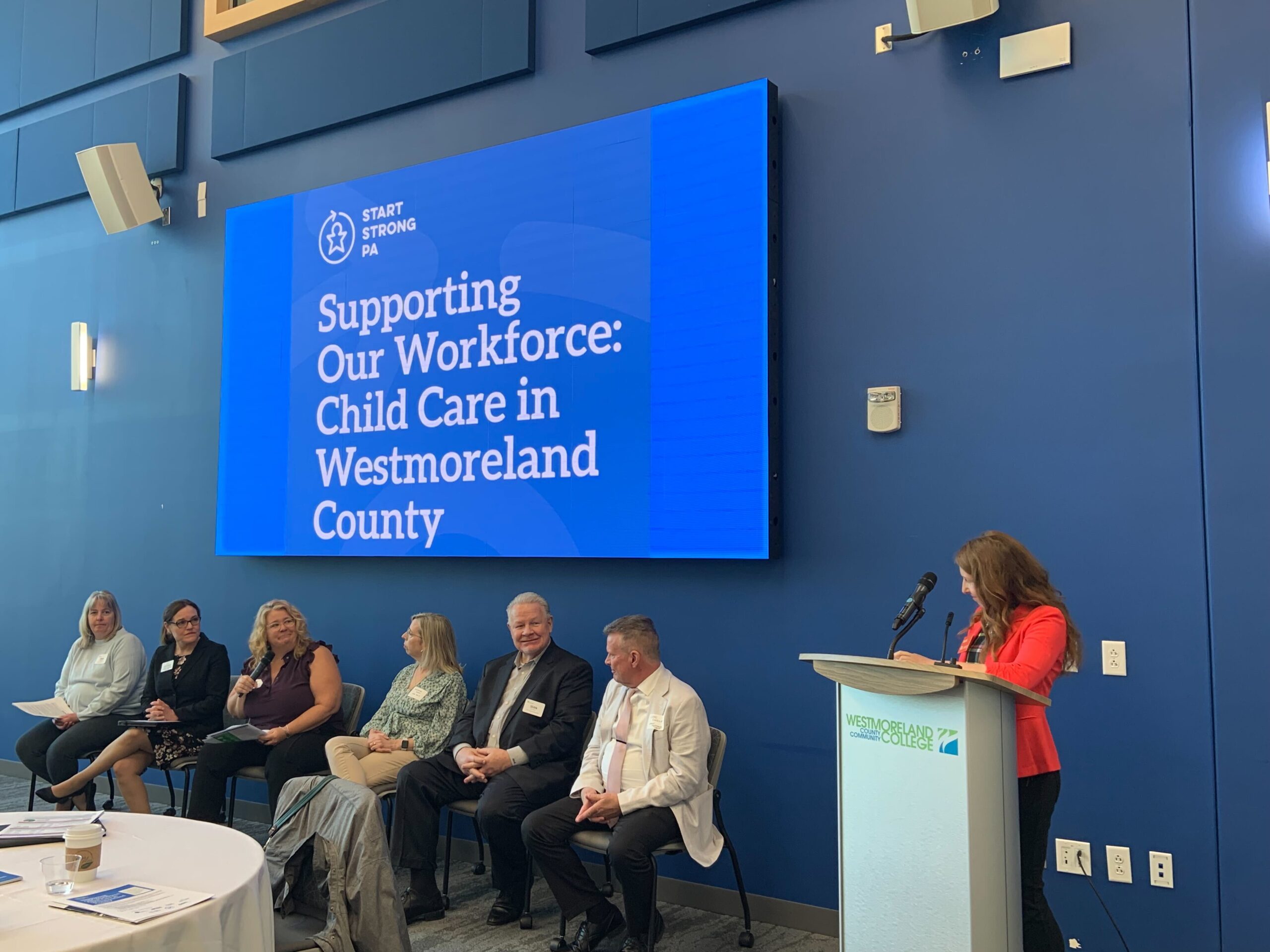
Area lawmakers, child care providers, and members of the business community met at Westmoreland County Community College on Thursday, April 20 to discuss concerns about a historic staffing shortage within the child care sector and its impact on the economy and working families.

About the Summit

Entitled, “Supporting Our Workforce: Child Care in Westmoreland County,” the event was organized by Start Strong PA and the Westmoreland County Chamber of Commerce, in partnership with:

It featured several speakers, including Pennsylvania State Representatives George Dunbar and Eric Davanzo, General Manager of Live! Casino Pittsburgh Sean Sullivan, Queens College Economist Dr. Clive Belfield, Executive Director of Trying Together Cara Ciminillo, and CEO of the Greensburg YMCA Suzanne Printz, all of whom detailed new research regarding the impacts of the child care crisis.

Summit Highlights

  • Sullivan noted impact that limited child care options has on the workforce, saying, “When parents don’t have reliable, affordable, and quality child care, their work suffers which has an impact for both the employee and employer.”
  • Belfield, who conducted the research for the recent ReadyNation report which revealed that gaps in the Pennsylvania child care system cost employers and taxpayers about $6.65 billion annually, cited the report. He explained that 60% of parents surveyed reported being late for work, leaving work early, or missing full days of work due to child care problems. Twenty-seven percent of respondents said they quit due to child care struggles.
  • Ciminillo referenced a new Start Strong PA study showing the average child care teacher in Pennsylvania earns $12.43 per hour or less than $25,844 per year.Our research shows that 50 percent of early learning educators say they do not plan to or are unsure of whether they will remain in their jobs in the next five years due to low wages,” Ciminillo said. 
  • Printz noted that child care providers can’t just raise teacher wages because families are already struggling to afford the costs of care.
  • Participants referenced the dire impact that low wages are having on the availability of care and a recent Start Strong PA survey that revealed more than 3,600 open staff positions across the state, resulting in more than 1,500 closed classrooms with a combined waitlist of more than 35,000 children.
  • Participants discussed a series of action steps for both policy makers and the private sector to better ensure affordable high-quality child care for Pennsylvania’s working families. Private sector actions included flexible working schedules, child care referrals, tuition assistance programs, dependent care flexible spending accounts, and even on-site care. For policy makers, participants stressed the urgent need for the Commonwealth to help implement and pay for a wage scale for child care teachers that will help providers better compete in the current labor market.

Learn More

To learn more, visit the the Start Strong PA website.

News

March 21, 2023

Supporting Our Workforce: Child Care in Westmoreland County

The Westmoreland County Chamber of Commerce will host this half-day summit to discuss the current state of child care for working families in Westmoreland County.

Panel discussions will highlight the current challenges facing the child care sector and the implications for working families trying to find and afford care; the impact of limited child care options on area businesses; and potential solutions to increase the availability of high-quality care and stabilize the child care sector.

Breakfast will be provided.

Event Details

Thursday, April 20 | 8 – 11 a.m.

Westmoreland Community College
145 Pavilion Lane
Youngwood, PA 15697

Register

Learn More

This event is being held in partnership with:

To learn more, visit the Westmoreland County Chamber of Commerce website or view the event flyer.

News

February 22, 2023

ELPA Poll Shows Strong Support for Investments into Early Childhood

A new poll, commissioned by the Early Learning PA Coalition and conducted by Susquehanna Polling and Research from February 1 – 7, 2023, found that 98% of PA voters believe that early childhood education is important. The poll also showed strong voter support for increased investment for early care and education programs like pre-k, high-quality child care and home visiting services.

There has been significant growth in voter’s overall support from a June 2022 poll, where 90% of voters said they found early childhood education to be important.

Poll Details

Partners of the Early Learning PA Coalition released the new polling data on voter support for early childhood care and education programs during a press conference held on Tuesday, February, 21, 2023 at the Capitol Rotunda in Harrisburg, PA.

According to the poll:

  • 78% of PA voters support increasing state funding to serve more eligible children in pre-k programs, which is an increase from 65% in 2022;
  • 78% of PA voters also support increasing state funding to help more low-income working families afford high-quality child care, up from 67% in 2022;
  • 68% of PA voters support increasing state funding to provide voluntary home visiting services to eligible families , up from 60% in 2022; and
  • 81% of PA voters favor allocating state funding to increase wages of child care workers.

“As we start budget season here in Harrisburg, the partners of the Early Learning PA Coalition urge Governor Shapiro and all members of the General Assembly to respond to this level of voter support for growing the Commonwealth’s investments in early care and education,” said Kristen Rotz, President of the United Way of Pennsylvania and principal partner in the Early Learning PA Coalition. “Pennsylvania must make these programs more accessible to children and families that qualify and further stabilize and strengthen the system by addressing historic teacher shortages caused by low wages.” said Rotz.

Visit the Pre-K for PA Facebook page to watch the February 21, 2023 press conference in full.

News

September 14, 2022

Participate in Early Childhood Wage Survey

Trying Together’s statewide partners — Children First and Reinvestment Fund with Start Strong PA — are conducting a survey to determine the wages of early childhood educators across Pennsylvania.

Child Wage Survey

Providers of early childhood education have struggled with low wages for some time. These unlivable wages have contributed to the current staffing shortages affecting the entire profession. In order to effectively advocate on behalf of educators, legislators need to know the current wages that early childhood professionals are being paid in real time.

To effectively gather this information, teachers in early childhood classrooms are encouraged to participate in this ongoing wage survey. Information will be confidential and any data collected will only be reported in the aggregate. Participants will also have the option to enter a drawing for a $50 Amazon gift card.

Please direct all questions to Mai Miksic, maim@childrenfirstpa.org, early childhood education policy director at Children First.

News

April 14, 2022

March 2022 Child Care Staffing Survey Results

A survey conducted by partners of the Start Strong PA Campaign quantifies Pennsylvania’s current child care  staffing crisis — caused by low wages.

Survey Results

The survey — conducted between March 8, 2022 and April 3, 2022 — details the current child care staffing crisis in 1,163 Pennsylvania child care programs across 63 counties and its effects on working families’ ability to access care.

According to the survey:

  • Nearly 32,500 children currently sit on waiting lists.
  • More than 30,000 additional children could be served at respondents’ sites if they were fully staffed.
  • 91% of respondents reported staffing shortages.
  • Programs need to fill nearly 7,000 open child care positions.
  • 48% of respondents have closed at least one classroom.

In September 2021, Start Strong PA released a similar survey showing that Pennsylvania’s child care centers were experiencing a staffing shortage resulting in more than 25,000 children sitting on waiting lists. In just six months, the waiting list numbers have increased by nearly 10,000 children with 169 fewer providers reporting.

The following fact sheets are available with statewide and county results:

Petition

Advocates are calling on the General Assembly and the Wolf Administration to “Raise Child Care” by allocating $115 million in sustainable state and/or federal funds as part of the final state budget to provide a $2 per hour wage supplement for child care teachers and staff.

Start Strong PA is asking for your signature in support the investment to child care providers.

More Information

To learn more about the survey and petition, visit the Start Strong PA website.

News

March 9, 2022

March 2022 PA Child Care Staffing Crisis Survey

The Start Strong PA campaign is collecting information from child care program owners and directors via a brief survey to help tell the story of Pennsylvania’s on-going child care staffing crisis.

(This article was updated on March 31, 2022 to reflect a deadline extension).

Take the Survey

The campaign will use survey results to demonstrate the urgent need for increased child care funding in the 2022-2023 state budget and to urge congressional delegation to support long-term, substantial investments in the early care and education sector to strengthen and secure the industry.

Directors and owners who complete the survey by Sunday, April 3, 2022 will be entered into a drawing for a $100 gift card. Start Strong PA will award two gift cards.

Take the March 2022 PA Child Care Staffing Crisis Survey.

Start Strong PA conducted a similar survey between August 30, 2021 and September 8, 2021. View the results of that survey.

News

March 1, 2022

Apply: PA ECE Provider Advisory Board

The Start Strong PA and Pre-K for PA Campaigns are seeking out early childhood professionals to apply to participate as a lead advocate in their region by serving on the first statewide Start Strong PA and Pre-K for PA Provider Advisory Board.

About the Provider Advisory Board

The advisory board will be composed of 30 early childhood professionals from across the state, working in diverse roles in all setting types. Participants will have:

  • an opportunity to elevate the voices of early childhood professionals by providing the field’s professionals with a consistent platform for policy updates and advocacy opportunities;

  • a space to identify the diverse needs of the early childhood workforce through a consistent feedback loop of what they are experiencing in the field;

  • free access to consistent advocacy related professional development, leadership development, and growth opportunities;

  • a chance to create equity driven strategies and connect practice to inform policy recommendations that support the needs of all providers, children, and families in Pennsylvania;

  • and opportunities to strengthen connections with community partners.

The advisory board will meet virtually once a month beginning in April 2022. All participants will be compensated for their time.

Apply

The application period will be from March 1 to March 28, 2022. Providers can apply online. Applicants will be notified of their application status via email the first week of April.

Share this flyer with your networks.

News

February 10, 2022

2022-23 Pennsylvania Budget Proposal Response

On February 8, 2022, Pennsylvania Governor Tom Wolf released the 2022-23 state budget proposal.

The principal partners of Early Learning Pennsylvania (ELPA), a statewide coalition of advocates focused on supporting young Pennsylvanians from birth to age five, are pleased with proposed investments in pre-k, evidence-based home visiting, and perinatal and child health. However, the proposal fails to adequately invest in child care.

ELPA operates four issue-based advocacy campaigns: Pre-K for PA, Start Strong PA, Childhood Begins at Home, and Thriving PA

Governor Wolf’s state budget proposal included:

Pre-k

  • $60 million in additional funding for the state’s Pre-K Counts program. 
  • $10 million in additional funding for the Head Start Supplemental Assistance Program.

Together, this $70 million expansion could serve approximately 2,300 additional young children. 

In a press release, ELPA states, “This funding continues the Commonwealth’s tradition and Governor Wolf’s unwavering commitment of expanding access to high-quality pre-k. This $70 million proposed expansion could provide this once-in-a-lifetime opportunity to more than 2,300 additional young learners.

“Research shows that high-quality pre-k benefits children’s cognitive, social, and emotional development and confirms the Commonwealth’s investment in pre-k pays dividends for the children fortunate enough to access it. This investment is not only essential for our children, but high-quality early education supports labor force participation, healthy families, and a globally competitive workforce of the future. By increasing pre-k access and opening the door to more families, our economic recovery reaps the benefits.”

Child Care

  • Level funding for the state Child Care Assistance and Child Care Services line items.
  • $77.7 million in federal funding to sustain child care subsidy base rates.
  • $44.3 million in federal funding to sustain the reduction in out-of-pocket family co-payments.
  • $6.1 million in federal child care funding to sustain the incentive for providing non-traditional hour care.
  • $30 million in state funding to provide state employees with increased access to and affordability of child care through the Department of General Services.

“The Wolf Administration’s budget proposal is an inadequate response to the current child care crisis and misses an important opportunity to help working families in search of affordable high-quality care,” ELPA representatives stated. “Furthermore, failure to fully stabilize the child care sector jeopardizes the efforts of Pennsylvania businesses trying to rehire their labor force. Child care programs are closing classrooms and entire facilities due to teacher and staff shortages. Child care staff are overworked and underpaid with the average child care teacher making less than $11 per hour.” 

While the budget proposal does utilize federal funds, ELPA believes it is not sufficient in light of flat funding for Pennsylvania’s Child Care Services and Child Care Assistance line items for the third consecutive year.  

Start Strong PA is urging state policymakers to allocate a portion of the projected year-end surplus of $2.8 billion to address staff recruitment and retention, and increase access to quality care for working families, specifically for infants and toddlers.

 Home Visiting

  • $15 million in additional funding for evidence-based home visiting in the Community-Based Family Center line item (this will serve an additional 3,800 pregnant women, children, and families), as well as $8 million in one-time federal stimulus funds specified for home visiting.

“Following two years of level funding, the [Childhood Begins at Home] campaign is pleased to see Governor Wolf’s proposed investment restarts his commitment to increasing service levels beyond the 5% of Pennsylvania families currently served,” ELPA stated. 

Perinatal and Child Health

  • Funding allocated for postpartum coverage extension for women in Medicaid from 60 days to 12 months.
  • $11.5 million in increased funding for the Early Intervention Part C (infant and toddler) program through DHS, with $1.2 million allocated for children eligible for tracking when their mothers have a positive screen for postpartum depression or anxiety.
  • Level-funding for the Part B Early Intervention program (age three to five) offered through PDE.

ELPA stated, “Medicaid is a significant source of insurance for Pennsylvania women and birthing individuals— especially for women of color— so expanding coverage to a full year postpartum is a vital step towards closing racial and health disparities.    

“Additionally, we must ensure all children from birth through age five with developmental delays are identified, referred to, and accepted for the services they need to reach their fullest potential.” 

More Information

Read ELPA’s full budget response statement for details. The Pittsburgh-based early childhood nonprofit Trying Together and other partners of ELPA will continue to advocate for these investments as the budget process continues. Stay up-to-date on how to advocate for these issues by signing-up to support Trying Together’s public policy agenda.