News

November 10, 2025

Trying Together Exec Director to Participate in Discussion on How Child Care Shapes PA Economy

Trying Together Executive Director Cara Ciminillo will take part in an upcoming virtual discussion on how child care shapes Pennsylvania’s economy.

Learn More

The state Governor’s Advisory Commission on Women will host a virtual discussion on Monday, November 17 on child care’s role in Pennsylvania’s economy. 

The event will be a candid conversation featuring participants from business and economic development, state government, and child care advocacy. It will explore the workforce, policy, and cultural shifts needed to strengthen child care in Pennsylvania.

The state is currently facing a child care crisis that affects every sector of its economy. Due to a shortage of 3,000 child care positions affecting care for more than 25,000 children, families are being forced to choose between cutting work hours or leaving the workforce entirely.

Since nearly 70% of children have working parents and 95% of child care workers are women, the issue is deeply intertwined with women’s economic opportunity.

The virtual discussion will focus on identifying the problem and shaping solutions that help families, employers, and the economy.

Panelists include Ciminillo; Shante Brown, the deputy secretary of the state’s Office of Child Development and Early Learning (OCDEL); Alex Halper, senior vice president of government affairs for the PA Chamber of Business and Industry; and Kevin Schreiber, president and CEO of the York County Economic Alliance.

Tracy Lawless – government affairs counselor for K&L Gates and chairwoman of the Women in the Workforce Subcommittee of the Governor’s Advisory Committee on Women – will be the moderator.

Those interested in attending can RSVP online.
News

November 5, 2025

PA Partnerships for Children’s Report Describes State “Crisis” in Early Childhood Education

Pennsylvania Partnerships for Children’s 2025 State of Early Care and Education report described the state’s early childhood education system as a “crisis” for families, educators, and the state’s economy.

Learn More

The report arrives amid the state’s ongoing budget impasse during which providers such as Pre-K Counts and Head Start haven’t been paid for months.

“Pennsylvania’s early care and education system is in crisis,” Pennsylvania Partnerships for Children wrote in the report. “Families can’t find or afford child care, educators are underpaid and leaving the field, and the state is losing billions in economic productivity.”

According to the report’s key statistics, a total of 72% of families with children under age 6 have all caregivers in the workforce. However, only 23% of eligible infants and toddlers are served by Child Care Works and 84,000 preschoolers lack access to high-quality, publicly-funded pre-k.

Infant care costs approximately $13,354 per year, which is nearly equal to college tuition, the report noted.

As a result of all this, many children in Pennsylvania are missing out on critical early learning that sets the foundation for lifelong success. When caregivers can’t access care, they are often forced to leave the workforce or reduce hours. 

Child care workers earn an average $15.15 per hour, which is lower than many entry-level jobs, and, as a result, providers are struggling to recruit and retain employees. Educators are leaving the profession for better-paying jobs in other industries.

There are currently more than 3,000 open positions statewide and Pennsylvania has lost 393 child care providers since 2019. Without adequate staffing, classrooms close in communities, leaving families desperate for care.

The report found that Pennsylvania loses $6.65 billion annually due to child care shortages.

For more information, read Pennsylvania Partnerships for Children’s full report.

News

September 9, 2025

Trying Together’s Director of Public Policy Discusses Early Childhood Education Crisis on PCN Capitol Preview

Trying Together’s director of public policy appeared this week on The PCN Capitol Preview to discuss Pennsylvania’s ongoing early childhood education staffing and funding crisis.

Learn More

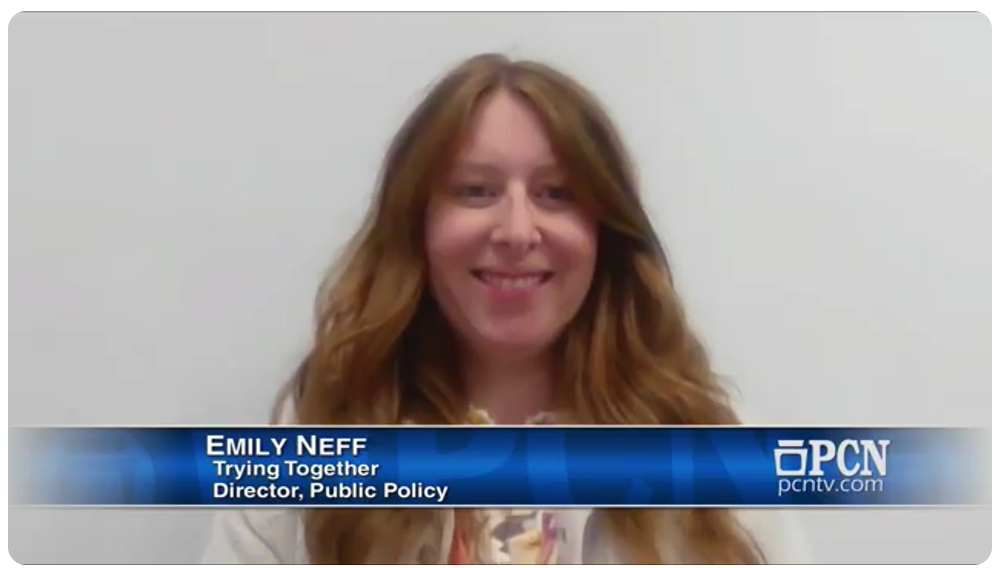
Emily Neff, Trying Together’s director of public policy, appeared on the program on Tuesday, Sept. 8 to discuss what Trying Together does to support early childhood development as well as the state’s teacher shortage and budget impasse.

“We are in a crisis,” Neff said. “The system is not working for everyone. Early childhood educators are woefully underpaid for the amazing work they do for our children. Families are paying as much for their rent or mortgage as they do for child care – and that’s if they can find it.”

Neff said many parents – including herself – are on long waiting lists to get their children into a program. Often, she added, programs have classrooms that are closed that could serve more children, but cannot due to the state’s staffing crisis. She said that one program she knows of recently closed its toddler class, while another said it would shut down if it lost another teacher. 

Neff cited Gov. Josh Shapiro’s proposed $55 million child care teacher recruitment and retention line item as an opportunity to address the state’s early education crisis.

“It’s a great opportunity for Pennsylvania to put itself on the map,” she said. “It would be a $1,000 payment to teachers, but we don’t know what’s going to happen with that right now.”

She said that the state’s budget impasse – during which the state Legislature has not passed a budget more than two months past the deadline, resulting public schools not receiving state funding that educators say is critical to keep them operating – has led some programs to lay off teachers, while parents have been left to find care elsewhere.

“We need more investments to make sure that programs have what they need, teachers are being paid better, and families have access – and it’s not costing families more than what they’ve already been paying,” Neff said.

The PCN Capitol Preview is available on YouTube.

News

May 13, 2024

Nearly Half of Eligible Pennsylvania Children Do Not Have Access to Pre-K

A total of 145,010 Pennsylvania children, ages three and four, are eligible for high-quality pre-kindergarten. However, only 46% of them have access, according to 2024 Pre-K for PA fact sheets.

Learn More

Of the eligible children – who comprise 52% of all children in that age range statewide – a total of 66,839 have access to high-quality pre-kindergarten. But 54% of eligible children – a total of 78,171 – do not have access. An additional 7,817 pre-k staff would be required to serve the remaining eligible children.

Pre-K for PA defines high-quality, publicly funded pre-kindergarten as:

  • Head Start (state- and federally-funded)
  • Pre-K Counts
  • School district pre-kindergarten
  • Philadelphia pre-K (PHLpreK)
  • Child care provided in Keystone STAR 3-4 centers and group child care homes participating in the Child Care Works subsidized program for preschool age children.

Four types of high-quality providers are eligible to receive Pre-K Counts funding to support a pre-k program:

  • Head Start
  • Keystone STAR 3-4 child care centers or group child care homes
  • Private academic nursery schools
  • School districts

Breakdown by County

Currently, there are 3,212 eligible pre-k locations in Pennsylvania, of which 74% are receiving public funds for pre-kindergarten. There are also 1,035 Pre-K Counts locations, of which 505 (or 49%) are in high-quality child care programs.

Allegheny County has 271 eligible pre-k locations, of which 205 (76%) are receiving public funds for pre-K. It has 88 Pre-K Counts locations, of which 28 (32%) are in high-quality child care.

Data in other counties includes:

  • Armstrong: 15 eligible locations (12, or 80% receiving public funds); six Pre-K Counts locations (one, or 17%, in high-quality child care)
  • Beaver: 33 eligible locations (32, or 97%, receiving public funds); 15 Pre-K Counts locations (five, or 33%, in high-quality child care)
  • Butler: 25 eligible locations (18, or 72%, receiving public funds); six Pre-K Counts locations (three, or 50% in high-quality child care)
  • Fayette: 25 eligible locations (20, or 80%, receiving public funds); 15 Pre-K Counts locations (six, or 40%, in high-quality child care)
  • Greene: 10 eligible locations (all receiving public funds); five Pre-K Counts locations (none in high-quality child care)
  • Indiana: 22 eligible locations (18, or 82%, receiving public funds); 12 Pre-K Counts locations (2, or 17%, in high-quality child care)
  • Lawrence: 27 eligible locations (22, or 81%, receiving public funds); 14 Pre-K Counts locations (seven, or 50%, in high-quality child care)
  • Washington: 48 eligible locations (39, or 81%, receiving public funds); 22 Pre-K Counts locations (nine, or 41%, in high-quality child care)
  • Westmoreland: 80 eligible locations (62, or 78%, receiving public funds): 38 Pre-K Counts locations (17, or 45%, in high-quality child care)

Addressing the Crisis

As part of the 2024-25 state budget, the Pre-K for PA campaign is asking the General Assembly to support an investment of $30 million in Pre-K Counts to increase the per-child rate to address workforce challenges and inflationary pressures. The campaign notes that additional investments would be needed in future years to further prevent teacher shortages as well as provide greater access to eligible children.