Carnegie Library of Pittsburgh Releases 2023 Best Books for Babies List

News

May 2, 2023

Carnegie Library of Pittsburgh Releases 2023 Best Books for Babies List

The Carnegie Library of Pittsburgh (CLP) recently released its 2023 Best Books for Babies list.

About the CLP Best Books for Babies List

Created by a panel of local librarians and child development experts, Carnegie Library of Pittsburgh’s annual Best Books for Babies list serves as a nationally recognized guide assisting parents, teachers, and caregivers in selecting quality materials to share with their babies.

The list is meant to encourage parents and other caregivers to read to babies and to recognize the authors, illustrators, and publishers who create exemplary books for babies ages birth to 18 months.

Typically a list of 10 books, the 2023 list features 16 titles, with several book sets included. Boasting books on babies, animals, nature, relationships, language, and sleep, the list offers topics for every early learner.

Access the CLP Best Books for Babies List

To access the list, visit the Carnegie Library of Pittsburgh website.

Trying Together and ELRC Region 5 Partnering to Offer First Aid & CPR Training

News

May 1, 2023

Trying Together and ELRC Region 5 Partnering to Offer First Aid & CPR Training

Trying Together and ELRC Region 5 are partnering to provide First Aid, Pediatric First Aid, cardiopulmonary resuscitation (CPR), and automated external defibrillator (AED) training to early childhood professionals throughout June, July, and August.

Participants will receive training through a single, six-hour, in-person course offered on multiple dates and at varying times throughout the summer.

About the Course

This course emphasizes hands-on learning and provides life-saving skills in alliance with The Occupational Safety and Health Administration (OSHA)’s Best Practices for Workplace First Aid Training Programs.

Certification will be issued upon successful completion of the course. This certification is valid for 2 years.

Course Offerings

Courses are available:

Register via the links above.

Learn More

The cost of the course is $35. The course is PQAS certified and must be paid for in full before registrants can participate. Registered individuals will receive additional course information prior to the start of their registered session. Please make sure to read all information before the start of the course.

For questions about the sessions, contact Holly Cessna at holly.cessna@alleghenycounty.us. For credit questions, contact Paige Kizior at paige@tryingtogether.org.

EITA Offering Professional Development Opportunity on the Growing Brain

News

EITA Offering Professional Development Opportunity on the Growing Brain

Early Intervention Technical Assistance (EITA) is offering early childhood professionals a professional development opportunity to learn about brain growth in children from birth to five years of age.

Aptly named, “The Growing Brain: From Birth to 5 Years Old,” this virtual series details child brain development and shares ways to encourage healthy growth in young children.

About “The Growing Brain”

Decades of research indicate that the early years of life are a period of exponential brain development, characterized by great opportunity and vulnerability dependent on child relationships and environment.

In this series, participants will develop skills and strategies to:

  • understand the architecture and neurobiology of brain development
  • support language, cognition, prosocial behavior, and social-emotional development
  • and reduce toxic stress that can negatively influence brain development in very young children

Session Details

“The Growing Brain” is offered in several, progressive sessions. Each session is offered twice, and interested individuals can register and attend as many or as few sessions as they like. One PQAS credit is available for each session. Sessions include:

Factors Affecting Brain Growth & Development

In this session, participants will identify factors that negatively impact brain development, understand the impact of stress on the developing brain, and learn about strategies for supporting healthy brain growth and development.

Offered:

  • Thursday April 27 | 12 – 1 p.m.
  • Friday April 28 | 8 – 9 a.m.

Communication & Language Development

In this session, participants will understand communication milestones, learn strategies for supporting early communication skills, and understand multi-language learning.

Offered:

  • Thursday May 4 | 12 – 1 p.m.
  • Friday, May 5 | 8 – 9 a.m.

Cognition & Executive Function

In this session, participants will review and summarize key cognitive milestones in brain development, as well as explore the layers of executive function and its importance in child development.

Offered:

  • Thursday, May 18 | 12 – 1 p.m.
  • Friday, May 19 | 8 – 9 a.m.

Social-Emotional Development

In this session, participants will review key social emotional development milestones in children, as well as connect which areas of the brain are involved in social interactions and examine the role that relationships and attachment play in social-emotional development.

Offered:

  • Thursday, May 25 | 12 – 1 p.m.
  • Friday, May 26 | 8 – 9 a.m.

Understanding Behavior

In this module, session leaders will discuss approaches for identifying the root cause of young children’s behavior and demonstrate effective strategies to address challenging behaviors in very young children.

Offered:

  • Thursday, June 1 | 12 – 1 p.m.
  • Friday, June 2 | 8 – 9 a.m.

Everyday Play

In this session, participants will learn to understand the stages and types of play that unfold in early childhood, the role of the brain in this process, and how to maximize children’s learning through play.

Offered:

  • Thursday, June 8 | 12 – 1 p.m.
  • Friday, June 9 | 8 – 9 a.m.

Register for any or all sessions on the PD Registry.

Learn More

This series is presented by EITA Consultants certified in “The Growing Brain” curriculum, which was developed by Zero to Three Professional Development and Workforce Innovations (PDWI). PDWI aims to elevate the knowledge skills and abilities of early childhood professionals.

For additional information on this offering, view the flyer. For additional information on “The Growing Brain,” visit www.zerotothree.org/growingbrain or the PD Registry.

Resources for May Observances

News

April 27, 2023

Resources for May Observances

Various organizations, states, and nations recognize a number of observances each month. Resources help parents, caregivers, and child care professionals acknowledge and navigate them.

Here is a list of resources for May observances:

Month-Long Observances

May is National Foster Care Month

May is Mental Health Awareness Month

May is Asian American and Pacific Islander Month

Weeks of Recognition

May 1 – 7 is Children’s Book Week

May 8 – 12 is National Teacher Appreciation Week

Days of Recognition

May 7 is National Children’s Mental Health Awareness Day

May 12 is National Child Care Provider Appreciation Day

May 14 is Mother’s Day

May 28 is World Hunger Day

PA DHS Extends LIHEAP Application Period

News

April 26, 2023

PA DHS Extends LIHEAP Application Period

The Pennsylvania Department of Human Services (PADHS) has extended the Low-Income Home Energy Assistance Program (LIHEAP) application period.

Previously set to close April 28, PADHS will now accept applications through May 12. Pennsylvanians who are behind on or having trouble paying home heating bills are encouraged to apply for LIHEAP benefits before the new deadline.

About LIHEAP

The Low Income Home Energy Assistance Program (LIHEAP) helps families living on low incomes pay their heating bills in the form of a cash grant. Households in immediate danger of being without heat can also qualify for crisis grants.

The cash grant is a one-time payment sent directly to the utility company/fuel provider to be credited on your bill. These grants range from $300 to $1,000 based on household size, income, and fuel type.

Eligibility

Applicants must meet income requirements for 2022-2023. They are as follows:

  • One-person household: $20,385

  • Two-person household: $27,465

  • Three-person household: $34,545

  • Four-person household: $41,625

  • Five-person household: $48,705

  • Six-person household: $55,785

  • Seven-person household: $62,865

  • Eight-person household: $69,945

  • Nine-person household: $77,025

  • Ten-person household: $84,105

  • For every additional person: Add $7,080

Applicants must have proof of income for each adult in the household, a copy of their most recent utility bill, and the social security number of each adult in the household (and child, if possible).

Apply

There are two ways to apply for LIHEAP:

After your application is reviewed, you will receive written notice explaining your eligibility and the amount of assistance you will receive. Please allow 30 days for a response.

Learn More

To learn more, visit the LIHEAP webpage on the PADHS website.

Advocacy Organizations Release Report on Rural Early Care and Education

News

April 25, 2023

Advocacy Organizations Release Report on Rural Early Care and Education

Trying Together, in partnership with Start Strong PA and Pre-K for PA, recently released a report on the current state of early child care and education in Pennsylvania’s rural counties.

Entitled, “A Snapshot of the Rural Early Care and Education Landscape: Examining data from 13 counties in Pennsylvania,” the report shows that families in rural Pennsylvania communities have limited access to quality care, despite having a higher proportion of parents in the workforce, and a greater prevalence of long and nontraditional hours and commutes.

About Rural Counties and the Rural Early Care and Education Report

Authors of the report considered counties in which the number of people per square mile amounted to less than 291 (the statewide average), rural. Of Pennsylvania’s 67 counties, 72% met this definition, and just over 162,000 children under five live in them.

This report highlights data in the following rural counties: Armstrong, Butler, Centre, Clarion, Fayette, Franklin, Greene, Indiana, Somerset, and Washington. It also includes data from Lancaster, Westmoreland, and York counties. These counties aren’t classified as rural based on the population, but include pockets of rural communities facing similar challenges.

Report Findings

Rural families and child care providers have some of the greatest challenges in accessing and providing child care in Pennsylvania. This is due to the unique realities of rural areas, including fewer high-quality options, distance and travel, limited transportation, higher teacher turnover, fewer qualified individuals living in the region, and lower family incomes.

Specifically:

Working Families Child Care Needs

  • Nearly every rural county in PA shows a majority of all available parents in the labor force.
  • Seven of the counties reviewed have a higher proportion of working parents than does the state.
    • Over 80% of parents in Butler County are in the workforce, as are three quarters of parents in Indiana and Somerset counties.
  • In rural areas, options for evening, overnight, or weekend hours are scarce, with one parent describing them as non-existent.

Child Care Provider Capacity

  • The number of Child Care Works (CCW) subsidy-eligible children who need child care exceeds the licensed capacity in every county reviewed, with the exception of Centre.
    • Families are eligible for the CCW subsidy if their incomes are at or below 200 percent of the Federal Poverty Level ($60,000 for a family of four).
  • Most rural child care programs are not operating at full capacity because they don’t have enough staffing.
  • Statewide home-based providers make up about 30% of licensed programs, yet home-based providers comprise a much higher proportion in some of the rural counties analyzed.
    • In Greene County, home-based providers account for over 70% of licensed options, and for over half in Franklin County. Indiana County home-based providers make up 48% of licensed options, and in Armstrong and Somerset counties, home-based providers are 42% of licensed child care.

Public Funding for Child Care and Pre-K

  • The state only serves a quarter of CCW-eligible infants and toddlers. Unfortunately, this figure is even lower in every rural county reviewed. In rural counties, both subsidized and private pay infant and toddler care is difficult to find and afford.
  • Pre-K children are served at much higher rates than infants and toddlers, given that pre-k investments have been more consistent and sustainable.
    • Clarion, Greene, Indiana, and Lawrence counties are serving more than half of their eligible three- and four- year olds.

The Child Care Workforce

  • Pennsylvania is experiencing a dramatic decline in teachers from pre-k to 12th grade, and rural communities have been the most significantly impacted by this decline.
  • No county shows median annual earnings above $26,000, with six counties below $20,000 a year. The median earnings fall well under the cost of living in every county.
  • Providers highlighted the difficulty of training staff, especially with changing requirements and when onboarding new employees.
  • Another challenge that providers raised is the lack of mental and behavioral health and early intervention services.

Recommendations

Early childhood programs can’t continue to operate with their current budgets and expenses. Additionally, middle class families cannot continue to shoulder the brunt of the cost, while child care teachers subsidize the system through their own low wages. Thus, Trying Together, Start Strong PA, and Pre-K for PA recommend the following:

  1. Invest long-term, sustainable funding for early childhood educator wages.
  2. Conduct further research on family child care needs and choices in rural communities.
  3. Support resources and quality for home-based and relative care providers.
  4. Increase infant and toddler contracted slots (grants).
  5. Move to an alternative cost methodology for setting subsidy rates.
  6. Increase early intervention, mental health, and behavioral health resources, and professionals.
  7. Provide more support and resources to help rural providers meet training requirements.

Learn More

To learn more, read the full report.

April Recalls on Children’s Products

News

April 24, 2023

April Recalls on Children’s Products

Parents and caregivers should be aware of several child-related product recalls.

Learn More

Here is a list of April recalls collected from the following major federal agencies: the Consumer Product Safety Commission, the Food and Drug Administration, and the National Highway Traffic Safety Administration.

More Information

For recall details, visit the links above or review the Consumer Product Safety Commission, the Food and Drug Administration and the National Highway Traffic Safety Administration websites.

Westmoreland County Chamber Hosts Summit to Address Child Care Crisis

News

Westmoreland County Chamber Hosts Summit to Address Child Care Crisis

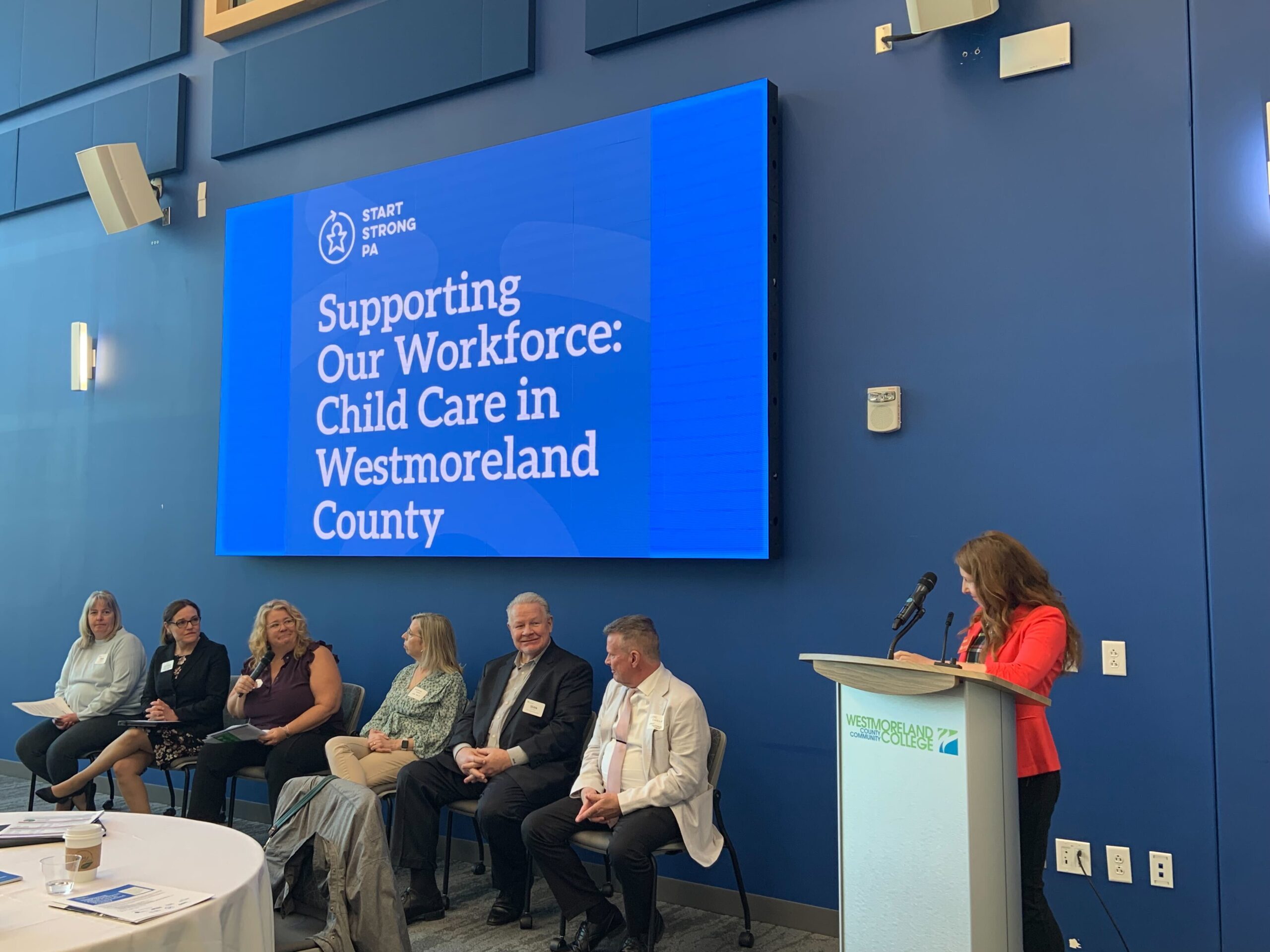
Area lawmakers, child care providers, and members of the business community met at Westmoreland County Community College on Thursday, April 20 to discuss concerns about a historic staffing shortage within the child care sector and its impact on the economy and working families.

About the Summit

Entitled, “Supporting Our Workforce: Child Care in Westmoreland County,” the event was organized by Start Strong PA and the Westmoreland County Chamber of Commerce, in partnership with:

It featured several speakers, including Pennsylvania State Representatives George Dunbar and Eric Davanzo, General Manager of Live! Casino Pittsburgh Sean Sullivan, Queens College Economist Dr. Clive Belfield, Executive Director of Trying Together Cara Ciminillo, and CEO of the Greensburg YMCA Suzanne Printz, all of whom detailed new research regarding the impacts of the child care crisis.

Summit Highlights

  • Sullivan noted impact that limited child care options has on the workforce, saying, “When parents don’t have reliable, affordable, and quality child care, their work suffers which has an impact for both the employee and employer.”
  • Belfield, who conducted the research for the recent ReadyNation report which revealed that gaps in the Pennsylvania child care system cost employers and taxpayers about $6.65 billion annually, cited the report. He explained that 60% of parents surveyed reported being late for work, leaving work early, or missing full days of work due to child care problems. Twenty-seven percent of respondents said they quit due to child care struggles.
  • Ciminillo referenced a new Start Strong PA study showing the average child care teacher in Pennsylvania earns $12.43 per hour or less than $25,844 per year. “Our research shows that 50 percent of early learning educators say they do not plan to or are unsure of whether they will remain in their jobs in the next five years due to low wages,” Ciminillo said. 
  • Printz noted that child care providers can’t just raise teacher wages because families are already struggling to afford the costs of care.
  • Participants referenced the dire impact that low wages are having on the availability of care and a recent Start Strong PA survey that revealed more than 3,600 open staff positions across the state, resulting in more than 1,500 closed classrooms with a combined waitlist of more than 35,000 children.
  • Participants discussed a series of action steps for both policy makers and the private sector to better ensure affordable high-quality child care for Pennsylvania’s working families. Private sector actions included flexible working schedules, child care referrals, tuition assistance programs, dependent care flexible spending accounts, and even on-site care. For policy makers, participants stressed the urgent need for the Commonwealth to help implement and pay for a wage scale for child care teachers that will help providers better compete in the current labor market.

Learn More

To learn more, visit the the Start Strong PA website.

PNC Foundation to Match Donations to Pre-K and Head Start Requests

News

April 21, 2023

PNC Foundation to Match Donations to Pre-K and Head Start Requests

The PNC Foundation is partnering with DonorsChoose—an online nonprofit that allows individuals to fund classroom projects and teacher requests for resources and materials—to help early childhood educators obtain quality resources and experiences for students in public pre-K, public charter, and Head Start classrooms.

By committing to match “dollar-for-dollar” any DonorsChoose donations that support pre-k and Head Start projects, the foundation hopes to encourage others to fund child care and early childhood education.

The duration of the match is undetermined and subject to restrictions and a maximum dollar amount.

DonorsChoose Educator & Project Eligibility

Who can participate?

Pre-K teachers in every state, subject area, and grade level can use DonorsChoose. If you are an educator at a public school, public charter school, or Head Start program, are employed full-time by a school or district, and work directly with students at least 75% of the time, you are eligible to post projects.

What is eligible for funding?

You can request anything you need to enrich your students’ experience at school. Sports equipment? A classroom library? Furniture? Musical instruments? DonorsChoose can help. If you can imagine it, you can post a classroom project request for it.

How does it work?

The process is simple:

  1. Create your project in DonorsChoose.
  2. Receive donations from friends, family, and supporters through the DonorsChoose website.
  3. Receive your request. DonorsChoose orders everything for you and ships it straight to you or your school.

How long does it take?

The average project takes about 25 minutes to create and submit. Once your project is funded, DonorsChoose takes care of the rest.

Participate in the Match

To utilize the match from the PNC Foundation and better fund your pre-k or Head Start classroom project, add it to the DonorsChoose website by following the step-by-step instructions on the “How it Works” page.

Results from Past Partnerships Between the PNC Foundation & DonorsChoose

Previously, the PNC Foundation flash funded almost $2 million dollars in requests from 3,054 pre-k teachers across 30 states through DonorsChoose. As a result, almost 89,000 pre-k and Head Start students and their early educators received support for materials and projects. Throughout greater Pittsburgh, 126 pre-k teacher requests were fully funded.

Learn More

PNC’s support of DonorsChoose coincides with the launch of this year’s “Great Month” at PNC—an annual celebration held each April to raise awareness of PNC Grow Up Great® and the importance of high-quality early childhood education. Launched in 2004, the $500 million, bilingual initiative supports programs, resources, and experiences that help to prepare children from birth through age five for success in school and life.

To learn more about PNC’s partnership with DonorsChoose and how to participate, visit the PNC Bank website or view the flyer.

ELRC Region 5 Shares Resources and Information on Facebook

News

April 20, 2023

ELRC Region 5 Shares Resources and Information on Facebook

Early Learning Resource Center (ELRC) Region 5 makes resources and information available on social media. With an active presence on Facebook, ELRC Region 5 provides families, early learning service providers, and communities support for their child care needs in real time.

Learn More

Social media managers post to the ELRC Region 5 Facebook page at least once a day, providing the most up-to-date early childhood news, professional development opportunities, family events, ELRC Region 5 office hours, Child Care Works (CCW) information, family assistance opportunities, and more.

Facebook users interested in receiving daily information from ELRC Region 5 should like or follow the ELRC Region 5 page.

For additional resources and information from ELRC Region 5, subscribe to the monthly ELRC Region 5 Family Newsletter, or weekly ELRC Region 5 Providers Newsletter.