Advocacy Organizations Release Report on Rural Early Care and Education

News

April 25, 2023

Advocacy Organizations Release Report on Rural Early Care and Education

Trying Together, in partnership with Start Strong PA and Pre-K for PA, recently released a report on the current state of early child care and education in Pennsylvania’s rural counties.

Entitled, “A Snapshot of the Rural Early Care and Education Landscape: Examining data from 13 counties in Pennsylvania,” the report shows that families in rural Pennsylvania communities have limited access to quality care, despite having a higher proportion of parents in the workforce, and a greater prevalence of long and nontraditional hours and commutes.

About Rural Counties and the Rural Early Care and Education Report

Authors of the report considered counties in which the number of people per square mile amounted to less than 291 (the statewide average), rural. Of Pennsylvania’s 67 counties, 72% met this definition, and just over 162,000 children under five live in them.

This report highlights data in the following rural counties: Armstrong, Butler, Centre, Clarion, Fayette, Franklin, Greene, Indiana, Somerset, and Washington. It also includes data from Lancaster, Westmoreland, and York counties. These counties aren’t classified as rural based on the population, but include pockets of rural communities facing similar challenges.

Report Findings

Rural families and child care providers have some of the greatest challenges in accessing and providing child care in Pennsylvania. This is due to the unique realities of rural areas, including fewer high-quality options, distance and travel, limited transportation, higher teacher turnover, fewer qualified individuals living in the region, and lower family incomes.

Specifically:

Working Families Child Care Needs

  • Nearly every rural county in PA shows a majority of all available parents in the labor force.
  • Seven of the counties reviewed have a higher proportion of working parents than does the state.
    • Over 80% of parents in Butler County are in the workforce, as are three quarters of parents in Indiana and Somerset counties.
  • In rural areas, options for evening, overnight, or weekend hours are scarce, with one parent describing them as non-existent.

Child Care Provider Capacity

  • The number of Child Care Works (CCW) subsidy-eligible children who need child care exceeds the licensed capacity in every county reviewed, with the exception of Centre.
    • Families are eligible for the CCW subsidy if their incomes are at or below 200 percent of the Federal Poverty Level ($60,000 for a family of four).
  • Most rural child care programs are not operating at full capacity because they don’t have enough staffing.
  • Statewide home-based providers make up about 30% of licensed programs, yet home-based providers comprise a much higher proportion in some of the rural counties analyzed.
    • In Greene County, home-based providers account for over 70% of licensed options, and for over half in Franklin County. Indiana County home-based providers make up 48% of licensed options, and in Armstrong and Somerset counties, home-based providers are 42% of licensed child care.

Public Funding for Child Care and Pre-K

  • The state only serves a quarter of CCW-eligible infants and toddlers. Unfortunately, this figure is even lower in every rural county reviewed. In rural counties, both subsidized and private pay infant and toddler care is difficult to find and afford.
  • Pre-K children are served at much higher rates than infants and toddlers, given that pre-k investments have been more consistent and sustainable.
    • Clarion, Greene, Indiana, and Lawrence counties are serving more than half of their eligible three- and four- year olds.

The Child Care Workforce

  • Pennsylvania is experiencing a dramatic decline in teachers from pre-k to 12th grade, and rural communities have been the most significantly impacted by this decline.
  • No county shows median annual earnings above $26,000, with six counties below $20,000 a year. The median earnings fall well under the cost of living in every county.
  • Providers highlighted the difficulty of training staff, especially with changing requirements and when onboarding new employees.
  • Another challenge that providers raised is the lack of mental and behavioral health and early intervention services.

Recommendations

Early childhood programs can’t continue to operate with their current budgets and expenses. Additionally, middle class families cannot continue to shoulder the brunt of the cost, while child care teachers subsidize the system through their own low wages. Thus, Trying Together, Start Strong PA, and Pre-K for PA recommend the following:

  1. Invest long-term, sustainable funding for early childhood educator wages.
  2. Conduct further research on family child care needs and choices in rural communities.
  3. Support resources and quality for home-based and relative care providers.
  4. Increase infant and toddler contracted slots (grants).
  5. Move to an alternative cost methodology for setting subsidy rates.
  6. Increase early intervention, mental health, and behavioral health resources, and professionals.
  7. Provide more support and resources to help rural providers meet training requirements.

Learn More

To learn more, read the full report.

Westmoreland County Chamber Hosts Summit to Address Child Care Crisis

News

April 24, 2023

Westmoreland County Chamber Hosts Summit to Address Child Care Crisis

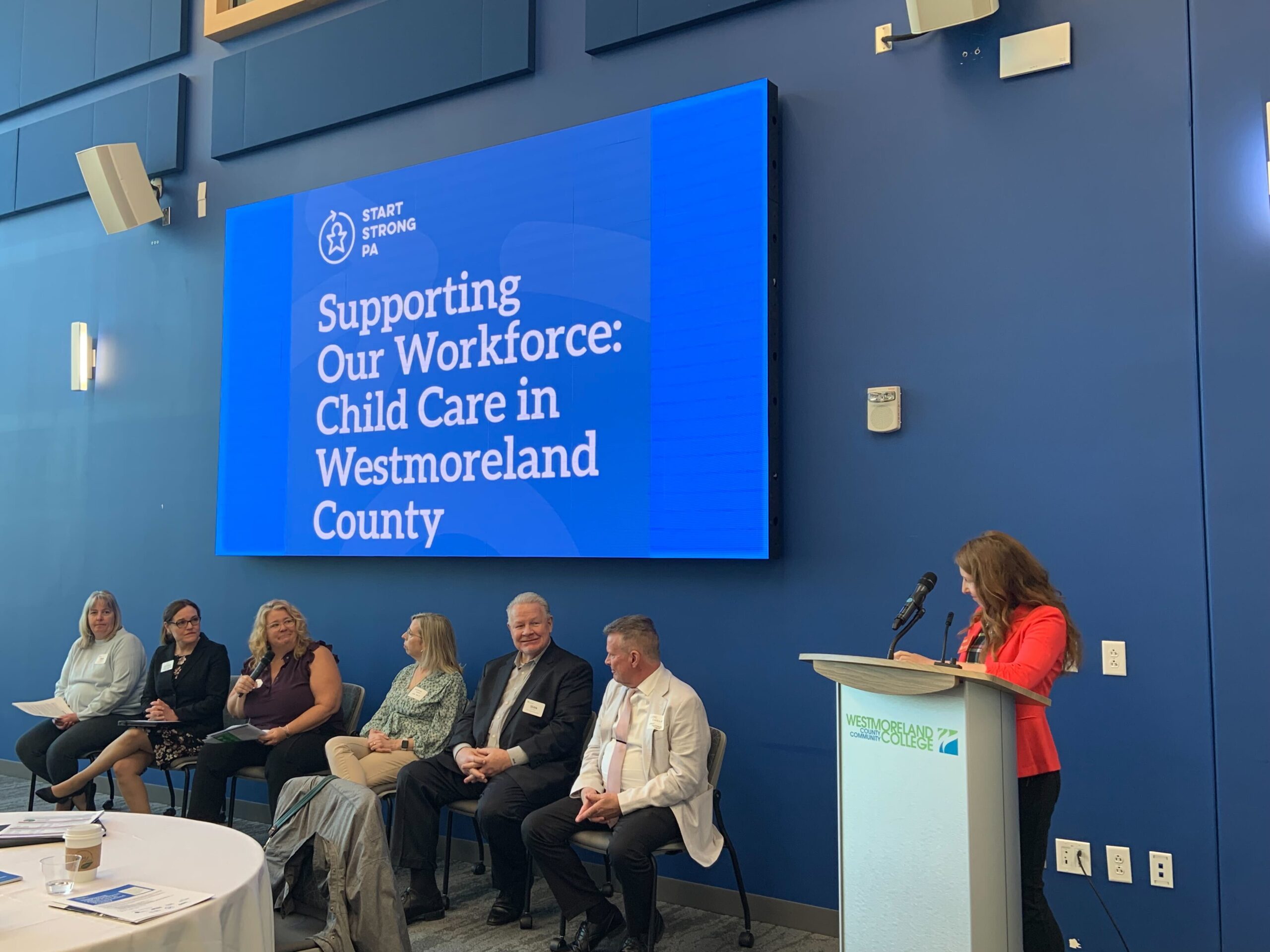
Area lawmakers, child care providers, and members of the business community met at Westmoreland County Community College on Thursday, April 20 to discuss concerns about a historic staffing shortage within the child care sector and its impact on the economy and working families.

About the Summit

Entitled, “Supporting Our Workforce: Child Care in Westmoreland County,” the event was organized by Start Strong PA and the Westmoreland County Chamber of Commerce, in partnership with:

It featured several speakers, including Pennsylvania State Representatives George Dunbar and Eric Davanzo, General Manager of Live! Casino Pittsburgh Sean Sullivan, Queens College Economist Dr. Clive Belfield, Executive Director of Trying Together Cara Ciminillo, and CEO of the Greensburg YMCA Suzanne Printz, all of whom detailed new research regarding the impacts of the child care crisis.

Summit Highlights

  • Sullivan noted impact that limited child care options has on the workforce, saying, “When parents don’t have reliable, affordable, and quality child care, their work suffers which has an impact for both the employee and employer.”
  • Belfield, who conducted the research for the recent ReadyNation report which revealed that gaps in the Pennsylvania child care system cost employers and taxpayers about $6.65 billion annually, cited the report. He explained that 60% of parents surveyed reported being late for work, leaving work early, or missing full days of work due to child care problems. Twenty-seven percent of respondents said they quit due to child care struggles.
  • Ciminillo referenced a new Start Strong PA study showing the average child care teacher in Pennsylvania earns $12.43 per hour or less than $25,844 per year. “Our research shows that 50 percent of early learning educators say they do not plan to or are unsure of whether they will remain in their jobs in the next five years due to low wages,” Ciminillo said. 
  • Printz noted that child care providers can’t just raise teacher wages because families are already struggling to afford the costs of care.
  • Participants referenced the dire impact that low wages are having on the availability of care and a recent Start Strong PA survey that revealed more than 3,600 open staff positions across the state, resulting in more than 1,500 closed classrooms with a combined waitlist of more than 35,000 children.
  • Participants discussed a series of action steps for both policy makers and the private sector to better ensure affordable high-quality child care for Pennsylvania’s working families. Private sector actions included flexible working schedules, child care referrals, tuition assistance programs, dependent care flexible spending accounts, and even on-site care. For policy makers, participants stressed the urgent need for the Commonwealth to help implement and pay for a wage scale for child care teachers that will help providers better compete in the current labor market.

Learn More

To learn more, visit the the Start Strong PA website.

Using Social Media to Advocate for Children

News

April 7, 2023

Using Social Media to Advocate for Children

Social media can be an effective tool in advocating for what you want. However, it is important to use these platforms appropriately to achieve the desired outcome.

Join the Pennsylvania Association for the Education of Young Children (PennAEYC) (an affiliate of the National Association for the Education of Young Children (NAEYC)) for this virtual session on learning effective ways to use social media to advocate for children and early education.

Session Details

Wednesday, April 12 | 1 – 2 p.m.

Virtual via Zoom

Register

Learn More

To learn more, visit the PennAEYC website.

Weathering the Storm: Keeping Immigrants and their Families Covered During the Medicaid Unwinding

News

February 16, 2023

Weathering the Storm: Keeping Immigrants and their Families Covered During the Medicaid Unwinding

The 2020 Families First Coronavirus Response Act created a continuous coverage requirement, ensuring that anybody enrolled in Medicaid would stay enrolled without going through the process of redeterminations. However, on April 1, 2023 the pandemic-era’s continuous coverage requirement will come to an end. States will have 12 months to initiate Medicaid redeterminations for more than 80 million people nationwide.

Although this “unwinding” puts all people enrolled in Medicaid at risk of coverage loss, immigrants and their family members face unique obstacles to remaining covered. These include language barriers, privacy concerns, and fear of immigration-based consequences. Advocates, enrollment professionals, and allies can help.

Join Protecting Immigrant Families (PIF) for this webinar to hear from national experts and state advocates about how to keep immigrants and their families covered and learn how to partner with PIF in these efforts.

Session Details

Thursday, February 23 | 12 – 1 p.m.

Virtual

Register

Learn More

To learn more, visit the Protecting Immigrant Families website.

Cost Estimation – Improving Child Care Subsidy Rate Setting

News

Cost Estimation – Improving Child Care Subsidy Rate Setting

In Pennsylvania, child care programs operate on razor-thin margins. Additionally, child care teachers and staff get paid low wages. Still, the price of child care remains high and a burden for most families.

Join Start Strong PA at this webinar to learn how cost modeling offers practical and achievable ways to change this reality.

Session Details

Wednesday, February 22 | 12 – 1:30 p.m.

Virtual

Register

Learn More

Cost modeling is the process that Pennsylvania needs to undertake to estimate the true cost of care for child care programs providing high-quality child care, including appropriate compensation for teachers and staff.

Determining the true cost of care is critical to addressing the underfunding in the child care system.

It is up to all of us to understand the solution, so that we can promote this change.

At this webinar, attendees will hear more about cost modeling from the following presenters:
  • Jeanna Capito, Principal, Prenatal to Five Fiscal Strategies
  • Daisy Lira, Director, Bumble Bee Learning Center, Sunland Park, New Mexico
  • Kelly Hoffman, Vice President of Data and Strategy, Pennsylvania Partnerships for Children
  • Jen DeBell, Executive Director, Pennsylvania Association for the Education of Young Children
  • Kimberly Early, Senior Director of Public Policy and Advocacy, Pennsylvania Association for the Education of Young Children

Apply: PA ECE Provider Advisory Board

News

March 1, 2022

Apply: PA ECE Provider Advisory Board

The Start Strong PA and Pre-K for PA Campaigns are seeking out early childhood professionals to apply to participate as a lead advocate in their region by serving on the first statewide Start Strong PA and Pre-K for PA Provider Advisory Board.

About the Provider Advisory Board

The advisory board will be composed of 30 early childhood professionals from across the state, working in diverse roles in all setting types. Participants will have:

  • an opportunity to elevate the voices of early childhood professionals by providing the field’s professionals with a consistent platform for policy updates and advocacy opportunities;

  • a space to identify the diverse needs of the early childhood workforce through a consistent feedback loop of what they are experiencing in the field;

  • free access to consistent advocacy related professional development, leadership development, and growth opportunities;

  • a chance to create equity driven strategies and connect practice to inform policy recommendations that support the needs of all providers, children, and families in Pennsylvania;

  • and opportunities to strengthen connections with community partners.

The advisory board will meet virtually once a month beginning in April 2022. All participants will be compensated for their time.

Apply

The application period will be from March 1 to March 28, 2022. Providers can apply online. Applicants will be notified of their application status via email the first week of April.

Share this flyer with your networks.

Advocacy 201: Crafting and Sharing Your Story

News

February 10, 2022

Advocacy 201: Crafting and Sharing Your Story

Effective messaging helps advocates communicate key points to their audience that can potentially influence their level of support. This workshop is for ECE professionals who have taken our Advocacy 101 or any other foundational advocacy training and would like to take the next step in preparing to speak with elected officials. We will review early childhood research and effective messaging such as brain science, return on investment, impact on workforce and business community, and high-quality teaching. Attendees will leave the workshop with talking points for meeting with elected officials to advocate for early childhood.

This session will be virtual via Zoom. Register online to obtain the Zoom link.

Objectives

  1. Apply ECE experience, child development knowledge, and storytelling to develop advocacy messaging and talking points.
  2. Demonstrate strategies for engaging with elected officials and communicating advocacy priorities for early learning.

This course is available for 1.5 hours of PQAS credit (K6.10 C2).

Learn More

Learn more about the Early Learning Pennsylvania campaigns and sign up for public policy alerts on the training together website.

Advocacy 101

News

Advocacy 101

The Advocacy 101 workshop gives an overview of the origin and need for advocacy in our region. Participants will receive an overview of the ELPA campaigns, how ECE programs are impacted by the budget process, and ways professionals and families can use their experience and knowledge to advocate. Participants should leave with foundational knowledge of the ELPA campaigns, and various advocacy actions they participate in or lead.

This session will be virtual via Zoom. Register online to obtain the Zoom link.

Objectives

  1. Gain knowledge of the what advocacy is defined of in regards to early childhood efforts.
  2. Discover what the early childhood landscape consists of in the state of Pennsylvania.
  3. Begin to learn about advocacy strategies and messaging to elevate the early childhood profession.

This course is available for 1.5 hours of PQAS credit (K6.5.C1).

Learn More

Learn more about the Early Learning Pennsylvania campaigns and sign up for public policy alerts on the training together website.

Overcharged and Undervalued: How Blackness Colors the Worth of a Home

News

February 9, 2022

Overcharged and Undervalued: How Blackness Colors the Worth of a Home

Join the Homewood Community Engagement Center for a virtual panel exploring discriminatory home valuation. Learn about home valuation disparities in Pittsburgh, PA. Panelists will discuss the barriers to equitable taxation, how we got here, and what we can do to repair the broken systems.

Home value estimates play an important role in property taxation system. However, throughout U.S. history and up to present day, biased home evaluation practices and intentional price manipulation have produced a property tax landscape that favors the white and wealthy at the expense of all others.

Register to Attend

Registration is available on the Homewood CEC website. Participate in the conversation virtually (via Zoom) or in-person (at the Community Engagement Center in Homewood or the Mattress Factory Museum).

Additional Information

Overcharged and Undervalued: How Blackness Colors the Worth of a Home is part of a series of virtual programming around Sed Valorem, an installation by Harrison Kinnane Smith currently on display at the Mattress Factory Museum in Pittsburgh, PA as part of the making home here exhibition.

This event was organized by the Mattress Factory Museum in collaboration with the University of Pittsburgh Community Engagement Center in Homewood and the University Art Gallery.

NAEYC Virtual Public Policy Forum

News

NAEYC Virtual Public Policy Forum

Join NAEYC for live engagement, virtual Congressional visits, and opportunities to build connections with educators, advocates, and allies in your state and local community.  Visit the 2022 Public Policy Forum website for more information on sessions and speakers, and to register for this event.

Registration will close on February 22, 2022. Reserve your spot today to become part of this strong, supportive, and growing community of advocates standing up for our nation’s children, families, and early childhood educators.

NAEYC Members may attend this year’s Virtual Public Policy Forum at no cost. Individuals must be a member by February 20 to qualify for this benefit.

About the Event

  • Sunday, February 27 | 1 – 4:30 p.m.
  • Monday, February 28 | 1 – 2:30 p.m.

In order to provide participants with the most timely and relevant information and access to speakers and content, NAEYC shares the agenda and resources shortly before the start of the policy forum. Once registered, the state leader will contact participants in mid-February with details and state and community Congressional visits.

About NAEYC

NAEYC promotes high-quality early learning for all children, birth through age 8, by connecting practice, policy, and research. They advance a diverse, dynamic early childhood profession and support all who care for, educate, and work on behalf of young children.