News

October 17, 2025

Pre-K for PA, Start Strong PA Surveys Find Devastating Impacts from Budget Impasse

Recent surveys conducted by the Pre-K for PA and Start Strong PA campaigns and the Pennsylvania Office of Childhood Development and Early Learning (OCDEL) of early childhood providers found widespread, devastating impacts resulting from the state’s budget impasse.

Learn More

The surveys found that 95 Pre-K Counts and Head Start Supplemental Assistance Program providers in 32 counties have collectively taken on nearly $20 million in loans to continue serving working families while state funding has been frozen.

Many of the loans were business lines of credit taken out at an average interest rate of 7.5%, while others have been personal loans with higher interest rates. Many providers indicated that loans will only sustain operations for a short period of time and the accumulated interest liability may have severe consequences for future operations. 

“This survey represents just a small portion of early learning providers, but it is clear that the continued state budget impasse is further destabilizing a sector that was already in the midst of a crisis with financial and staffing challenges,” said Kara McFalls, executive director of the Pennsylvania Head Start Association. “Early learning providers cannot withstand additional insecurity.”

While numerous providers have taken on debt to keep classrooms open, others have been forced to take more dramatic measures, such as layoffs and closing classrooms completely.

Through outreach across 21 grantees operating Pre-K Counts or Head Start programs in 16 state counties, OCDEL documented closures, planned closures, or delayed openings of classrooms that affect more than 4,000 slots in Pennsylvania. As a result, working families across the state are struggling to arrange and pay for alternate care for their children during working hours. Both Pre-K Counts and Head Start are free programs for qualifying families.

“Shutting our youngest learners out of classrooms will certainly have negative impacts on school readiness for this cohort of three- and four-year-olds in years to come,” said Robert S. Carl, Jr., president of the Schuylkill Chamber of Commerce. “It’s time to compromise and pass a budget that invests in the early learning workforce.”

Previous surveys have documented thousands of unfilled early learning teaching positions due to low pay. Providers fear that closures and layoffs resulting from the state budget impasse will exacerbate these staffing challenges and further destabilize programs.

Polling from March 2025 shows that Pennsylvania voters overwhelmingly support increased state funding for early learning programs – including 83% support to allocate state funding to increase child care worker wages, 73% support to increase funding to serve more eligible children in pre-k programs, 73% support to increase funding to help more low-income families afford high-quality child care, and 72% to allocate funding to increase compensation for pre-k teachers.

Pre-K for PA and Start Strong PA urge state lawmakers to pass a final budget that includes:

  • A $55 million investment in a new and recurring Child Care Recruitment and Retention line item to grant licensed child care providers participating in the child care subsidy program with $1,000 per educator
  • $17 million in additional funding for Pre-K Counts
  • $9.5 million for the Head Start Supplemental Assistance Program
  • A $16.2 million increase for infant/toddler Early Intervention and a $38.1 million increase for preschool Early Intervention

News

September 15, 2025

Trying Together Article on EIM Directors Series Featured on Simple Interactions Website

An article by Trying Together on Everyday Interaction Matter (EIM) and its directors series is featured on the Simple Interactions website.

Learn More

The article, “Trying Together’s EIM Directors Series Supports Directors and Educators Participating in Everyday Interactions Matter,” discusses how Trying Together’s experience with EIM began and how it helped to develop a series of professional development sessions for providers.

The article, written by Karian Wise, an interactions design strategist for Trying Together, delves into how Trying Together works directly with educators to build skills and improve program quality.

“Through our work with programs, we realized that interactions between adults within programs are as important as the interactions between adults and children,” the article reads. 

Trying Together’s EIM Directors Series teaches professionals to recognize meaningful daily interactions and share practices with peers. Its aim is to provide directors with a method to think about interactions with caregivers and staff that aligns with the Everyday Interactions Matter approach and to support relationship building.

To learn more about the components and sessions in Trying Together’s EIM Directors Series, read the article on the Simple Interactions website.

Simple Interactions is a practice-based, strengths-focused, and community-driven approach to support helpers who serve children, youth, and families.

News

September 2, 2025

The Common Causes for ECE Burnout and Tips on How to Manage It

A recent article by Zero to Three addresses the common causes for early childhood educator burnout and provides tips on how to manage or prevent it.

Learn More

The article by Zero to Three – a national nonprofit focused on the healthy development of infants and toddlers – notes that burnout in early childhood education goes beyond fatigue. It is “described as a state of mental, physical, and emotional exhaustion” that can be a response to intense or prolonged stress.

According to the Zero to Three article, burnout may be disguised as cynicism, detachment, or feelings of helplessness or ineffectiveness. Physical symptoms can manifest as headaches, stomachaches, changes in appetite, and continuing to feel drained after adequate rest.

Common Causes

The three most common causes of early childhood educator burnout are:

  • Emotional labor – the effort required to manage emotions, especially when meeting workplace demands; for example, this may look like patience with young children even when their behavior is challenging.
  • High workloads – due to early childhood staff  shortages, educators often find themselves juggling more demands, often leaving little time for breaks or relaxation; as a result, this can lead to impaired work-life balance that can result in everything from headaches to sleep issues.
  • Lack of resources – limited access to specialized materials can make it challenging to support children with developmental delays, disorders, or disabilities; also, teachers may experience feelings of guilt or inadequacy if they sense they’re being forced to cut corners or compromise their quality of service.

Self-Care Tips

Zero to Three provides tips on how educators can cope with stress and frustration to avoid burnout, arguing that self-care is “nonnegotiable.” 

Three areas to focus on include:

  • Mindfulness – the intentional practice of being fully present in any given moment and approaching it with openness and acceptance. In the early childhood education sphere, the advantages of mindfulness include: reduced anxiety, higher empathy and compassion, and improved well-being.
  • Seeking peer support – consider forming a peer support group or establishing individual mentorships to help with stress management in child care settings.
  • Setting boundaries – establishing healthy boundaries help to prevention overextension or over-commitment, reduce emotional exhaustion and stress, reinforce self-worth and self-respect by promoting the prioritization of well-being, and protecting enthusiasm for serving young children and their families. 

To learn more, read Zero to Three’s recent article.

News

August 25, 2025

Students in Trying Together’s Summer CDA Course Tout Program’s Relationship Building

Students in Trying Together’s summer Child Development Associate (CDA) credential program said the program helped them to learn more about the early childhood education system as well as learn from each other.

Learn More

The summer CDA program was the first time Trying Together offered a hybrid course option with an in-person class in the beginning, the middle, and at the end. All other classes in between were virtual. 
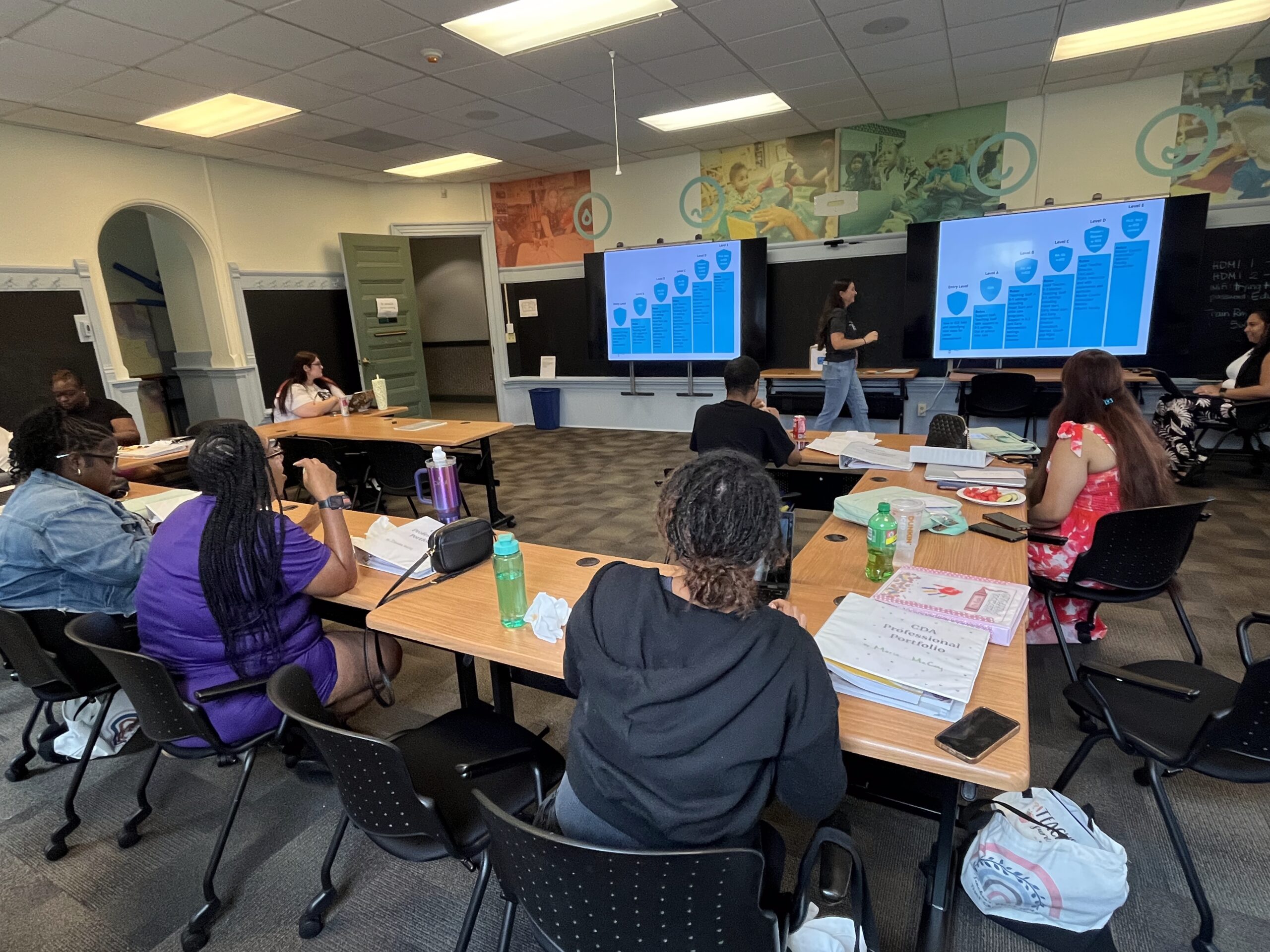
Students met with instructors twice a week, every other week, for Zoom classes to review CDA course content and build their professional portfolio. The format of the summer program moved more rapidly than Trying Together’s typical CDA Program, condensing six months of content into three while still maintaining a high standard of quality. 

“I am grateful to have my CDA with Trying Together,” said student Rajlakshmi Ghosh Pal. “The whole team is just amazing. They are so helpful that I feel so confident after being in this class.”

The students were motivated and excelled at relationship building with one another. Between the instructors and students, there was a sturdy support system in which they encouraged one another to keep pushing. 

As instructors presented course content, students shared their own experiences in their classrooms and suggested teaching strategies to each other. The instructors enjoyed seeing the community building between them and their students. 

“This program has helped me to implement different types of learning into my classroom to better help children learn,” student Madison Deithorn said. “I have also learned from classmates their way of teaching to try in my classroom.”

Even though summer classes have wrapped up, the students are continuing to work hard by completing their CDA applications, taking the exam, and being observed in their classroom to showcase their work to earn their CDA Certificate.

Student Maria McCoy said she was glad to have participated in the class and noted that “Trying Together helped me become more aware of the impact that I make in my classroom daily.”

Another student, Denise Hazlip, said the class gave her a greater understanding of the early childhood education system.

“Taking my CDA class has been a valuable and rewarding experience,” she said. “Throughout the course, I have gained a deeper understanding of child development, early learning standards, and the important role that educators play in supporting children and families. The class has not only given me knowledge, but also practical strategies that I can use every day in the classroom.”

News

August 6, 2025

Pennsylvania Selected to Participate in Action Research Partnership Initiative

The Pennsylvania Office of Child Development and Early Learning (OCDEL) announced that Pennsylvania has been chosen as one of three states to participate in the National ECE Workforce Center’s Action Research Partnership, a yearlong initiative to drive meaningful systems change for the early childhood education workforce.

Learn More

Through this initiative, OCDEL will reimagine Pennsylvania’s ECE Career Pathway in collaboration with providers and in direct response to feedback from the field.

The initiative is a direct response to what has been heard from early childhood education professionals across the state. Providers, educators, and community stakeholders have voiced the importance of honoring experience, reducing barriers to advancement, and recognizing the full scope of skills and roles within the field.

The goal is to create a more comprehensive, flexible, and supportive system that recognizes the true value and complexity of the early childhood education profession. The effort builds on work already underway, including human-centered design workshops, extensive community engagement, and insights from OCDEL’s recent workforce study.

As part of the Action Research Partnership, OCDEL will receive targeted support, collaborate with national peers, and work closely with a dedicated change team of state leaders, educators, and partners across sectors. The aim is to build a system that centers the voices of early educators, supporting recruitment, retention, and long-term growth in early childhood education across the state.

News

July 2, 2025

Vodcasts on Water Safety, POC Training Available for PA Providers

Two new vodcasts are available for early childhood education providers on the topics of water safety and plan-of-correction (POC) training.

Learn More

The first vodcast – Swimming, Wading, Water Activity Provider Training – is a 40-minute video that reviews regulatory requirements surrounding water activity as outlined in the Pennsylvania code. However, the vodcast does not satisfy requirements for water safety instruction.

The other vodcast – Provider Tiered POC Training – is a nine-minute video that explains how a tiered LIS includes a directed plan of correction that requires more than one step to come into compliance for one area of regulatory non-compliance. The tiered summary video walks viewers through the process of completing tiered LIS training. A tiered POC tip sheet was provided for providers as an additional resource.

Both vodcasts and other information about operating a child care facility can be found on the state’s Early Childhood Education page.

News

June 27, 2025

Trying Together Calls for Presentation Proposals for October UnConference

Trying Together invites those interested in presenting at its October UnConference, “From Representation to Inclusion,” to submit proposals for presentation topics relating to working with families of other cultures in early learning settings. 

Learn More

Trying Together’s UnConference is an innovative, hands-on professional development training format where a deeper experience is provided around a particular theme related to early childhood education. Speakers are invited to present and participants are encouraged to engage hands-on in the workshops.

Trying Together’s upcoming event, UnConference: From Representation to Inclusion, will be held on Oct. 4 at the Carnegie Museum of Art in Pittsburgh.

Trying Together is seeking a focused range of topical presentations for the UnConference, which aims to be an introduction to working with families of other cultures in early learning settings. The audience for the UnConference will be early childhood educators – employees of child care and early learning programs – who may have limited experience working with children and families from cultures other than their own.

To submit a proposal, download the submission form. Then, submit the proposal as an attachment to learning@tryingtogether.org with the subject line “October 2025 Unconference Proposal” by 11:59 p.m. on July 25.

Choosing Topics

Appropriate topic areas include, but are not limited to:

  • Language access 
  • Early literacy in English learner populations
  • Trauma-informed care for early learners
  • Early intervention access for multicultural families
  • Using the ASQ or other assessment tools with non-English speakers
  • Considerations around social emotional learning/mental health
  • Engaging with and showcasing the diversity in your child care program
  • Important distinctions between immigrants and refugees
  • Technology tools to support non-English speaking families
  • Cross cultural parenting practices/family systems
  • Engaging fathers from other cultures
  • Culturally specific workshops – for example, working with Muslim or Latinx families (lived experience preferred)
  • Community needs and resources to meet them
  • Immigrant rights and advocacy
  • School enrollment, adjustment, engagement, and involvement for immigrant children and their families, including kindergarten transition
  • Understanding microaggressions in cross-cultural settings

Proposals will be reviewed by the UnConference’s planning committee, which will review proposals based on:

  • Extent to which the proposal targets and is relevant to the early learning child care workforce in Southwestern Pennsylvania
  • Experience/expertise of presenters
  • Definition and focus of the topic
  • Ability to engage participants in discussion and hands-on learning experiences
  • Practical application of material and takeaways
  • Timeliness and importance of topic

Each workshop proposal should:

  • Encourage active learning
  • Present culturally sensitive ideas, practices, and/or relevant research aimed at positioning attendees as leaders at the early learning programs in which they work
  • Offer strategies for effective implementation of information acquired
  • Include presenters who have significant expertise in the topic area and who have spoken successfully in front of groups
  • Cover a 90-minute block of time

The proposal form will ask for a program description, learning objectives, and instructional methods. Those submitting proposals should provide enough detail, so the planning committee can understand how the session will be structured and which key issues will be covered. 

Stipends and Important Dates

Trying Together will offer an honorarium of $250 to any organization or individual (if not affiliated with an organization) whose proposal is chosen to be presented at the UnConference. This opportunity is open to presenters located in Southwest Pennsylvania.

Proposals will be due on July 25 and all applicants will be notified by Aug. 15 about the status of their proposal and the time of their workshop. Presentation slides and materials/overviews are due electronically by Sept. 19. The UnConference will take place on Oct. 4.

News

June 17, 2025

Trying Together Exec Director Featured on Women and Girls Foundation Podcast

Trying Together’s executive director recently discussed the organization’s mission and the need for an increase in early childhood education workers’ wages on the Women and Girls Foundation podcast.

Learn More

The podcast, led by host Camila Rivera-Tinsley, frequently features guests who are “working toward a more equitable future” and tackles such topics as gender, racial, and environmental justice.

In a recent episode, Tinsley discussed issues surrounding early child care – from parents seeking child care for their children so they can work to those employed in the field in need of higher wages – with Cara Ciminillo, Trying Together’s executive director.

On the podcast, Ciminillo talks about how she got involved in early childhood education, April’s Month of the Young Child, the origin of Trying Together’s name, and the organization’s advocacy efforts during the state budget season.

Ciminillo talked about how early childhood education is an overwhelmingly women-led field.

“Probably about 96 percent of all early learning experiences and child care experiences are led by and provided by women,” she said. “It is a women-led field and has a high number of women of color who lead the work in this industry. They are brain builders.”

Ciminillo said the success of many of the state’s industries is tied to whether communities provide adequate child care options. She added that the state’s early childhood education teacher shortage is caused by the industry’s low wages.

“If you want to solve (the problems of) an industry’s workforce, you have to solve for the child care workforce,” she said. “It’s very much a challenge in terms of our collective economic mobility if we don’t solve the economics of child care and the wages they make.”

 To learn more, watch Ciminillo and Rivera-Tinsley discuss early childhood education on the Women and Girls Foundation podcast.

News

June 4, 2025

Trying Together Exec Director Discusses Your Career, Our Future on Yinz Are Good Podcast

Trying Together’s executive director discussed the Your Career, Our Future campaign alongside the Early Excellence Project on Yinz are Good’s latest podcast.

Learn More

Cara Ciminillo, Trying Together’s executive director, joined Dr. DaVonna Shannon, director of research and impact for the Early Excellence Project, to discuss the initiative with Yinz are Good host Tressa Glover. The Early Excellence Project champions Black and Brown child care providers by fostering equality, equity, and accessibility in early childhood education.

Ciminillo and Shannon discussed how the Your Career, Our Future campaign has collected stories from early educators and families in the Pittsburgh region with the intention that their shared experiences will inspire more people to answer the call to become early educators.

Making Educators the Centerpiece

The campaign centers around 15 educators and parents, who relay their positive experiences with the early childhood education field. Ciminillo cited several stories from the campaign. One educator entered the the profession at a young age and rose from being a classroom aide to an executive director. Another was a stay-at-home father who become a classroom educator due to his interest in understanding how his child was developing.

“We’re always trying to center the educator,” Ciminillo said. “They are exemplars of people coming into the field. We ask how we can help others to see themselves in these stories to draw other people to the field. You need to help people see what opportunities exist, so making provider stories the centerpiece is important.”

A Need for Investment

Ciminillo and Shannon said the campaign aims to combat an ongoing early educator shortage that has resulted in repercussions for businesses, the economy, and local communities.

“One of the pain points that we’ve heard frequently – it predated COVID and was exacerbated after COVID – is that child care programs are struggling with staffing,” Ciminillo said. “We are a field where wages are suppressed and the reason why is that families can’t pay more. Child care is expensive and it’s a regulated system; it’s based on a child-to-staff ratio. The public system has not invested enough to alleviate that problem.”

Ciminillo said that this lack of investment in early childhood education has resulted in low wages for teachers and, in turn, teachers leaving the profession as well as challenges in recruiting and retaining them.

“What happens is that providers subsidize (a lack of funding) with their own wages,” she said. “As a result, you’re not getting as much interest in going into the field as other fields that are higher income-generating.”

Ciminillo noted that many early childhood educators were making just over $9 per hour prior to COVID-19, but are now earning an average $15. However, she said wages will need to continue to rise due to the profession’s often challenging nature. She said the job’s primary focus is “brain building.”

Shannon added that part of the Your Career, Our Future campaign involves letting families know that early childhood education is not “babysitting.”

“Children are developing in these early childhood programs, which are very high-quality,” she said. “The message to employers is: If you don’t know how to invest in early childhood education, you will lose staff. People won’t be able to work if they can’t afford child care.”

To listen to the entire interview, “Episode 168: Trying Together & Early Excellence Project’s Your Career, Our Future Campaign,” visit the Yinz are Good podcast’s website.

News

May 27, 2025

PACCA Partners with Alvernia University to Offer T.E.A.C.H. Scholarships

The Pennsylvania Child Care Association (PACCA) has established a new partnership with Alvernia University to offer T.E.A.C.H. bachelor’s degree scholarships.

Learn More

The university is now offering a fully online, accelerated Early Childhood Education bachelor’s degree program with PK-4 teacher certification.

More details for the degree program include:

  • Fully online with observation and student teaching completed local to the student
  • Mindfully designed with flexibility for working adults
  • Generous transfer credit policy as well as a streamlined associate to bachelor’s degree pathway program
  • Approved by the Pennsylvania Department of Education
  • The university is a PACCA/T.E.A.C.H. scholarship-approved institution

Those interested in learning more about the program can attend a virtual information session on Wednesday, June 4 from 6:30 p.m. to 7:30 p.m. 

Attendees are asked to register in advance for the session. After registering, participants will receive a confirmation email with a link to log onto the screen.