Talking with Young Children about Disabilities

News

April 23, 2021

Talking with Young Children about Disabilities

Discussing Delays and Disabilities

In order to teach children about disabilities and special needs, a parent or caregiver should be open to the child’s curiosity and answer their questions in honest and developmentally appropriate ways. Encouraging children to interact as they would with anyone else, without pretending that the disability doesn’t exist, is important to forming relationships and understanding empathy.

Deborah Elbaum, M.D. shares the following tips on Care.com for teaching your child about peers with special needs:

  • Basic ideas to share with your child
    • No two people are the same — some differences are just more noticeable.
    • A disability is only one characteristic of a person. People have many facets: likes and dislikes, strengths and challenges.
    • Children with disabilities are like all children in that they want friends, respect and to be included.
    • Children can be born disabled or become disabled from an accident or illness.
    • Just because someone has a physical disability (when a part or parts of the body do not work well) does not mean they necessarily have a cognitive (or thinking) disability.
    • Children with disabilities can do many of the things your child does, but it might take them longer. They may need assistance or adaptive equipment to help them.
  • Special needs at school
    • Special teachers may come into the classroom to work one-on-one with the student.
    • Sometimes students will leave the room for a part of the day for individualized attention.
    • Accommodations may be present in the classroom. For example, a teacher may wear a microphone so that a student with a hearing impairment can hear better in school.
  • Getting to know children with disabilities
    • Most parents of children with disabilities would prefer that other adults ask them about their child directly, rather than avoiding them. A smile or friendly “Hello!” is an easy icebreaker.
    • Even if a child doesn’t talk, there are still activities the children can do together, such as play board games or arts and crafts.
    • Have a playdate with a child with a disability or invite him or her to a birthday party. Call the other parent and say simply, “How can we make this work?”
    • Share any concerns with the other parent. Parents of children with disabilities will often be happy to facilitate a successful play date or outing.
  • Learning more about disabilities
    • Read picture books with younger children and discuss them afterward.
    • Chapter books with characters who have special needs are appropriate for older readers. Ask your child about the book when he or she is done — maybe you’ll be intrigued and read it yourself.
    • Some audio-visual materials have positive portrayals of children with disabilities. “Sesame Street,” for example, routinely includes children with disabilities in their episodes.
    • Websites with age-appropriate explanations and activities can be interesting and fun to explore.

Invisible Disabilities in Young Children

According to the Invisible Disabilities Association, an invisible disability is a physical, mental, or neurological condition that is not visible from the outside, yet can limit or challenge a person’s movements, senses, or activities. Unfortunately, the fact that these symptoms are invisible can lead to misunderstandings, false perceptions, or judgements.

Educating young children about invisible disabilities is also important. Explain how there are disabilities that we cannot see that affect a child’s behavior or mood. Emphasize that it’s not always up to the child whether they react a certain way to a situation – sometimes their mind or body responds for them.  It’s important to embrace these conversations with young, curious minds rather than to shy away from them (via We Are Teachers).
Family Guide for Navigating Early Intervention Services

News

Family Guide for Navigating Early Intervention Services

Navigating Early Intervention Services

According to Moms Rising, parents and caregivers should keep the following tips in mind when navigating early intervention services:

  • Trust your instincts about your child’s early development.
  • Seek out knowledge and information on early development and document your concerns.
  • Keep a record of all important information.
  • Prepare for meetings with your early intervention team and don’t be afraid to ask questions.
  • Build positive Relationships and communicate regularly with the professionals on your early intervention team.
  • Understand the policies and regulations governing early intervention services.

Parents and caregivers should be aware of their risk for burnout when navigating the processes for early intervention. Consider joining a support group or practicing self care regularly. Parents and caregivers may also want to consider the feelings of non-disabled siblings and encourage discussion with them to ease any tension within the family.

Parents and caregivers who are interested in learning more about advocating for their child’s wellbeing may participate in educational opportunities from the PEAL Center. PEAL is an organization of parents of children with disabilities and/or special health care needs who bring knowledge and experience as a resource for education and special healthcare information and resources in Pennsylvania.

More Information

To learn more about navigating the early intervention process, access this comprehensive guide from the Pennsylvania Department of Education (available in both English and Spanish).

Video Series: Exceptional Care with a Team Approach to Inclusion

News

Video Series: Exceptional Care with a Team Approach to Inclusion

In January 2021, Trying Together hosted a Virtual UnConference on Exceptional Care with a Team Approach to Inclusion. These workshops covered topics such as educational support in the early childhood environment, creating inclusive support teams for children, using ASQ questionnaires, early intervention services, and lesson development. Video recordings of these sessions are available to view.

What Policies Govern Early Intervention and Inclusion in Pennsylvania?

News

What Policies Govern Early Intervention and Inclusion in Pennsylvania?

Early Intervention and Inclusion

The Program for Infants and Toddlers with Disabilities is also known as Part C of the Individuals with Disabilities Education Act, or simply Part C (IDEA, 2004). It is a federal grant program that helps states operate early intervention (EI) services for children from birth to age 3 and their families.

Each state and territory has its own system for providing services under Part C, including an agency that oversees the EI system for children from birth to 3 years of age. The system includes such things as evaluation and assessment, eligibility for Part C services, and the development of Individualized Family Service Plans (IFSPs). Part C says that EI services and supports must be provided in natural environments, including both home and community settings where children would be participating if they did not have a disability. (via Administration for Children and Families, U.S. Department of Health & Human Services)

The U.S. Department of Health and Human Services and the U.S. Department of Education state in their 2015 Policy Statement on Inclusion of Children with Disabilities in Early Childhood Programs:

“It is the Departments’ position that all young children with disabilities should have access to inclusive high-quality early childhood programs, where they are provided with individualized and appropriate support in meeting high expectations. This joint ED and HHS policy statement aims to advance this position by:

  • Setting an expectation for high-quality inclusion in early childhood programs;
  • Increasing public understanding of the science that supports meaningful inclusion of children with disabilities, from the earliest ages, in early childhood programs;
  • Highlighting the legal foundations supporting inclusion in high-quality early childhood programs;
  • Providing recommendations to States, LEAs, schools, and early childhood programs for increasing inclusive early learning opportunities for all children; and
  • Identifying free resources for States, programs, early childhood personnel, and families to support high-quality individualized programming and inclusion of children with disabilities in early childhood programs.”

More Information

To see a full list of laws, regulations, and announcements on early intervention in Pennsylvania, visit the Pennsylvania Department of Education website. The Pennsylvania D.O.E. also provides a guide on problem solving in early intervention in both English and Spanish.

Navigating Difficult Emotions as Caregivers: A Guide for Families

News

Navigating Difficult Emotions as Caregivers: A Guide for Families

About

From the moment a parent or caregiver meets their child, they experience a shift in their daily lives, expectations, and roles. Navigating these changes can be difficult, but as many caregivers have said: “The experience of watching your child learn, develop, and grow is well worth it.”

To support families, Trying Together developed the following guide on navigating emotions as a parent or caregiver. Although the strategies and support services included will not eliminate the challenges families face entirely, they can help make the journey a little easier.

Strategies for Navigating Difficult Emotions

Stay In Tune With Your Emotions

  • Recognize that it is natural to experience difficult emotions. There is no shame in feeling angry, sad, or upset. However, it does matter what you do with those emotions.
  • Take 10 minutes to reflect on your thoughts and emotions. You can do this silently or by writing your reflections in a journal. Think through the following questions:
    1. How am I feeling today?
    2. Why am I feeling this way? Did something specific cause this feeling?
    3. Is this feeling temporary or have I felt this way for a long time?
    4. Have I told anyone about this feeling? Why or why not?
    5. Where am I holding those feelings in my body? Am I tensing my shoulders? Clenching my jaw? Overthinking?
    6. How am I interacting with others? Are my emotions impacting my interactions?
    7. What can I do to relax, cope with this feeling, or get into a better headspace?
    8. Who can I reach out to for support? What time should I reach out to them?
    9. What am I grateful for today? What am I proud of?

Managing Emotions In The Moment

  • Take a pause before you respond to someone or a situation. When we experience big emotions, those emotions can influence our reactions. Taking a moment allows you to recognize how you are feeling and implement strategies to cope.
  • Inhale slow, deep breaths through your nose and exhale slowly through your mouth. Rather than breathing into your chest cavity, imagine that you are breathing into your stomach. Place your hands on your stomach and feel it rise and fall. This will decrease your heart rate, slow your breathing, and make you more present in your body.
  • Take a moment to observe the situation without the influence of your emotions. What is happening? What could have caused this situation? How is someone feeling? What did someone say or do? Finding the answers to these questions can help you identify what steps to take to resolve the situation.
  • Focus your mind on something specific, like the feel of your shirt or the scent of something in the area. This can help to keep you grounded in the moment.
  • See this Mindfulness Guide from the New York Times for more mindfulness ideas.

Managing Daily Stress

  • Managing stress looks different for everyone, so find a method that works for you. Start off by identifying what causes you stress on a daily basis and brainstorm ways to either eliminate or reduce that stress.
  • If you have many tasks or activities to keep track of, create a daily, weekly, and/or monthly calendar to list your upcoming engagements. Make this calendar easily accessible in your home or consider using a phone calendar.
  • Add notes around your house that remind you to take a deep breath, drink some water, and relax your body. Those little reminders can help you get into the practice of using these strategies on a regular basis.
  • Know your limits and set boundaries. If you are feeling overwhelmed, let the people around you know and say no to things that you cannot take on at that moment.

Ask for Support When You Need It

  • Ask if a friend, family member, or loved one would be able to take over caregiving responsibilities for a period of time, even if it is only for 10 minutes. Having some time alone can help you process your emotions and give you time to refresh your mind.
  • If no one is available at home, consider using a crisis child care center such as Jeremiah’s Place for temporary respite care.
  • Reach out to a loved one, family member, or trusted person to let them know what you are struggling with. Never feel as if you have to suffer alone.
  • When you feel uncomfortable sharing with a loved one, reach out to the Family Resources of Pennsylvania Parenting Warmline at 412.641.4546.
  • Join a support group such as Fathers Trying Together, Single Mom Defined, or Women’s Rap.
  • Reach out to your local Family Support Center to access a range of services, including parent support groups, parenting skills programs, family activities, and more.
  • If you live in Pennsylvania and need help accessing mental health services, call 2.1.1 or text your zip code to 898.211 to talk with a resource specialist for free. For individuals outside of Pennsylvania, call the SAMHSA National Helpline at 1.800.662.4357.

Prioritize Self-Care

  • Take time to identify what makes you feel better in difficult situations. Do you like taking a warm bath? Drinking a cup of hot tea? Taking a short walk? Identify the things that help you recharge and schedule time for them into your daily schedule. If you need a place to start, check out these Self-Care Planning Resources from the University of Buffalo School of Social Work.
  • Create joyful moments by trying something new. You can try a new food combination, a new scented candle, hairstyle, or activity. The best part about this is that you can include your child in these things as well. Take time to be playful and creative together.

Take Time to Celebrate

  • When surrounded by stress, it can be easy to focus on the bad. Escape this cycle by taking time to celebrate your personal or parenting wins, or identify what you are thankful for that day. Whether it is a funny joke that you told earlier in the day or simply getting a meal on the table, celebrate those wins.

Resources

Developmentally Appropriate Parenting Series

Developmentally Appropriate Parenting is a family resource content series developed by Trying Together as an effort to empower caregivers to create high-quality experiences at the earliest stages of their child’s life.

Family Resources of Pennsylvania Parenting Warmline

The Family Resources of Pennsylvania Parenting Warmline is a free, confidential hotline for parents and caregivers with non-medical parenting concerns and questions. If you live in Allegheny County, call 1.877.927.6596. If you live outside of Allegheny County, call 1.800.641.4546.

PA 2.1.1 Southwest

PA 2.1.1 Southwest provides access to an extensive list of resources for families in Southwestern Pennsylvania. Specialists provide referrals to human needs resources, physical and mental health resources, child care programs, and more. For more information, call 2.1.1 or visit their website.

SAMHSA National Helpline

SAMHSA’s National Helpline is a free, confidential information service (available in English and Spanish) for individuals and family members facing mental and/or substance use disorders. This service provides referrals to local treatment facilities, support groups, and community-based organizations.

Jeremiah’s Place

Jeremiah’s Place is Pittsburgh’s only crisis child care center that provides a safe haven of respite, health, renewal, and support for children and families during times of crisis. Services are provided for free and are available 24 hours a day, seven days a week.

Hello Baby

Hello Baby supports parents with newborn children in Allegheny County by making it quick and easy to find local resources.

Print This Resource

Download this resource as a printable PDF document (English)(Español).


Strategies to Support Social-Emotional Development: A Guide for Families

News

Strategies to Support Social-Emotional Development: A Guide for Families

About

From infancy through adulthood, social-emotional skills are intertwined with every aspect of our daily lives. These skills enable us to communicate our needs, wants, and ideas; build relationships; communicate emotions; and handle conflict effectively.

To assist families in understanding the importance of social-emotional development, Trying Together created a family guide. Continue reading to explore the meaning of social-emotional development and strategies caregivers can use at home to support their child’s development.

What is Social-Emotional Development?

Social-Emotional Development is the process of learning mental and behavioral patterns that impact a person’s ability to work through social and emotional situations. These patterns can be broken down into individual skills such as:

    • building and maintaining positive relationships;
    • working productively in a team;
    • recognizing, coping with, and empathizing with emotions;
    • resolving conflicts with others; and
    • building confidence in oneself and others.

In addition to the skills listed above, there are several others. To view lists of social-emotional skills, view the Center for Disease Control and Prevention’s Developmental Milestones resource.

When are Social-Emotional Skills Developed?

Because social-emotional skills are introduced in early childhood, a child’s early relationships and experiences play influential roles in determining which social-emotional patterns they develop. While these patterns can be difficult to break, individuals continue to develop and fine-tune their social-emotional skills throughout adulthood.

If a child regularly screams during difficult situations, they may develop a long-term pattern of responding to tense situations with an outburst of anger. While caregivers should not demand their children to withhold their natural emotional responses, teaching children strategies to express and cope with their emotions effectively can help. Caregivers should strive to create a safe, nurturing environment in which children feel safe in expressing their thoughts and emotions.

Strategies for Caregivers

    • If you find yourself struggling with your own social-emotional responses as a caregiver, these strategies can guide you in further developing your toolkit and modeling these strategies.

Children practice social-emotional skills during play.

    • Provide your child with opportunities to play independently, with caregivers, and with children. Include different types of play, such as nature play, imaginative play, cooperative play, etc.

When your child is experiencing a big emotion, avoid saying “calm down” or “don’t be sad/mad.”

This teaches children that certain emotions are “bad” and should not be expressed or shared. Instead, help them recognize, name, and work through what they are feeling. Examples:

    • “When Mya took your toy, you started crying. It must have been hard for her to take that toy from you. How are you feeling? Did you feel sad?”
    • “I see that Juan stepped on your favorite shirt. It doesn’t feel nice when someone steps on something you like, huh? How did you feel when that happened?”
    • Explore different emotion/feeling words together so your child can better identify and express what they are feeling.

No matter what age your child is, have back and forth interactions with them.

    • Make eye contact with your child and show them different facial expressions.
    • If a baby coos at you, reciprocate that interaction with your own sound, a smile, or whatever feels right in the moment.
    • If a toddler shows you something, pay attention and ask questions about it.
    • If your child is having a hard time writing letters or adding numbers, empathize with what your child may be feeling (anger, frustration, sadness, shame), help them recognize those emotions, and help them practice the task at hand.
    • Model the social-emotional skills you would like your child to develop. If you would like your child to share with others, make sure they see you sharing with others. If you would like them to wait for their turn, show them situations where you are waiting patiently (in a grocery store, to use the restroom, etc.)
    • Talk through situations where you are practicing a social-emotional skill in front of your child. Think of it as narrating the situation and the thoughts you have about sharing your favorite snack, resolving a conflict, etc.
    • Create a safe space in your home where your child can go to relax. While children should feel safe to come to you with their emotions, they also need a place to go to process their emotions alone. Add their favorite items in their safe space. Children should never be forced to go to their safe space.

Practice mindfulness techniques with your child.

    • Tell them that it is okay to take a pause to process their feelings and help them practice this skill. They can take a few deep breaths, drink some water, count to five, or hug a stuffed animal. See this Mindfulness Guide from the New York Times for more mindfulness ideas.

Do not solve all of your child’s problems.

    • To develop independence and self-confidence, children need to work through their challenges independently (reaching a toy that is too far away, resolving a conflict, etc.). If the situation is unsafe, step in. But if it involves lower levels of risk, give your child a chance to solve the issue.

Help children share their ideas and opinions.

    • One way to encourage respect and shared decision-making is by introducing the concept of voting. If a decision needs to be made about a shared experience (play, snack, etc.), have children share their ideas and vote to decide the outcome. Ideas that do not win can be incorporated during the next play session.

Praising children for their effort, not the outcome.

    • This builds their self-confidence, persistence, and resiliency to challenges or failure. You communicate that their effort matters and, regardless of the outcome, you are proud of them.

Resources

If you are interested in learning more about social-emotional development and other early childhood topics, consider utilizing the resources listed below.

Developmentally Appropriate Parenting Series

Developmentally Appropriate Parenting is a family resource content series developed by Trying Together as an effort to empower caregivers to create high-quality experiences at the earliest stages of their child’s life.

ZERO TO THREE

ZERO TO THREE works to ensure that all babies and toddlers have a strong start in life. Visit their website to access their online resources to learn more about empathy development, self-esteem, developing social-emotional skills, and more.

NAEYC

The National Association for the Education of Young Children (NAEYC) works to promote high-quality early learning for all young children, birth through age eight, by connecting early childhood practice, policy, and research. Their website includes resources on building social-emotional skills at home, working through challenging behaviors, and more.

Fred Rogers Productions

In the television series “Mister Rogers’ Neighborhood,” Fred Rogers explores several social-emotional skills such as empathy, imagination, self-esteem, and self-control. Watch recordings of the episodes on the Fred Rogers Productions website.

Print This Resource

Download this resource as a printable PDF document (English)(Español).


Supporting Social-Emotional Development Through Play: A Guide for Families

News

Supporting Social-Emotional Development Through Play: A Guide for Families

Why does it matter?

As the caregiver of a young child, you may have heard of physical skills such as crawling and running; cognitive skills such as long-term memory and pattern recognition; and academic skills such as reading and subtraction. However, have you heard of social-emotional skills?

Social-emotional skills act as the backbone for conversations, relationships, and a person’s ability to work through emotions in a healthy, productive way. To succeed in school, the workplace, and their personal lives, children need to develop social-emotional skills. Without them, children are more likely to experience difficulties maintaining relationships, self-regulating their emotions, and demonstrating self-control throughout their lifetimes.

Children’s early experiences with their loved ones have a big influence on what skills they develop. Because of this, caregivers must consider what social-emotional skills or patterns they are modeling or practicing themselves. Children develop skills and patterns based on what they were taught or exposed to in early childhood. While these patterns can change over time (in childhood and adulthood), the earlier a child practices these skills, the better.

Trying Together created this family guide to define social-emotional skills and highlight at-home activities caregivers can use to support their child’s development.

Social-Emotional Skills

Examples of social-emotional skills include, but are not limited to, the following:

    • building positive relationships with other children and adults;
    • being able to recognize non-verbal cues and maintain eye contact;
    • displaying confidence in themselves and others;
    • displaying respect for other people’s feelings, ideas, and opinions;
    • displaying self-control and patience;
    • listens and pays attention to others;
    • recognizing their own and other people’s emotions;
    • sharing toys or materials with other children; and
    • working together with other children or adults.

By practicing these skills, young children will develop a toolkit of social-emotional skills that will help them navigate interpersonal (with others) and intrapersonal (with self) situations. For information about social-emotional developmental milestones by age, visit the Centers for Disease Control and Prevention (CDC) website.

At-Home Activities

    • A simple game of peekaboo provides a chance for children to make eye contact and exchange facial expressions with their caregiver. Try out different facial expressions each time you reappear to see how your baby responds.
    • Read at least one picture book per day with your child. While reading, bring characters (and their emotions) to life by changing your voice pitch, tone, speed, or volume and facial expressions. If your child can read, ask them to read out the character’s lines themselves. If they cannot, ask them to mimic the emotion or repeat a line.
    • While reading, pause before you flip the page and ask your child what they noticed about the characters, what they think about what is happening, how they would feel, what they would do, or what they think is going to happen next. Make up your own questions as you go!
    • Let your child express themselves through art. Give them a piece of paper, a canvas, or any type of artistic material and let their imagination run free. When they are done creating, ask them what it is, what inspired them to create it, and how they felt during the process. If you have multiple children, have them work on a piece of art together.
    • If your child is experiencing big emotions, show them yoga poses they can do to practice their breathing and move their bodies.
    • Try activities like this printable Emotional Sorting Game or have them make Plastic Egg Faces to help your child learn about different emotion and feeling words. Puppets can be used as a tool for children to explore or express their emotions.
    • Schedule a playdate at your house to help your child practice sharing, teamwork, creativity, and independence. If multiple children live in your household, that works too. Gather items like clothes, child-safe dishes, books, and more and let the children determine how they will use them. Card and board games can be used as well.
    • Create a safe space in your home where your child can go to relax alone. Ask your child what items, colors, smells, tastes, or materials make them feel better. Walk around the house, help them collect the things they mentioned, and spend time together creating their new safe space. Take time each month to ask these questions and redesign. Children should never be forced to go to their safe space.

Resources

If you are interested in learning more about social-emotional development and other early childhood topics, consider utilizing the resources listed below.

Developmentally Appropriate Parenting Series

Developmentally Appropriate Parenting is a family resource content series developed by Trying Together as an effort to empower caregivers to create high-quality experiences at the earliest stages of their child’s life.

NAEYC

The National Association for the Education of Young Children (NAEYC) works to promote high-quality early learning for all young children, birth through age eight, by connecting early childhood practice, policy, and research. Their website includes resources on building social-emotional skills at home, working through challenging behaviors, and more.

Playful Pittsburgh Collaborative

The Playful Pittsburgh Collaborative is a group of organizations dedicated to advancing the importance of play in the lives of children, families, and communities in the Pittsburgh region. Read their blog to learn about playful activities for children of all ages.

Fred Rogers Center

The Fred Rogers Center works to extend the legacy of Fred Rogers to today’s generation of children and the adults who love and care for them. Visit their website to access resources on simple interactions, child wellness, and digital learning.

Print This Resource

Download this resource as a printable PDF document (English)(Español).


Fatherhood Support Programs in Allegheny County

News

April 16, 2021

Fatherhood Support Programs in Allegheny County

About

Are you a father in need of support? Support services are available in Allegheny County to help. Most centers are open Monday through Friday, 9 a.m. to 4 p.m. Please call a center near you for more information about their daytime and evening hours.

Fatherhood Programs

The Allegheny County Department of Human Services offers programs to support fathers, including Fatherhood Programming at Family Support Centers. While all Family Support Centers provide programs for all parents, the following centers have programs for fathers:

Sign Up

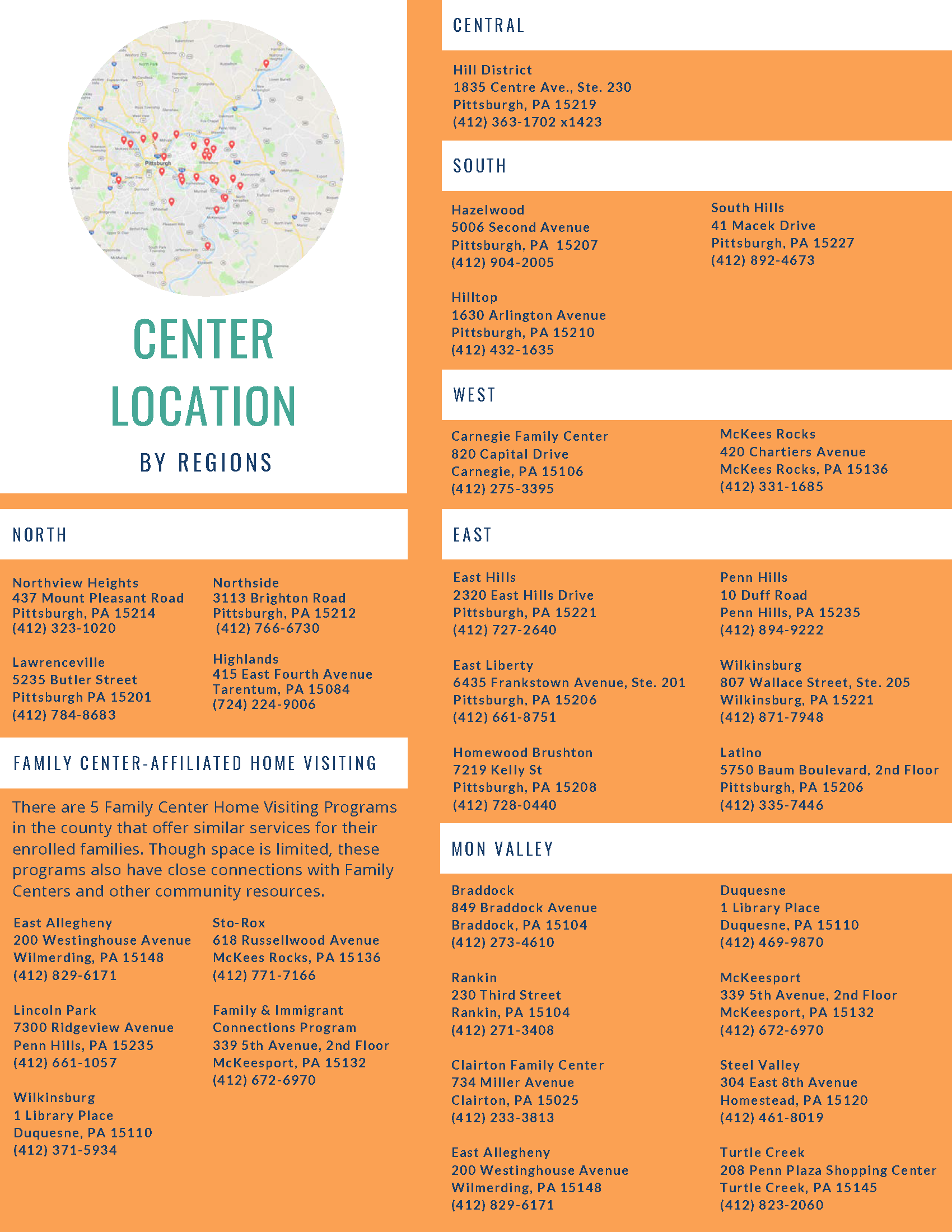
To sign up for a program, call the Family Support Center nearest to you. Center contact information can be found on the Family Centers of Allegheny County website or by viewing this flyer. (PNG).

Resources

For more information about additional fatherhood programs, check out the following resources:


Through the Eyes of a Child, Harvard Medicine

News

January 21, 2021

Through the Eyes of a Child, Harvard Medicine

About

Direct and indirect exposure to racism and discrimination during early childhood can have lifelong impacts on a child’s development, physical health, and general wellbeing.

In “Through the Eyes of a Child,” Elizabeth Gehrman explores these topics and more, including: racial trauma; the difference between positive, tolerable, and toxic stress; lifelong impacts on health; trauma-informed care; and more.

Featured Quotes

    • “We do surveys with Black youth here in Pittsburgh, and kids ages 10 to 15 are reporting that people have been racist toward them. By tenth grade, about fifty percent of them have encountered racial discrimination.” – James Huguley, Interim Director of the University of Pittsburgh’s Center on Race and Social Problems
    • “The general public belief is that early experiences don’t have lasting impacts until kids get older. But now we know that even very young kids are affected. Biology makes it clear: The body doesn’t forget. Early experiences both positive and negative literally shape the architecture of the developing brain and other biological systems from the beginning.” – Julius B. Richmond FAMRI Professor of Child Health and Development at the Harvard T.H. Chan School of Public Health and Harvard Graduate School of Education
    • “Part of the work of becoming an adult is learning how to modulate the fear response and move toward safety. But when the sense of threat never goes away, and you’re in a chronic state of seeking safety, that short circuits higher-order functions.” – Alisha Moreland, Director of Trauma-Informed Treatment, Consultation, and Outreach at McLean Hospital’s Center of Excellence in Depression and Anxiety Disorders
    • “No child can survive significant adversity by pulling themselves up by the bootstraps. But whether it’s a parent, a childcare or health care provider, a neighbor, or a teacher, just one person can confer the protective effect, bringing the stress system back to baseline by providing caring support.” – James Huguley, Interim Director of the University of Pittsburgh’s Center on Race and Social Problems

Access This Resource

To read the full article, visit the Havard Medicine website.


Housing Resources for Families in Allegheny County

News

December 23, 2020

Housing Resources for Families in Allegheny County

Housing and Eviction Resources

If your family is at risk for eviction or homelessness, resources and programs are available to help.

Housing Stabilization Program

The Urban Redevelopment Authority’s Housing Stabilization Program provides one-time or short term (up to three months) financial assistance to households who are facing a temporary, non-reoccurring housing crisis. Depending on which type of support is needed, you may be able to receive funding to cover move-in fees, utilities, rent, mortgage payments, and legal fees.

Eligibility

To qualify, individuals must:

    • be a renter or homeowner,
    • live in the City of Pittsburgh,
    • develop a stability plan with a service provider.

Apply For This Program

If you are eligible, contact Untiled Way by dialing 211 or texting your zip code to 898.211. Interested applicants may also contact United Way via chatroom (located at the bottom right of the webpage) or the online contact form.


Housing Legal Assistance Program

The Housing Legal Assistance Program assists individuals through the following services:

    • Tangled-Title: Legal assistance of up to $5,000 if you own a home but need the deed transferred to your name.
    • Eviction Prevention: Legal assistance of up to $3,000 if you are at risk of eviction or are currently experiencing eviction and need legal assistance.

Eligibility

To qualify for Tangled-Title assistance, individuals must live in the City of Pittsburgh, have an income that is at or below 80 percent of the Average Monthly Income, and not have any outstanding City, School, and County real estate taxes (or must be on a payment plan for at least three months.

To qualify for Eviction Prevention assistance, individuals must live in the City of Pittsburgh, have an income that is at or below 50 percent of the Average Monthly Income, and be experiencing wrongful threats of lock-out, eviction, or sub-standard living conditions.

Apply For This Program

To apply for Tangled-Title assistance, contact United Way by texting your zip code to 898-211 or by dialing 211. To apply for Eviction Prevention, call 412.255.6574 or email hof@ura.org.

For more information, contact Victoria Jackson at 412.255.6696 or hof@ura.org.


Just Mediation Pittsburgh

Just Mediation Pittsburgh offers free, confidential mediation services to landlords and tenants who are looking to find solutions to housing disputes. Just Mediation Pittsburgh mediators facilitate a dialogue between both parties to identify positive solutions and create a shared, legally binding agreement.

Request Services

Participation in these services is voluntary. Both parties must be willing to share their perspectives, listen to the other individual’s perspective, and create constructive solutions. To request services, visit the Just Mediation Pittsburgh page. For more information, contact 412.228.0730 or info@justmediationpgh.org.


Allegheny Link

If you are experiencing a housing crisis, the Allegheny Link can help connect you to resources. The Allegheny Link will assess your eligibility for homeless supports such as rental assistance, utility assistance, and homeless services.

Range Of Services

The Allegheny Link assists Allegheny County residents:

    • who are experiencing or at risk of homelessness in finding stable housing,
    • who are pregnant, or parents and caregivers of children up to age six years of age, get referrals to home visiting programs,
    • who are over the age of 60 live safely in their community, and
    • with any disability find services that meet their needs.

Contact

If you are in need of services, contact the Allegheny Link at 1.866.730.2368. This line will be open Monday through Friday from 8 a.m. to 7 p.m. Callers between 7 p.m. and 8 a.m. will be directed to appropriate supports by an automated message. Individuals can also contact the Allegheny Link via email. This method is especially suggested for individuals who are deaf or hard of hearing.


Rental Payment Assistance

The Department of Public Assistance has an Emergency Shelter Fund that provides financial assistance to help individuals prevent eviction or foreclosure, obtain permanent housing, or obtain temporary shelter. Individuals must be receiving public assistance benefits to qualify. For more information, contact 412.565.2146.


Fair Housing Partnership of Greater Pittsburgh

Do you feel you have been the victim of housing discrimination? Fair Housing Partnership of Greater Pittsburgh investigates allegations of housing discrimination. If you have been a victim of housing discrimination, all of their services are free of charge.

Report Discrimination

To file an anonymous complaint, or to speak with a member of their staff, call 412.391.2535. Individuals can also report discrimination by completing this online form.


Shelter Directory

Pennsylvania’s Education for Children and Youth Experiencing Homelessness (ECYEH) Program has a Shelter Directory on its website that contains a filterable list of emergency shelters and housing providers. Shelters and providers included on the list accept homeless families and/or homeless youth. Some shelters and providers may admit single adults. Access the Directory.


More Information

Visit the Allegheny County website to learn more about housing subsidies, mortgage assistance, homelessness, discrimination support services, and more. If you are experiencing homelessness, visit the Homeless Services page.