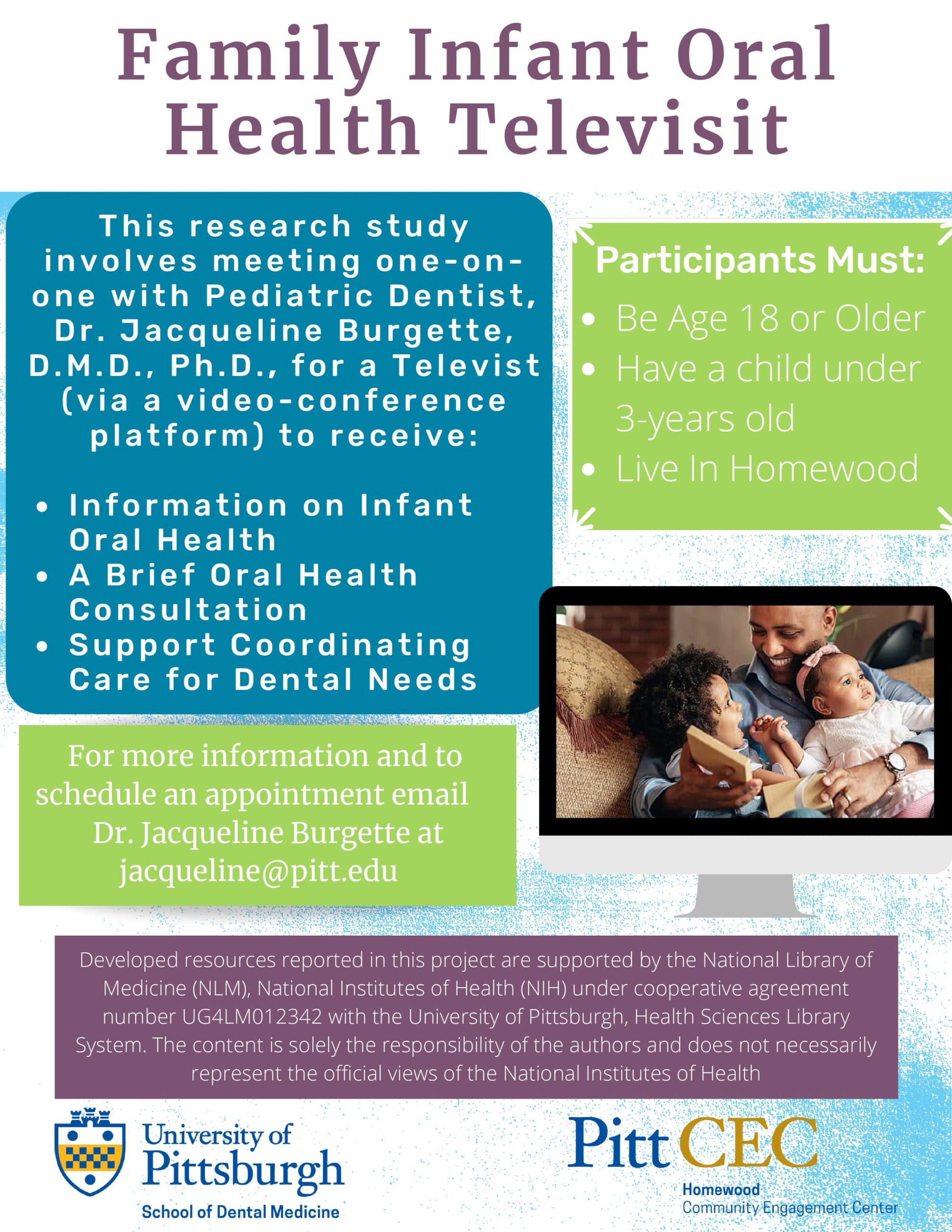
Family Infant Oral Health Televisit, University of Pittsburgh

News

February 3, 2021

Family Infant Oral Health Televisit, University of Pittsburgh

Are you interested in keeping your child cavity-free during the pandemic? Schedule a free Virtual Oral Health Visit for tips on toothbrushing for young children and getting your child dental care.

About

This research study involves meeting one-on-one with mom and Pediatric Dentist, Jr. Jacqueline Burgette, D.M.D., Ph.D., for a televisit on Zoom to receive information on Infant Oral Health, a brief Oral Health Consultation, and support coordinating care for dental needs.

This opportunity has been provided by the University of Pittsburgh School of Dental Medicine and the Pitt Homewood Community Engagement Center (CEC). Share this flyer with your family and friends.

Schedule A Visit

For more information and to schedule a televisit, email at jacqueline@pitt.edu.

What Types of Child Care Are Available?

News

December 14, 2020

What Types of Child Care Are Available?

About

Did you know that there are several types of early childhood education and care programs that you can enroll your child into? To find a program type that works best for your family, review the options listed below.

Available Program Types

Child Care Center

At a child care center that is state-certified by the Office of Child Development and Early Learning (OCDEL), care and education services are provided to more than seven children.

Family Child Care Home

In a family child care home that is state-certified by OCDEL, one caregiver provides care and education services for three to six children who are not related to them in a home setting.

Group Child Care Home

In a group child care home that is state-certified by OCDEL, care and education services are provided for up to 12 children in a home or commercial setting.

Relative Care

Through relative care, one caregiver provides care and education services for no more than three related children in a home setting who may be eligible for subsidy reimbursement.

Public School

A public school provides pre-kindergarten programming. These schools may be publicly or privately funded.

Private School

A private school provides pre-kindergarten programming. These schools are funded by the individual family or school.

Other Things to Consider

Child Care Works

Through Child Care Works, federal and state-supported child care subsidies are provided to income-eligible families who either work or attend school or training programs and pay a co-pay. Subsidies are paid directly to a provider in a home, child care center, or community-based setting. To see if you are eligible or to receive assistance in finding child care, contact your local Early Learning Resource Center (ELRC).

Head Start

Head Start is a federally-funded comprehensive early childhood education program supplemented by state investment. Through the program, infant, toddler, and pre-kindergarten opportunities are provided at no cost to income-eligible families (100% of poverty). Children with developmental delays or disabilities, as well as children who are learning English as a second language, may also qualify. Programs are found in homes, child care centers, schools, and community-based settings. To see if you are eligible or to receive assistance in finding child care, contact your local ELRC.

Pre-K Counts

Pre-K Counts provides state-supported high-quality pre-kindergarten opportunities at no cost to income-eligible families (300% of poverty). Children with developmental delays or disabilities, as well as children who are learning English as a second language, may also qualify. Pre-K Counts classrooms are found in child care centers and schools. To see if you are eligible or to receive assistance in finding child care, contact your local ELRC.

School Districts

School districts allocate funds from their general fund to support their pre-kindergarten programs.

Privately Funded Birth to Kindergarten

Privately Funded Birth to Kindergarten is user-funded programming that is often provided by a nonprofit, for-profit, religious organization, or university.

Child and Adult Care Food Program

The Child and Adult Care Food Program (CACFP) provides aid for the provision of nutritious foods for children birth through school age. To learn more about this program, visit the Pennsylvania Department of Education website.

Quality Assurance

Keystone STARS is Pennsylvania’s quality rating and improvement system for early learning programs. NAEYC, NAFCC, and NECPA accreditation are voluntary private-pay national initiatives. Each ELRC offers access to information, services, and resources to promote high-quality early childhood education. Quality Coaches provide support and technical assistance to programs working to build quality.

Home Visiting Programs and Support Services

Home visiting services give parents and others raising children the support necessary to improve their health, safety, literacy, and economic self-sufficiency. Trained professionals visit women, families, and children to provide parent education and support in order to promote child well-being and development. The six evidence-based home visiting models in Pennsylvania include Early Head Start, Family Check-Up, Healthy Families America, Nurse-Family Partnership, Parents as Teachers, and SafeCare Augmented.

Early Intervention

Early Intervention is a system of publicly-funded services for children birth to age five with developmental delays or disabilities. Early Intervention supports and services are embedded in typical routines and activities within the family, community, and/or early care and education settings. Parents who have questions about their child’s development can call the CONNECT Helpline at 1.800.692.7288.

Print This Resource

This resource is available as a printable PDF. For additional assistance in finding an early learning program that meets your needs, check out our family guide, “How to Find, Choose, and Pay for High-Quality Child Care.”
 

Childhood Development and Lifelong Health, Center on the Developing Child

News

Childhood Development and Lifelong Health, Center on the Developing Child

About

Are you interested in learning how early childhood development and environments impact children’s lifelong physical and mental health? Check out the Center on the Developing Child’s whitepaper, “Connecting the Brain to the Rest of the Body: Early Childhood Development and Lifelong Health Are Deeply Intertwined.”

Featured Topics

In the whitepaper, researchers explore:

    • what 21st-century science is teaching us,
    • how early adversity affects developing biological systems,
    • common illnesses in adults that have roots in early childhood adversity,
    • facts about the health that are often misunderstood,
    • future directions for policies and practice, and
    • final reflections in a COVID-19 world.

Learn More

For more information, view this resource from Harvard University’s Center on the Developing Child.


How Racism Can Affect Child Development, Harvard Center

News

Child Development and Lifelong Health, Harvard Center

News

Child Development and Lifelong Health, Harvard Center

About

In their Working Paper entitled “Connecting the Brain to the Rest of the Body: Early Childhood Development and Lifelong Health Are Deeply Intertwined,” the Harvard Center on the Developing Child “examines how developing biological systems in the body interact with each other and adapt to the contexts in which a child is developing—for better or for worse—with lifelong consequences for physical and mental health.”

Featured Topics

The Working Paper examines the following topics:

    • What 21st-Century Science is Teaching Us
    • How Early Adversity Affects Developing Biological Systems
    • Common Illnesses in Adults Have Roots in Early Childhood Adversity
    • Facts About Health That Are Often Misunderstood
    • Future Directions for Policy and Practice
    • Final Reflections in a COVID-19 World

More Information

For more information, read the full Working Paper. This resource is available as a downloadable PDF.


Play and Physical Activity Guide for Educators & Families, Recess Advocacy Team

News

Play and Physical Activity Guide for Educators & Families, Recess Advocacy Team

About

The Recess Advocacy Team compiled a list of resources for educators and families to make sure play and physical activity are a part of children’s’ days and serve as a foundation for their learning, growth, and development. The list includes resources, activities, considerations, and ways that educators and families can incorporate play and physical activity into children’s daily routines.

Resources for Play & Physical Activity

Download This Resource

The Recess Advocacy Team is a group of organizations dedicated to health and wellness, education, and play with a focus on recess practices and policies. To view the full list of resources, download the guide (PDF).


Supporting Childhood Physical Health: A Guide for Families

News

Supporting Childhood Physical Health: A Guide for Families

Support Your Child’s Physical Health!

Did you know that children’s brain development is influenced by many health-related factors, including nutrition, physical activity, and toxic stress? That’s why it’s important for parents and caregivers to create routines and environments that support their children’s health. For more information, continue reading below.

The Importance of Exercise

All children should engage in at least one hour of physical activity daily and should not be still for more than 60 minutes at a time. To support physical activity, families should:

    • provide a space where children can safely run and play with toys and equipment (75 square feet is adequate),
    • provide a space for riding tricycles, running, and rolling balls,
    • purchase balls and toys with wheels that can keep a child active,
    • plan activities that promote perceptual motor development, the ability to interact with one’s environment by using one’s senses, and
    • have children dance to nursery rhymes or chants to help them develop rhythm.

Benefits of Exercise

    • Supports the development of children’s fundamental motor skills including walking, throwing, kicking, running, balancing, hopping, and skipping.
    • In addition to helping a child move better, physical activity helps their bodies maintain healthy body weight and build healthy bones, muscles, heart, and lungs.
    • Fights off depression, anger, and anxiety at early stages.
    • Sparks creativity and problem solving.

The Importance of Nutrition

Making healthy food and nutrition choices is a challenge for not only adults, but for children too. A balanced meal can help reduce the risk of many health conditions such as high blood pressure, obesity, diabetes, and cardiovascular diseases.

Fresh foods like fruits and vegetables are nutritious options and a great source of fiber. Children’s fruit and vegetable intake per meal should be as follows:

    • Two- to Three-Years-Old
      One cup of vegetables and one cup of fruit daily.
    • Four- to Eight-Years-Old
      One and a half cups of vegetables with each meal, and one and a half cups of fruit daily.
    • Nine-Years-Old and Older
      Two cups of vegetables with each meal, and one and a half cups of fruit daily.

TIP: Smoothies can be fun to make with children. They love to watch whole fruits being crushed up to make juice!

Benefits of Nutritious Food

    • Helps children’s digestive and immune systems stay healthy.
    • Provides a good source of vitamins.
    • Helps to fight infections.
    • Makes wonderful snacks that can be easily packed.

Strategies for a Healthy Routine

Create a schedule that includes time to be active throughout the day.

    • Dance
      A creative and fun way to keep the body moving, get the heart rate up, and promote good blood flow.
    • Tag
      One game that can help promote movement in a fun and fast-paced way.
    • Scavenger Hunt
      A creative way to get children up and moving. This can be done inside or outside. This is a great way to promote exploratory play with younger children.
    • Games
      It’s important to incorporate rules with some games, and to vaguely give directions for others. This helps children learn how to create their own rules which enhances their thinking abilities.
    • Some Rules
      Example: You can only hop during tag; no tagging the person who tagged you; freeze once you’re tagged, etc.
    • Meal Planning
      Create a meal menu. This helps to not only save money, but helps to keep track of the things one is eating. Allow children to help season food, sort food by type or color, and even taste the vegetables before they are cooked. Some children like raw veggies as snacks.

TIP: When making a schedule to support a healthy routine, try to block off time for activities that can be done in a 60-minute timeframe.

Print This Resource

This resource is available as a printable PDF (English) (Español).

Acknowledgments

This document was created by Darnell Campbell, in partnership with Trying Together, as a resource for Part II: Childhood Physical Health of the Developmentally Appropriate Parenting Series. Darnell Campbell is a Physical Education Teacher at Winchester Thurston, CPR Instructor, and Personal Trainer.

Developmentally Appropriate Parenting is a family resource content series developed by Trying Together as an effort to empower caregivers to create high-quality experiences at the earliest stages of their child’s life.


Using Play to Support Children’s Physical Health

News

Using Play to Support Children’s Physical Health

Creating play-rich early environments.

As children’s first teachers, parents and caregivers play a vital role in supporting their children’s healthy development. While it may sound like a big task, the first step is simple: incorporate developmentally appropriate activities into your daily routines!

Physical Activity Recommendations

Birth to one year old:

Caregivers should encourage their infants to practice movement skills while their infant is awake. These skills include supporting their head, rolling, crawling, walking, and picking up both small and large objects. Include at least 30 minutes of tummy time every day.

Ages two to five years old:

It is recommended that toddlers remain physically active throughout the entire day through a combination of play-based activities. Aim to include a mix of structured, adult-led play and unstructured, free play every day.

    • Structured play activities follow rules to reach a specific goal. Examples include assembling a LEGO set, playing organized sports like soccer, and playing tag.
    • Unstructured play is child-led, improvised, and creative. It does not follow a specific set of rules. Examples include playing with blocks, creating new games to play, and improvised dance.

Ages six years old and older:

Children in this age range should get at least 60 minutes of moderate-to-vigorous physical activity every day. There should be a mix of aerobic (running, swimming, jump roping) and bone- and muscle-strengthening activities (climbing, yoga, basketball, bodyweight exercises).

Playful Activity Ideas

Consider using these activities to get your family up and moving!

Infants and Young Toddlers: Household Item Play

With supervision, give your child their own spoon at meal time or give them a child-safe bowl and spoon to play with. You can also give your baby blocks and balls to strengthen their grip, practice their holding skills, and improve dexterity.

Pre-k: Muddy Maneuvers

Even though mud is messy and slippery, it provides a lot of great play opportunities for you and your child. Let your child take off their shoes; squish mud between their toes and fingers; make handprints, footprints, and mudpies; and more! Just bring some water and towels to clean up after!

Kindergarten: Nature Hunt

Take a walk in nature with your child and try to find local animals, plants, and bugs. If you have them, bring binoculars to see how far away you can see and a magnifying glass to get a closer look at bugs and plants. You can research information online about local plant life and wildlife to create a scavenger hunt and list of fun facts! For example, what type of animal is it? What does it eat?

School Age: Hold that Animal Pose (Yoga)

Challenge your child to pose like a giraffe, flamingo, and other animals to help build their muscles, practice their balance, and work on patience. You can find examples of yoga animal poses beforehand or tune in to your creativity to create poses (with your child) on the spot! For an extra challenge, ask them to hold a book, milk jug, or another household item while holding the pose.

Resources

Developmentally Appropriate Parenting Series

Developmentally Appropriate Parenting is a family resource content series developed by Trying Together as an effort to empower caregivers to create high-quality experiences at the earliest stages of their child’s life.

Playful Pittsburgh Collaborative

The Playful Pittsburgh Collaborative is a group of organizations dedicated to advancing the importance of play in the lives of children, families, and communities in the Pittsburgh region. Read their blog to learn about playful activities for children of all ages.

KidsHealth

The KidsHealth website features a wide range of information on childhood health topics such as exercise, breastfeeding, nutrition, and more.

Print This Resource

This resource is available as a printable PDF (English) (Español).


DAP Series: Free Printable Cards

News

DAP Series: Free Printable Cards

About

A child’s parent is their first and most important caregiver. From the moment a caregiver meets their child, whether that is through birth, adoption, fostering, or guardianship, parents use their instincts and experiences to guide their personal caregiving style. Caregivers’ perspectives are valuable and can be especially powerful in supporting children’s long-term success when paired with research and science on the way that children learn and develop.

That’s why Trying Together created the Developmentally Appropriate Parenting (DAP) Series to assist caregivers in creating high-quality early learning environments at the earliest stages of their child’s life. Through the Series, printable cards are available. Each card features information and resources on a specific early childhood topic.

Featured Part Topics

As of October 2021, Trying Together’s printable cards feature the following topics:

Additional topics will be added through 2022 as resources are finalized.

Download the Cards

The cards are available as a downloadable PDF. For more information about the Series, visit the About the Series page.


How to Find, Choose, and Pay for High-Quality Child Care

News

August 11, 2020

How to Find, Choose, and Pay for High-Quality Child Care

About

Choosing child care for the young children in your life can be less stressful if you know what to look for when determining whether or not a program is “high-quality.” Continue reading below to learn what to look for, how to find and pay for child care, and more!


What to Look For

Caregivers who:

    • communicate through talk and touch, songs, and stories
    • engage at the child’s level, sitting, squatting, or laying on the floor
    • use a warm and supportive tone of voice while addressing a behavior or redirecting attention

Classrooms and settings that include:

    • organized, clean, and accessible materials for children to select without adult assistance
    • a variety of materials available for all types of play:
      • physical—developing gross and fine motor skills
      • object—sensory tables with rice, sand, or water, loose parts play
      • dramatic—costumes, housekeeping, or kitchen objects
      • constructive—art materials, blocks
      • games with rules—fingerplays to music or books, board games

Curriculum:

    • play-based and allows for exploration, creativity, and inquiry

Family Engagement that includes:

    • an open-door policy for family members to drop-in
    • regular updates about a child’s day
    • special events, family nights, and programming in the evenings or on weekends

Designations like:

* Note that only licensed child care programs may participate in these rating systems.


Find Child Care

Now that you know how to determine if a program is high-quality, it is time to find programs that meet your location, time, and transportation needs. Here are a few resources to support your search.

Allegheny Child Care

Caregivers and parents of young children can now search available child care spots at all Allegheny County early learning, after-school, out-of-school, summer camp, and virtual programs in real-time with the Allegheny Child Care tool. Visit the Allegheny Child Care website to try it out and learn more.

Early Learning Resource Center (ELRC) Region 5

ELRC Region 5 provides a single point-of-contact for families, early learning services providers, and communities to gain information and access services that support high-quality child care and early learning programs. To learn more, visit the ELRC Region 5, email elrc5@alleghenycounty.us, or call 412.350.3577.

United Way of Southwestern Pennsylvania

To talk to a resource specialist, call 2.1.1 or text your zip code to 898-211. Pennsylvania 211 resource specialists will listen to your needs and connect you to programs in your community.


Paying for Quality Care

You found a high-quality child care program and are ready to enroll your child, but how do you pay for it? Do you qualify for publicly-funded programs? Learn more about qualifying for subsidy and supplemental payment programs available for families below.

Pre-K Counts

Pre-K Counts is available to families with incomes that are no more than 300 percent of the federal poverty guidelines. Pre-K Counts is a school-day, school-year program for children ages three to four. This program may give preference to four-year-olds.

Child Care Works

Child Care Works (CCW) is available to families with incomes that are no more than 200 percent of the federal poverty guidelines. Through CCW, children ages birth to 12 may receive a voucher to attend a child care program based on their family’s or household’s school or work schedule. A small co-pay is required from the family to receive services.

Head Start

Head Start is available to families with incomes that are no more than 100 percent of the federal poverty guidelines. Head Start is a school-day, school-year program for children ages three and four. This program may give preference to four-year-olds.

Early Head Start

Early Head Start (EHS) is available to families with incomes that are no more than 100 percent of the federal poverty guidelines. Early Head Start serves children birth to age two in home-based or center-based programs. Most of these programs are not full-time care.

Scholarships and Tuition Assistance

Even if you do not qualify for the programs listed above due to your income, many programs offer their own independent scholarships or tuition assistance programs. Ask each program you are considering if they offer financial assistance.


Take Action

After searching for an affordable high-quality program, too many families find themselves making compromises in the process. Affordable programs fill up quickly and many have long waiting lists. Simply put, there are just not enough high-quality slots to meet the needs of all families.

As a leading advocate in western Pennsylvania, Trying Together works every day with our local, regional, and state partners to advocate for child care access, affordability, and quality. Join our effort to expand access to high-quality child care by signing up to receive our advocacy action alerts!


Print This Resource

This resource is available as a downloadable PDF (English) (Español).