Educators Explore Ways to Care for Immigrant Children and Families at October UnConference

News

October 9, 2025

Educators Explore Ways to Care for Immigrant Children and Families at October UnConference

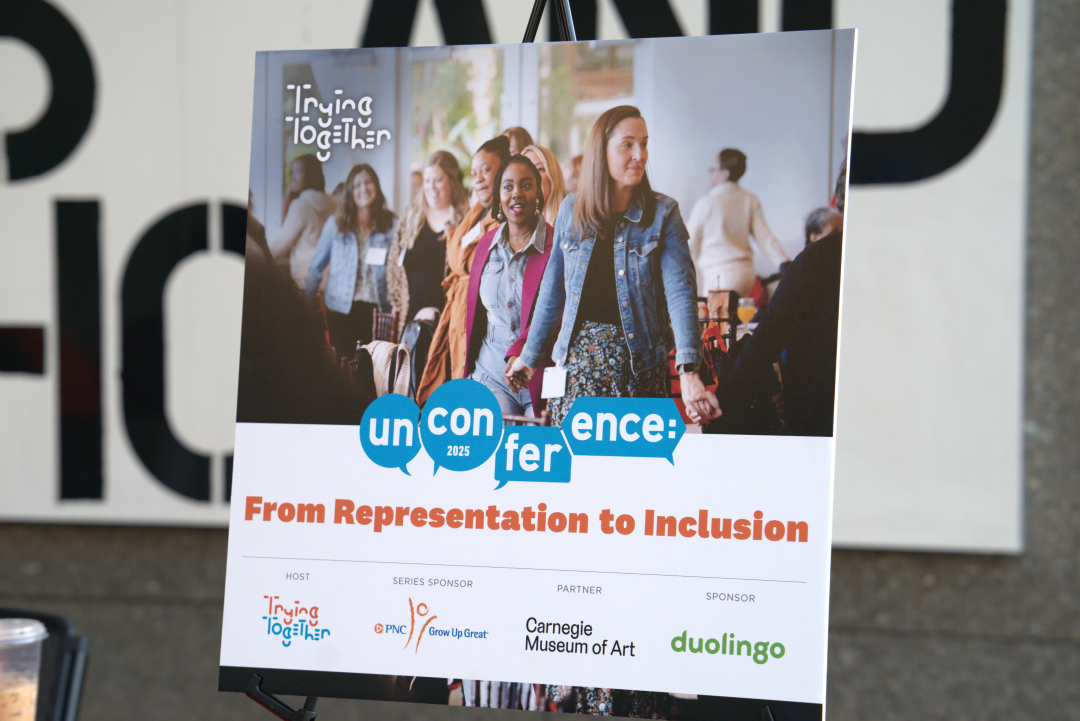
Early care and education professionals gathered at the Carnegie Museum of Art on October 4 to learn how to foster supportive and inclusive learning environments for immigrant children.

Learn More

A smiling woman with dark hair stands at a podiumUnConference: From Representation to Inclusion kicked off with keynote speaker Ivonne Smith-Tapia, director of refugee and immigrant services at Jewish Family & Community Services. During her presentation to the over 90 early childhood educators in attendance, Smith-Tapia explained the significant challenges immigrant families face when navigating unfamiliar environments and practices.

“Immigrant parents have to adjust in many different ways when they migrate,” she explained. “For many, the adjustment is not only about language differences. It’s also about understanding the cultural nuances. The spoken rules of society can become overwhelming and create stress in parents’ daily lives. Experiences can be particularly challenging when parents lack a community to guide and support them.”

Smith-Tapia also noted the crucial role that early care and education professionals play in supporting immigrant families. “Every time a child educator takes an extra moment to learn about a family’s cultural practices, they’re creating the structure, function, and quality of social connection that transforms isolation into belonging,” she said.

Parent Panel

A group of six people sit on a stage in front of a large crowdFive parents participated in a panel discussion to share their own unique experiences as immigrants with children enrolled in child care. They drew comparisons between child care in their home country vs. the United States,  noting that access, cost, and enrollment requirements can vastly differ.

The panelists also shared personal anecdotes, detailing both difficulties and joys. They offered practical tips and advice for educators, encouraging them to listen and ask questions so the immigrant families in their care feel welcome, safe, and included.

The panel included Ana Guerrero, Sol Moure Peña, Jing Zhang, Januka Regmi, and Ricardo Solis Moreno.

The Cultural Iceberg

Casey Rich, director of professional learning for Trying Together, explained to the group the concept of the “cultural iceberg.” This visual representation demonstrates that culture is comprised of both visible and invisible components, with much of what makes up a culture living beneath the surface.

“By understanding that these layers of culture exist,” Rich explained, “you can have a better understanding of why people act the way they do, and appreciate them for those differences instead of always seeing those differences as sources of conflict.”

With this concept in mind, participants engaged in a creative self-reflective art activity that encouraged them to examine their own cultural traditions, both visible and below the surface.

Workshops

After lunch, representatives from organizations that serve immigrant families in the region led hands-on workshops focused on inclusion in early childhood classrooms.

The first round of afternoon sessions included discussions on trauma-informed communication pathways for English learners and their families, building trust and inclusion with Muslim families in learning environments, exploring cross-cultural communication through play, and supporting positive identity development through picture books.

The second round of sessions focused on honoring identity through cultural learning, inclusive practices that nourish, background and practical considerations for early childhood education teachers, and a reflection on bias and creating inclusivity within multicultural classrooms.

Takeaways

Participants gained a deeper understanding of the lived experiences of immigrant children and families and left with new resources to better equip them to care for immigrant families in their classroom. Additionally, participants were offered translated versions of Trying Together’s Developmentally Appropriate Parenting series – now available in seven different languages thanks to the generous support of Duolingo.

ELRC Region 5 Kicks Off Winter Coat Program on October 14

News

ELRC Region 5 Kicks Off Winter Coat Program on October 14

Families can visit Early Learning Resource Center Region 5 starting Tuesday, October 14 to receive free winter coats for their children.

Learn More

The coats are available for families while supplies last as part of a partnership between ELRC Region 5 and the Pennsylvania Department of Human Services.

Children and their families can pick up their coats at:

ELRC Region 5
304 Wood Street, Suite 400
Pittsburgh, PA 15222

The office is open from 8 a.m. to 4:30 p.m. on Monday through Friday. ELRC Region 5 offices will be closed on Wednesday, October 29.

For more information, call the office at 412-350-3577.

Trying Together to Host Office Hours on 2025 Child Care Market Rate Survey

News

October 8, 2025

Trying Together to Host Office Hours on 2025 Child Care Market Rate Survey

Trying Together’s Policy Team will host four upcoming office hours to discuss the importance of completing the 2025 Child Care Market Rate Survey and to offer support and answer questions.

Learn More

Every three years, the Market Rate Survey helps the Pennsylvania Office of Child Development and Early Learning (OCDEL) to set child care subsidy payment rates that are reflective of the private pay market.

The survey’s purpose is also about understanding the private pay tuition rates that programs charge to operate and that families are willing to pay. Even if a survey respondent doesn’t serve children on subsidy, their participation helps the field and may increase the payments to providers.

More programs completing the survey means that Pennsylvania has more information about program needs and what families are paying. This can help to make the case for greater investment in early care and education that will affect all programs.

The survey is open through Monday, December 8.

Trying Together’s office hours to discuss the survey include:

  • Thursday, October 23 from 6 p.m. to 7p.m.
  • Thursday, October 30 from 1 p.m. to 2 p.m.
  • Wednesday, November 12 from 1 p.m. to 2 p.m. and 6 p.m. to 7 p.m.

Office hour attendees who confirm that they completed the survey will be entered into a raffle to receive a gift card. Those interested in attending should register to attend one of the office hours sessions.

Those interested in attending Trying Together’s office hours can sign up online.

Treasurer Announces Short-Term Funding Relief for Pre-K Counts Programs, Head Start Providers

News

October 7, 2025

Treasurer Announces Short-Term Funding Relief for Pre-K Counts Programs, Head Start Providers

The Pennsylvania Treasury Department’s Budget Bridge Loan program will now accept applications from Pre-K Counts programs and organizations that provide rape prevention and response services as well as domestic violence prevention and support services for survivors, state Treasurer Stacy Garrity announced this week.

Learn More

Eligible organizations must use the Budget Bridge Loan for immediate operating expenses as indicated by the loan agreement. Funds will be received shortly after an application is approved.

In late September, Garrity announced $500 million in Budget Bridge Loans for Head Start providers and county governments to help support vital human services. Treasury expects to be able to expand the program to Pre-K Counts and rape and domestic violence prevention programs without increasing the original program amount.

The Treasury Department will reach out directly to Head Start programs and county governments. Those who enter into a loan agreement will be required to pay back the initial investment along with a 4.5% annual interest rate within 15 days of state funds being released following the enactment of a state budget for Fiscal Year 2025-26. Providers eligible to apply for the loans will receive communication directly from the Treasurer’s Office with instructions on how to apply.

“The response to Treasury’s short-term funding solution has been positive, and I’m pleased to be able to expand this program to include organizations that provide critical services to more children and also to survivors of rape and assault,” Garrity said. “I’m using the tools available as state treasurer to make sure critical services can continue without interruption. These loans are a lifeline.”

For more information, read the Treasury Department’s announcement on the loan program.

While we continue to advocate for a final budget with early childhood investments, this is welcome relief for Pre-K Counts and Head Start programs. 

Trying Together Calls for Presentation Proposals for February UnConference

News

Trying Together Calls for Presentation Proposals for February UnConference

Trying Together invites those interested in presenting at its February 16 UnConference, “Kindergarten Transition,” to submit proposals for presentation topics relating to that topic by Friday, October 31.

Learn More

Trying Together’s UnConference is an innovative, hands-on professional development training format where a deeper experience is provided around a particular theme related to early childhood education. Speakers are invited to present and participants are encouraged to engage hands-on in the workshops.

Trying Together’s upcoming event, UnConference: Kindergarten Transition, will be held on Monday, February 16 at the Allegheny Intermediate Unit, located at 475 E. Waterfront Drive in Homestead. PQAS and Act 48 credits will be available for attendees.

Trying Together is seeking a focused range of topical presentations for the UnConference, which will focus on the topic of the transition to kindergarten. The audience for the UnConference will be early childhood educators, including employees of child care and early learning programs.

Those submitting proposals should design them to fit a 90-minute session.

To submit a proposal, download the submission form. Then, fill it out and submit to learning@tryingtogether.org with the subject line “February 2026 UnConference Proposal” no later than 11:59 p.m. on October 31.

Census Survey Includes Statistics on Children Living in Poverty, Pre-K Counts Eligibility

News

October 6, 2025

Census Survey Includes Statistics on Children Living in Poverty, Pre-K Counts Eligibility

The U.S. Census Bureau recently released results of the 2024 Community Survey (ACS), an annual source of up-to-date information on social, economic, and housing data and trends. 

This year’s survey found that the number of Pennsylvania children under the age of 18 living in families below the federal poverty level decreased by about 1%.

Learn More

The survey provides local statistics on a variety of demographic and economic topics, including health insurance coverage, household income, and educational attainment.

Pennsylvania Partnerships for Children highlighted some of the most noteworthy statistics in a recent newsletter. These include:

  • The number of Pennsylvania children under age 18 living in families below the federal poverty line – less than 100% FPL – decreased from 404,000 to 396,000, or from 16% to 15%.
  • Racial gaps remain for children living in poverty: Approximately 31% of Black children live in poverty as well as 26% of Latino children, 10% of non-Hispanic white children, and 20% of children with two or more races.
  • The rate of Pennsylvania children under age 6 who have all available parents in the labor force remained at 72%.
  • Pennsylvania children under 6 who are eligible for Pre-K Counts (less than 300% FPL) decreased from 54% to 51%.

For more statistics, visit the Pennsylvania KIDS COUNT Data Center or the 2024 Community Survey. 

Genius of Play Encourages Outdoor Play, Suggests Activities

News

Genius of Play Encourages Outdoor Play, Suggests Activities

Although the summer is over, the weather outside will still be ideal for outdoor activities for the foreseeable future. The Genius of Play has compiled a short list of activities that adults can recommend to children to encourage them to put down their smart phones and other screens for a while.

Learn More

Spending time outside provides children with important opportunities for growth and learning, the Genius of Play wrote in its recent newsletter. 

Four activities that the organization included in its newsletter that can be used to encourage outdoor play are:

  • Shadow Art – In this activity, children use varied positions and angles to help them learn that differences can alter the shape of the shadow they create; drawing and creative skills are utilized.
  • Act It Out – This activity involves reading a book aloud and acting it out by assigning a child a role. 
  • Obstacle Course – Adults should design a path for children to follow by creating an imaginary balance beam with tape; make stepping stones with other objects and have children follow the path by crawling over them.
  • Basket Toss – Place objects within easy reach of a child and have them throw them into a basket; the idea is to present a challenge, but not a frustration.

Each of the activities can also be played indoors, if the weather isn’t cooperative.

For more play activities, visit the Genius of Play website.

Articles Discuss Importance of School Attendance and Barriers

News

October 1, 2025

Articles Discuss Importance of School Attendance and Barriers

Education is essential for students’ success and social progress, and one of the largest impediments to achieving these things is chronic absence.

Learn More

When a student misses several days of class each month, they can fall behind in their classes, Kidsburgh wrote in a recent article. Then, teachers have to juggle the challenges of helping them to catch up while teaching new material to them and the rest of the class.

In the article, education advocates noted that the Pittsburgh region has a large nonprofit and philanthropic community that can help families connect to resources on such issues as food insecurity or child care to enable older siblings to focus on their own education.

Attendance Works, an organization that focuses on ensuring that all students attend school regularly and participate in learning, wrote an article on the root causes of absence from school. It argued that understanding why students are absent as well as what motivates them to attend is important in creating a system of support.

Attendance Works wrote that reasons for absences typically fall into four categories:

  • Barriers to attendance
  • Aversion to school
  • Disengagement from school
  • Misconceptions about the impact of absences

Within these categories, various reasons were included – such as chronic illness, family responsibilities, or poor transportation (barriers); struggling academically or unwelcoming school climate (aversion); lack of challenging or engaging instruction (disengagement); and losing track and underestimating total absences (misconceptions).

Attendance Works included a worksheet that educators can use to mark the reasons why students in their district are absent.

To view the entire list of reasons for absence by category, visit Attendance Works’ website.

APOST to Sponsor OST Professional in TALI’s Emerging Leaders Program

News

September 30, 2025

APOST to Sponsor OST Professional in TALI’s Emerging Leaders Program

Allegheny Partners for Out-of-School Time (APOST) announced that it will sponsor one out-of-school time (OST) professional to participate in The Advanced Leadership Institute (TALI)’s Emerging Leaders Program.

Learn More

The program addresses the needs of rising Black leaders and their allies by using the pillars of academic instruction, alumni mentoring, and peer networking to hone the skills professionals who are growing in the leadership phase of their career need to move into higher levels of management, successfully navigate challenges they may encounter, and support their ascent up the organizational ladder.

Candidates may include strong individual contributors with supervisory aspirations and those in managerial positions. Applicants must have a minimum of three to five years of professional work experience in corporate, nonprofit, government, or entrepreneurial sectors. A bachelor’s degree or five years of additional, equivalent, and relevant experience is required.

The program’s sessions are held once a month on a consecutive half-day Friday (noon to 5 p.m.) and half-day Saturday (8 a.m. to noon) from January through June. All sessions are held in person on the Carnegie Mellon University campus. 

The deadline to apply is Oct. 15. Those interested can apply online. 

September Recalls on Children’s Products

News

September Recalls on Children’s Products

Below is a list of September recalls from the following federal agencies: the Consumer Product Safety Commission, the Food and Drug Administration, and the National Highway Traffic Safety Administration. 

Learn More

  • URMYWO recalled its baby loungers due to the risk of suffocation or fall hazards. The loungers violate the mandatory standard for infant sleep products because the sides are shorter than the minimum side height limit to secure an infant, the sleeping pad’s thickness exceeds the maximum limit, and an infant could fall out of an enclosed opening at the foot of the lounger or become entrapped.
  • Blueroot Health recalled its bottles of Bariatric Fusion Iron Multivitamins due to the risk of serious injury or death from child poisoning. The multivitamins contain iron and are not in child-resistant packaging as required by the Poison Prevention Packaging Act.
  • Shierdu recalled children’s toys that could pose a choking hazard. The toy is intended for children under three years of age and contains small parts, which violates a small parts ban and poses a risk of choking.
  • In My Jammers recalled its button flare pajama sets due potential risks of burning injuries to children. The pajama sets violate mandatory standards for children’s sleepwear flammability. 
  • Youbeien recalled crib mobiles that violate the mandatory standard for toys containing button batteries. The compartment that holds the batteries in the remote can be accessed without the use of a common household tool. If button cell or coin batteries are swallowed, they can cause serious injuries, including internal chemical burns and death.
  • YooxArmor recalled its multi-purpose kids’ helmets because they violate the mandatory safety standard for bicycle helmets. The helmets do not comply with the impact attenuation, positional stability, labeling, and certification requirements. In the event of a crash, the helmet can fail to protect the user, posing a serious head injury.
  • LXDHSTRA recalled its baby loungers and crib bumpers because they pose suffocation and fall hazards. The loungers violate the mandatory standard for infant sleep products. The sides are too low to contain an infant and the sleeping pad is too thick, posing a suffocation risk. The enclosed openings at the foot of the loungers are wider than allowed, posing a fall hazard and an entrapment hazard to infants. Also, the baby loungers do not have a stand, posing a fall hazard if used on elevated surfaces.
  • EnHomee Dressers were recalled due to the risks they pose of entrapment for infants if they tip over. The dressers are unstable if they are not anchored to the wall and can entrap children if they tip over.